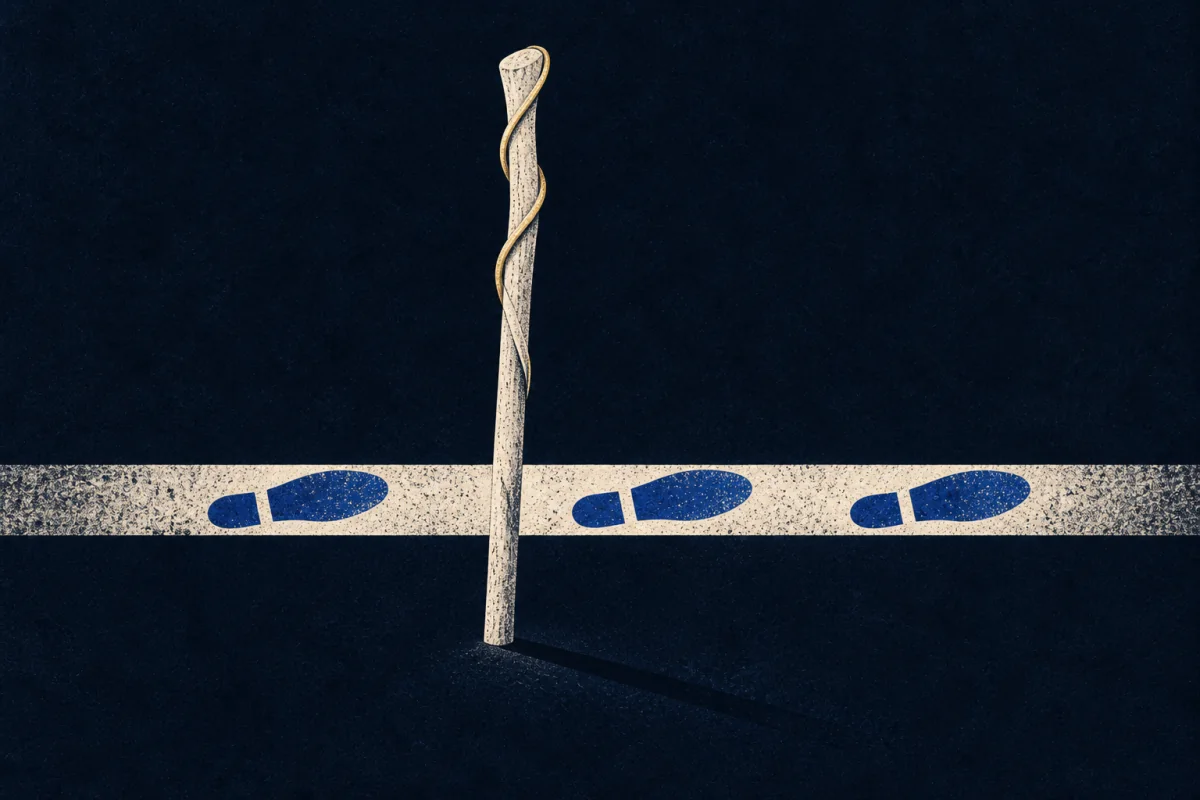
In Plain Sight
Some people walk for weeks because the road does the work. They are not chasing adventure, and the destination is mostly an excuse to keep going. Something settles out there that will not settle at home. You'd notice this in the one who comes back from three months on foot changed in a way nobody around them can name.
The Pattern at Work
What happens is not what anyone expects before they have done it, and it is roughly the same for everybody who has.
The first week is the body: feet, weather, weight, the wrong socks. The second week is boredom, which is when most people stop, and it is not boredom so much as the mind running out of things it had been saving up. Somewhere in the third week the internal commentary exhausts itself. The argument that has been rehearsed for eleven years gets rehearsed for the last time, and then simply does not come back, not because it was resolved but because there is nothing left to do with it. After that the walking is quiet, and the quiet is the thing the whole enterprise was for, and it cannot be reached in under about three weeks by any known means.
A second version, entirely domestic and much commoner. Someone gets bad news at a hospital and walks home rather than taking the bus. It is nine miles and takes most of the afternoon. Nothing is decided and nothing is processed in any sense a counsellor would recognise. They arrive home in a different state from the one they left in, and the change was done by the distance rather than by any thinking that happened across it.
And the smallest version, repeated for years. The same seven miles every day, in all weathers, by someone who would find it difficult to say why and would find it much more difficult to stop.
What the Examples Show
Escapism is the usual accusation, and it assumes the walking is away from something.
What is actually being used is a specific and quite rare arrangement: the body fully occupied at a low, sustainable load, the mind entirely unoccupied, and no arrival to anticipate for weeks. Almost nothing else in ordinary life produces that combination. Sitting still leaves the body free and the mind races. Hard exercise takes the whole attention. A holiday has a shape and an end. Walking at three miles an hour for a month has none of those.
Which is why the destination matters so little and is never abandoned. The road needs an end in order to be a road, and the end is the least interesting part of it.
And it explains the timescale. This does not work in an afternoon. The useful state begins somewhere past the point where a person has run out of things to think about, which takes as long as it takes and is not negotiable.
Going Deeper
Every settled society has produced a version of this and has usually had to build a whole institution to make it permissible, which is the first thing worth noticing about it: walking away for three months is not something a community tolerates without a reason it recognises.
So the reasons were supplied. Medieval penitential pilgrimage sent people across Europe on foot as a sentence, and the sentence was also a treatment. The Shikoku henro is eighty-eight temples and roughly seven hundred miles, and the people walking it have for centuries included a large number who are between things — bereaved, retired, unemployed, unwell — and the route has an established culture of feeding them. Tibetan kora circles a mountain. Bashō left Edo in 1689 on a journey he did not expect to survive and wrote the account that still defines the form. The wandering dervish, the Irish turas, the Camino.
The costs are consistent and are mostly paid at home.
It requires a life that can be left for months, which is a privilege disguised as an austerity, and the people who can most easily go are rarely the people who most need to.
The state does not transfer back. Whatever settles on the road tends to come unsettled within weeks of returning to the arrangement that unsettled it, and the second and third walks are often attempts to recover something the first one produced.
It cannot be reported. A returning walker has nothing to say that survives being said — the account is either a list of towns or a claim about an inner change, and neither lands, so the experience stays sealed.
And it can become a way of never settling anywhere, with each departure fully justified and the pattern only visible after about fifteen years.
The Image
The day the arguing stops.
Somewhere in the third week the running commentary finishes its material and goes quiet. Nothing was resolved and nothing was worked through. It simply ran out, which is a thing that cannot be arranged and can only be walked to.
Carry that one into any problem that has been thought about enough and has not moved.
Where It Stops
Endurance is the obvious reading and it is only half. Plenty of very tough people find a week of this unbearable, and several who do it well are unfit, slow, and entirely open about both.
It goes wrong as needing the departure. The road is genuinely useful and it is also an exit, and the two are impossible to distinguish from inside. The honest test is whether anything at home is different six months after a return, or whether the next walk is already being planned.
It also fails where the trouble is practical. Somebody out of money, in a failing marriage, or with something untreated does not need three weeks of quiet. They need the thing addressed, and the walk will make them feel better about a situation that is still there on their return.
Take the plainer explanation first. Long-distance hiking is a popular hobby and needs no inner dimension at all. The test is duration and solitude: alone, long enough for the commentary to run out, and done again.
Where It Pays
It pays almost nowhere, and that should be said first rather than softened. There is no employer who wants somebody available in three-month blocks, and the state this produces is not a skill that can be brought into a Monday.
What it does pay for is a small set of trades where duration on foot is the actual requirement: long-distance guiding, expedition and trek support, ecological transect and survey work, droving and stock work in open country, mountain and trail maintenance, pilgrimage hospitality, and the kind of field research that involves covering ground slowly for months. In those, the relevant thing is not fitness, which can be trained, but tolerance of duration, which appears to be much harder to acquire and which this pattern has in unusual quantity.
Outside work is where nearly all of it happens, and the cost worth naming is borne by other people. A household absorbs the absence, the uncertainty and the money, and receives in return a person who is different in a way that cannot be described to them. That is a real debt. It does not make the walking wrong, and it is owed a conversation that most walkers never manage to have.
Try This
Walk somewhere you would normally travel to, and make it long enough to be inconvenient.
Not a hike with a view at the end. An errand, done on foot, taking three or four hours, with no music and no phone and nothing to arrive at except the thing you were going to do anyway.
What is worth watching is the second hour. The first is pleasant, the second is dull, and the dullness is the doorway. Most people put headphones in at exactly that point, which is the point.
Do it three or four times and see whether the dull stretch shortens.
The long road is a tool, not a self. Pick it up where a thing has been thought about enough. Put it down where the problem is money, or medicine, or a conversation you have been avoiding.
If This Isn't You
Most people sort things out by talking to somebody or by getting on with the week, and both work better and cost less. Having no wish to walk for a month is not a lack of depth; it is usually a sign the arrangement at home is bearable.
Where To Go Next
Its near-twin — Vertical Surface Scaler. Both are solitary and physical and neither is really about the sport. Vertical Surface Scaler is after intensity, which clears the mind in seconds. This one is after duration, which takes three weeks and works differently.
Its shadow — Group Music Channeler. Group Music Channeler cannot work without a roomful of people and has nothing at all alone. This one needs the absence of everybody, and the two arrive at a similar quiet by opposite roads.
Most often confused with — Wayfinder. Wayfinder is getting somewhere and the route is a means. This one is not going anywhere in particular, and would be perfectly content if the destination were moved.