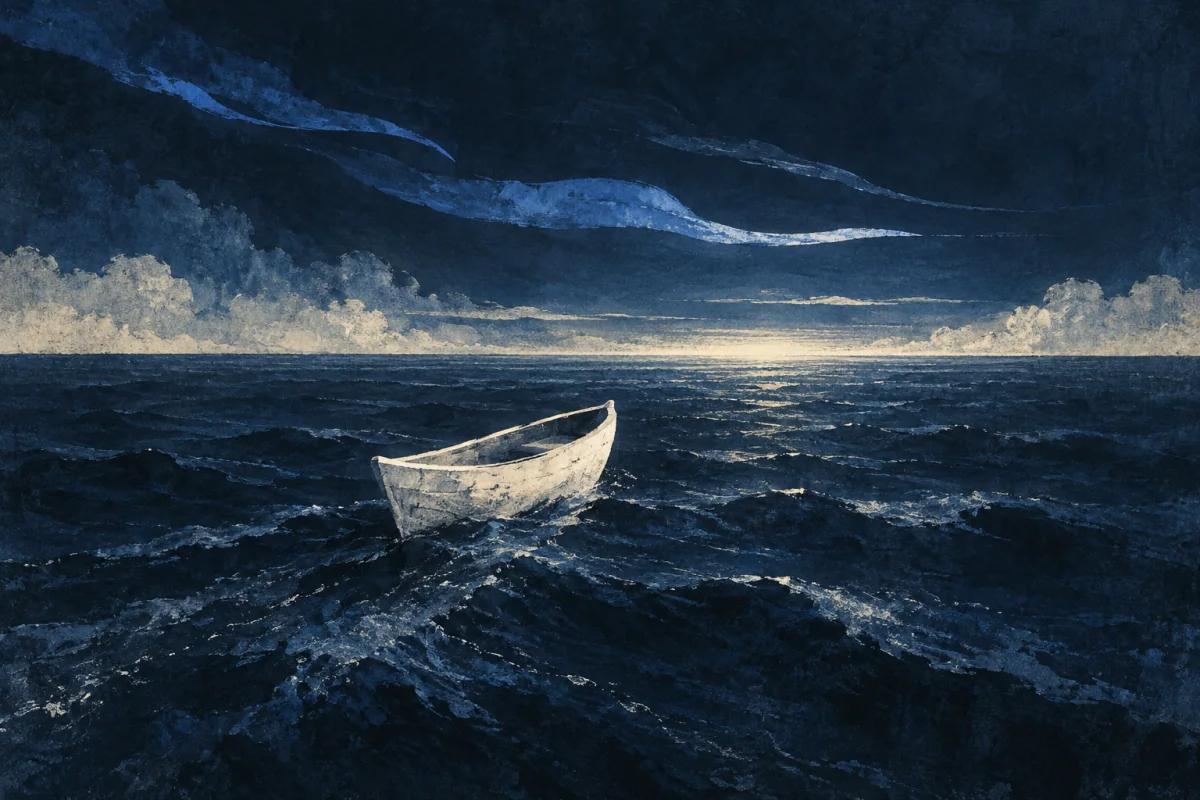
In Plain Sight
A person with this pattern keeps track of direction when conditions keep changing. They do not need every step marked; they read small signs and adjust before others feel lost. You'd see this in the friend who notices the group has drifted off plan, checks the sky, the map, and the mood, then quietly points everyone back.
The Pattern at Work
Cloud down to four hundred metres and a group of six on a broad shoulder where every direction looks identical. Nobody is worried, which is the problem. One person has been carrying something nobody asked for since the last certain point: how long since the wall, roughly what pace, roughly what bearing, and a drift to the left that has been showing up in the way the ground falls away underfoot for the last ten minutes. They stop the group, check three things that each mean very little on their own, and turn everyone about forty degrees. Twenty minutes later a fence corner appears exactly where it ought to, and nobody remarks on it.
A small boat on a coastal passage, engine on, visibility fine. The heading has been held all afternoon and the boat is nonetheless a mile further west than the heading would suggest, because two hours of tide have been quietly moving the whole sea sideways. One person has been correcting for it continuously, a few degrees at a time, rather than discovering the whole error at once at the harbour entrance in the dark.
And a project eight weeks into a twelve-week plan, where every individual week was reported as fine. Someone lays the actual sequence of decisions against the original intention and points out that the thing being built is now a different thing, arrived at by seven reasonable steps none of which was wrong. That is the same act indoors, and it is the one that saves the most.
What the Examples Show
Having a good sense of direction is the usual phrase, and it suggests some inbuilt instrument that simply reports where north is.
Nothing of the kind is happening. What runs is a continuously maintained estimate — a running account of course, speed and elapsed time, updated against whatever evidence offers itself, and held with an honest sense of how much it has decayed since the last confirmation. Nobody sees where they are. This is an argument about where they must be, kept up without a break.
Which is why the corrections are small and early. An estimate that is updated every few minutes needs a nudge. An estimate abandoned two hours ago needs a rescue, and by then the group is somewhere nobody predicted.
And it is why this works indoors, on plans and budgets and relationships, which is where most people would never think to look for it.
Going Deeper
Any group that had to cross something featureless — an ocean, a desert, a snowfield, a season — ran into the same problem. There is no way to observe a position directly. All that can be done is to account for everything that has happened since the last time the position was known, and to keep doing it, and to be honest about how much confidence has leaked out of the estimate in the meantime.
The Pacific navigators built an entire discipline on this and taught it without writing anything down. Stars rising and setting in a fixed order around a mental compass, swell trains that hold their direction under local wind, the shape of cloud over an island still below the horizon, the flight of birds at dusk. In 1976 the Hōkūle'a sailed from Hawai'i to Tahiti with Mau Piailug aboard, navigating by those means alone. Indian Ocean pilots crossed on the monsoon with a kamal and a knotted cord. Norse sailors ran latitudes. European ships kept dead reckoning for centuries because there was nothing else, and lost whole fleets when the reckoning drifted.
The costs are the same in all of these and they are not obvious.
The estimate has to be maintained without interruption, which means the attention cannot be put down for the length of the passage. Stopping does not pause it — it destroys it.
It is carried alone. Everyone else on the boat is experiencing an ordinary afternoon, and there is no way to share the load without first teaching the whole method.
And the outcome is asymmetric. Getting it right is invisible: a fence corner turns up and nobody notices. Getting it wrong is public, expensive, and impossible to explain afterwards, because the explanation is a chain of small reasonable adjustments.
The Image
The running account.
Nobody sees their own position. What can be held is an account of everything since the last certain point, revised continuously, with an honest note about how stale it has become.
Carry that one into anything that started with a plan and has been running for a while without anybody checking where it has actually got to.
Where It Stops
Confidence is not the ingredient. Several people who do this well are quietly unsure the entire time, and it is the unsureness that keeps the account honest.
It goes wrong as trusting the estimate past its life. Every running account decays, and the discipline includes knowing roughly how fast. Somebody who keeps correcting from a reckoning that is two hours stale will steer a group with great precision into the wrong valley, and will do it with more conviction than anybody who has simply admitted to being lost.
It also fails where the terrain gives nothing back. This needs signs to correct against — a slope, a swell, a star, a number. Put it somewhere genuinely featureless, or somewhere the feedback is delayed by months, and the method runs open-loop and produces confident nonsense.
Take the plainer explanation first. Anyone who knows one area well navigates it well from memory, which is familiarity rather than method. The test is whether it appears somewhere the person has never been.
Where It Pays
The contribution is easiest to see by its absence. Almost every long undertaking goes wrong the same way: it is not steered off course by a decision anybody would defend, it drifts, by small reasonable amounts, each one justified on its own day. Nobody is ever wrong, and at week eight the thing being built is not the thing that was agreed. Holding a running account — where this actually is, against where it was meant to be, updated while it is still cheap to turn — is the only thing that catches that class of failure, and it is almost never anybody's job. It pays best in expedition and maritime work, aviation, field operations, logistics, and long programmes of any kind, and it pays badly wherever the route is fixed, marked and short, since there is then nothing to estimate and the person will look like someone making a fuss about a walk.
Outside a job it turns up in hills, boats, long journeys, and in marriages and friendships that have been running for years on a course nobody has looked at recently. The cost worth naming is that this runs constantly and cannot be switched off for an afternoon, so the person carrying it is never quite on the same trip as everybody else. Being the only one who knows the group is drifting is a particular kind of solitude, and it does not get easier for being right.
Try This
Take something that has been running for more than a month with a plan behind it.
Write down, from memory and without looking at anything, where you think it has got to. Then go and find out. The gap between those two is the thing worth measuring, and most people have never measured it once.
Then set an interval — weekly, fortnightly, whatever the thing warrants — and do it again on schedule rather than when you feel uneasy. Feeling uneasy is a lagging indicator and arrives about a month late.
The running account is a tool, not a self. Pick it up where something is under way and unobserved. Put it down where the path is marked and somebody else is watching it.
If This Isn't You
Most people find out where they are by arriving, and the world is mostly arranged to permit that. Not carrying a continuous estimate is not carelessness; it is what signposts, timetables and maps were invented to make unnecessary.
Where To Go Next
Its near-twin — Wayfinder. Both get a group to where it meant to go. Wayfinder is finding a route through something. This one is holding a position through something, which is the harder half and the one nobody watches.
Its shadow — Order-Keeper. Order-Keeper wants every step marked and the record complete before moving. This one proceeds on an estimate it knows to be imperfect, because the alternative is not moving at all.
Most often confused with — Land-Reader. Land-Reader knows a place, deeply, and can answer questions about it. This one may know nothing whatever about the ground and still be the only person aware that the group has come off it.