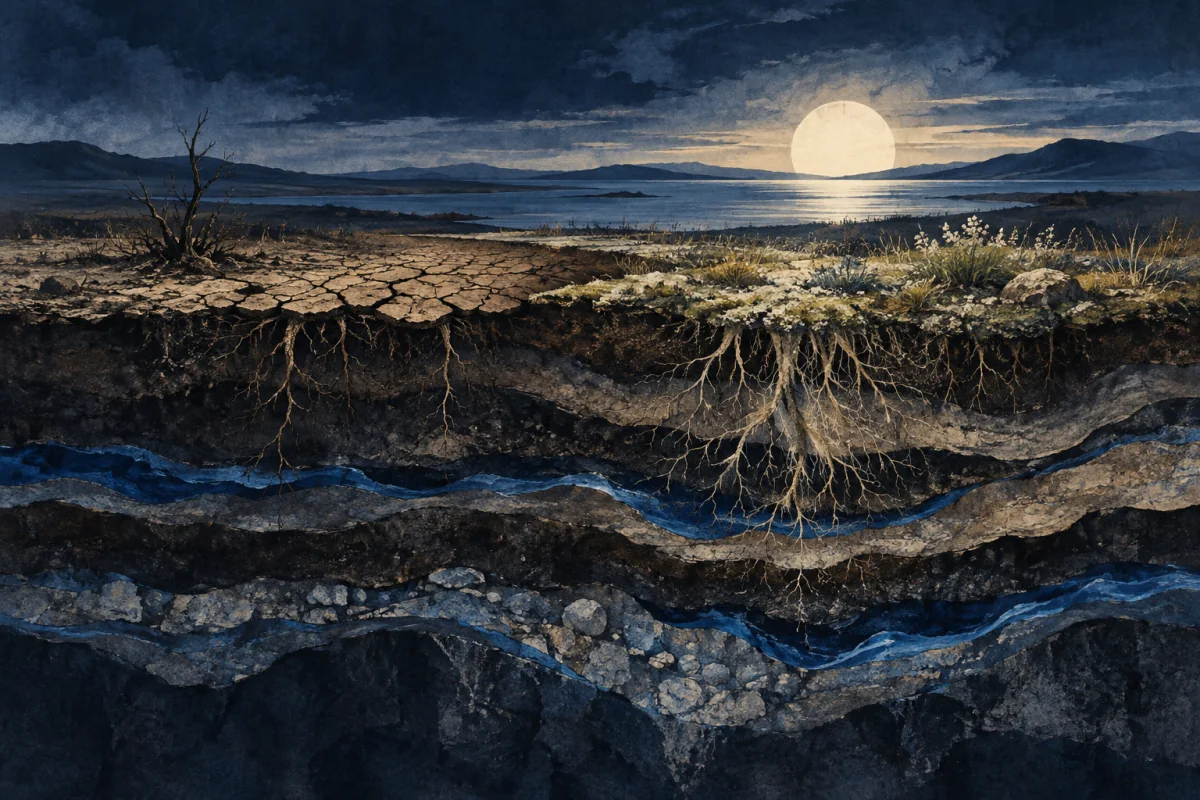
In Plain Sight
They tend to read places by slow change, not by quick impressions. They notice what dried out and what came back, then ask what needs rest. This is not liking nature. It is memory tied to care, because land gives warnings before it breaks. You'd find this in the neighbor who waters one corner less because the soil there stays wet.
The Pattern at Work
A field has been grazed the same way for six years and looks fine. One of the people who walks it says it is going, and is asked what she means. The grass is the same height, she says, but the clover has gone from the top third, the thistles have moved down the slope, and the wet patch by the gate is wet three weeks later into the summer than it used to be. None of those is a problem. Together they are the same problem arriving slowly, and the field is fixed by resting a third of it for a season — which is an argument nobody wins in a year when the grass looks fine.
An allotment where one corner never does well. The received answer is shade. Somebody who has been on that site eleven years says it is not shade, it is that the corner sits at the bottom of a run-off that nobody notices because it only happens in heavy rain, and the ground there has been waterlogged for two days after every downpour for as long as she has been coming. She waters it less and puts in the things that tolerate wet feet. It stops being the bad corner.
A street's plane trees. Two have been in decline for three years, which is slow enough that everyone has adjusted to how they look. The person who notices is the one who has walked the same route daily and holds a picture of the canopy in June from before.
What the Examples Show
This reads as green fingers, or a love of the outdoors, and both suggest something soft and a bit decorative.
What is running is memory of a specific place across years, held in enough detail to notice a difference that is too slow to see. That is the whole mechanism. Nobody detects gradual change by looking harder; they detect it by having an earlier version to compare against, and the earlier version has to be carried, uninstructed, by somebody who kept paying attention when nothing was happening.
The second half is what gets done with it. This pattern does not simply observe — it pulls toward intervening on behalf of the place, usually by taking something away. Rest the field, water less, stop cutting. The useful move is almost always subtraction, which is the hardest thing to argue for because it looks like doing nothing.
And that explains the friction. The warning always arrives while everything still looks fine, and the evidence is a comparison only one person holds.
Going Deeper
Some cultures built their whole law around this person, and the ones who did not have mostly regretted it.
An Aboriginal country-holder in Australia carries responsibility for a specific tract as an obligation rather than a property right — knowing its fire regime, when to burn and when not to, on a cycle longer than any single life, and answerable for it. An Andean ayllu holds land in common with rotation and fallow built into the arrangement, so that resting the ground is a rule rather than an argument somebody has to win each year. A watershed elder in North America held knowledge of a river system across seasons that no individual year would reveal. The Ainu iwor is a defined territory with a keeper who knows what may be taken from it and when.
None of those are conservation in the modern sense, which tends to mean fencing something off. They are arrangements for continuing to take from a place without ruining it, which is harder and requires somebody who knows the place well enough to say how much.
The cost is old and specific. This attention takes decades to become worth anything and is therefore worthless to anybody moving on, which means it is held by people who stay — and staying, in most economies, costs them. The warnings are not believable when given, because the place still looks fine, so the person is routinely ignored and later proved right, which is not a satisfying pattern to live inside. And the knowledge dies with the holder more completely than most, because it is about one piece of ground and cannot be generalised, written down, or carried anywhere else.
The Image
Three weeks later into the summer.
Not whether the ground is wet. Whether it is wet later than it used to be. The signal is never the state of a thing — it is the difference between now and a version somebody remembered.
Carry that one anywhere you are trying to tell decline from a bad week: a garden, a business, a friendship, a body. Ask what you are comparing against, and whether anybody actually holds it.
Where It Stops
Liking nature is not this, and plenty of devoted gardeners have no memory of a place at all — they have a method, applied anywhere.
It goes wrong as reading decline into normal variation. Land moves about on its own, some years are dry, and a pattern tuned to detect slow change will sometimes find it where there is only weather. The correction is other years, not more looking.
There is a failure that reads as stewardship: refusing all use. A place that may never be grazed, cut, walked on or built near is being preserved rather than tended, and this pattern can slide there, especially after being ignored a few times.
And take the plainer explanation first. Anyone trained in ecology, forestry or agronomy will do this inside their fieldwork. The test is whether it appears where nobody is paying for it and no survey is due — a verge, a park, a garden that is not theirs, a street of trees.
Where It Pays
Inside a job. Land management, farming, forestry, conservation, estates, groundskeeping, water and catchment work, and long-cycle monitoring of any kind. Less obviously, the same shape works anywhere change is slow enough to hide: estate maintenance, infrastructure, building fabric, long-term clinical observation. It pays badly in any role shorter than the cycle it reads, which is most of them, and badly where the measure is annual output, because the recommendation is usually to take less this year.
The real contribution is early warning at the only point where the fix is cheap. By the time a place is visibly failing, the remedy is expensive and often partial; the moment this pattern speaks, it is a season of rest. Organisations almost never reward being right at that point, because there is nothing yet to see.
Outside one. Gardens and allotments, a family's piece of ground, a stretch of river somebody swims in every summer, a street of trees they have lived under for twenty years. The cost worth naming plainly is being disbelieved on a schedule: the warning comes early, the evidence is a memory only one person holds, and the vindication arrives years later when it is no longer useful and nobody remembers who said it.
Try This
Pick one place you see often — a garden, a verge, a route you walk, a particular tree.
Write down five specific things about it as it is this week. Not impressions. Where the water sits after rain, what is growing at the edges, which part comes into leaf first, where the bare patches are, how far the shade reaches at noon.
Put it somewhere you will find it and set a reminder for the same week next year.
That is the exercise, and it takes a year, which is the point. You are testing whether you can tell slow change from memory without a record. Almost nobody can.
Three weeks later is a tool, not a self. Use it where decline is slow enough to hide. Put it down where something has simply had a bad week.
If This Isn't You
Most people meet a place as it is today, enjoy it or not, and get on with their lives. Nothing is missing from that, and the world does not need everyone carrying a decade of one field in their head.
Where To Go Next
Its near-twin — Tracker. Both read ground for what it is telling them. Tracker reconstructs one event from fresh sign, in hours. This one is comparing a place against itself across years, and would miss the footprint entirely.
Its shadow — Builder-of-Trades. Builder-of-Trades sees ground as what could be made of it and moves before the case is proven. This one asks what it needs taken off it. They rarely enjoy the same meeting.
Most often confused with — Greenery Tender. The Tender works on the plants and is rewarded by things growing. This one works on the place and is often recommending that less be grown in it this year.