In Plain Sight
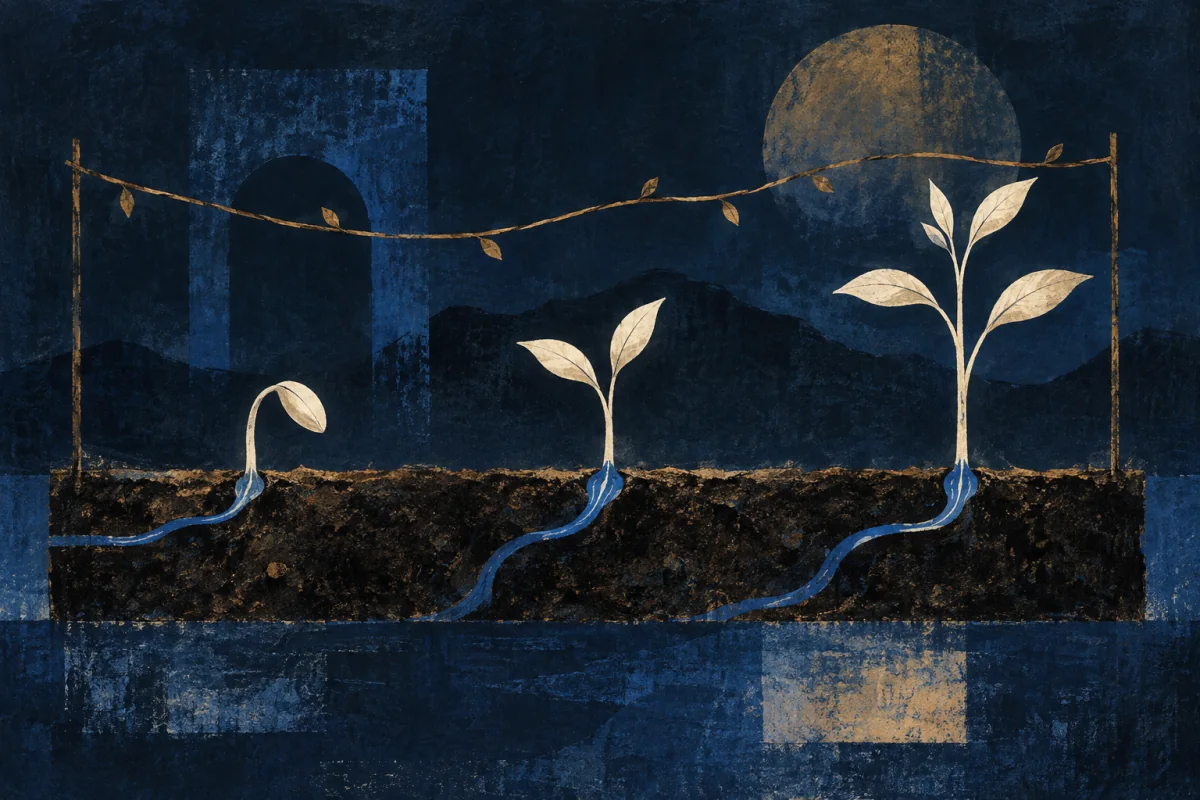
A person with this pattern grows things by noticing what each plant needs next. They do not force a finished picture. They make small changes and let time answer. The work moves slower than most making. You'd recognize this in the person who saves yogurt cups for seedlings and knows which one always dries out first.
The Pattern at Work
A bed has been wrong for two years. Not dead — wrong: leggy at the back, bare in front, three plants that are technically alive and have never done anything. The fix takes eighteen months and consists almost entirely of waiting. In the first autumn two things are moved a metre. The following spring one is taken out. Nothing is bought. By the second summer it reads as a bed somebody designed, and nobody who says so would believe how little was done to it.
A neglected orchard, four old apples and a pear. The advice offered is to cut them hard and start again. What happens instead is that about a fifth of the wood comes out in the first winter, and a fifth again the winter after, because a tree that is cut hard responds by throwing up water shoots and fighting, and a tree eased will come back into balance on its own. The fourth winter is the one where it fruits properly. That is the honest timescale and almost nobody will accept it.
Windowsills, yoghurt pots, a propagator made from a takeaway tray. The same person knows which pot on that sill dries first, because it sits where the morning sun lands, and waters that one separately. Nobody taught her and nobody has noticed. It is the orchard again, on a scale of inches and days rather than acres and winters.
What links those is not patience as a virtue. It is that the intervals belong to the plant, and somebody has arranged themselves around that.
What the Examples Show
The reading offered is that this person likes gardening, or has green fingers, which makes it sound like luck applied to plants.
Watch what is actually being done and it is mostly restraint. The common failure in growing things is intervening too much and too soon — more water, more feed, more cutting — and the skill here is having a sense of the interval, which is nearly always longer than instinct suggests. Doing nothing this week, on purpose, is a decision and takes knowledge.
The second half is that the picture is authored across seasons rather than composed on a day. A bed is not arranged; it is steered, over years, by small moves whose results arrive long after anybody could connect them to a cause. That requires holding an intention across a timescale in which most people would lose interest.
And it explains the attention to the particular. Not plants in general — this one, in this corner, which dries out. General knowledge is available in any book. What is not available is the specific behaviour of a specific square metre.
Going Deeper
The Persian paradise-garden was a walled enclosure with water running through it, made in a dry country, and the word for it came into Greek and then into every European language as the word for paradise — which says plainly enough what a garden meant to people for whom water was the difference between living and not. It was not decoration. It was a demonstration that a place could be made to hold life.
A Japanese garden-tender works on a timescale that outruns employment: a pine shaped over forty years, by a succession of hands, toward a form none of them will see settle. An English cottage garden mixes food and flowers in the same bed because the distinction is recent and largely imaginary. A Mesoamerican milpa farmer grows maize, beans and squash together, each doing something for the others, in an arrangement worked out over millennia and dismissed as primitive for most of a century before anybody checked.
What they share is an argument with the idea that growing is a technique applied to ground. In all four, the tender is a participant in something already running.
And the costs are the same wherever it appears. The results arrive too late to be attributed, so the work is invisible even to the person doing it. The timescale does not fit a lease, a job, or in many cases a life — much of this is done by people who will not see it finish. And the knowledge is specific to one piece of ground, which means moving house destroys most of it.
The Image
The interval.
Not what to do. How long to leave it. Most damage to growing things is done by acting on the right instinct a fortnight early, and the whole craft sits in knowing how long a week should be here.
Carry that one anywhere something is developing on its own clock — a plant, a new starter, a recovery, a difficult relationship. The question is usually not what would help. It is when the next touch should be.
Where It Stops
Owning a lot of plants is not this, and neither is enthusiasm. Some extremely keen gardeners lose things steadily by attending to them constantly, which is the characteristic failure rather than an occasional one.
It goes wrong as waiting where action was needed. Some things are dying now and the interval is nought: pests, drought, a tree against a building. The pull toward restraint does not distinguish between slow problems and fast ones and has to be overridden deliberately.
There is a failure that reads as harmony: refusing to shape anything. A garden left entirely to itself becomes whatever grows fastest, which is not a garden and is usually brambles. This pattern authors — lightly, slowly, but it authors.
And take the plainer explanation first. Anyone with horticultural training will do all of this inside their work. The test is whether it appears untrained and uneconomic: a windowsill, a verge, a neighbour's tomatoes, a houseplant nobody else would have persisted with.
Where It Pays
Inside a job. Horticulture, landscape and estate work, forestry nurseries, conservation planting, market gardening, and the long maintenance of any planted place. Less obviously, the same shape fits anywhere growth is the product and the intervals are not yours to set: long-term rehabilitation, fostering, the slow end of coaching, and managing somebody who needs three years rather than three months.
The real contribution is that things survive their establishment. Most planting failure happens in the first two seasons, through attention applied at the wrong moment, and somebody who knows the intervals converts a high failure rate into a low one — which is only visible as an absence of dead things and therefore never credited.
It pays badly wherever results are wanted this quarter, and badly again where the brief is a finished picture on a fixed date, because the honest answer is that the picture arrives in year four.
Outside one. Gardens, allotments, windowsills, orchards, and the long slow improvement of a piece of ground somebody happens to live on.
The cost worth naming plainly is that almost nobody sees the work. What is visible is a nice garden, which reads as a pleasant hobby rather than as fifteen years of small correct decisions about when not to act.
Try This
Pick one growing thing you are currently tending — a plant, a patch, or a person learning something.
Write down what you would normally do for it this week. Then do not do it. Write the date you expect to see a consequence of not doing it.
Wait. Go and look on that date.
Most of the time nothing will have happened, which is the finding: the interval was longer than your instinct said, and your instinct has probably been shortening it for years. Occasionally something will have gone wrong, and that is also the finding, cheaply bought.
The interval is a tool, not a self. Use it where something has its own clock. Put it down where something is dying this week and waiting is just a word for not helping.
If This Isn't You
Plenty of people buy the plant, enjoy it, and replace it when it dies, and the plant had a perfectly good life. Not wanting to arrange yourself around something else's timetable is a reasonable position.
Where To Go Next
Its near-twin — Land-Reader. Both hold a place across years. Land-Reader is watching for decline and usually recommends taking something off. This one is composing — it wants the place to become something, and will move a plant to get there.
Its shadow — Triage-Mind. Triage-Mind sorts and acts inside an hour. This one's unit is a season, and its most skilful move is frequently to do nothing at all until March.
Most often confused with — Foothold-Giver. Both supply slightly less help than is wanted so something can develop. The Foothold-Giver is reading a person who can respond and adjust. This one is reading something that cannot, and the feedback arrives a season late.