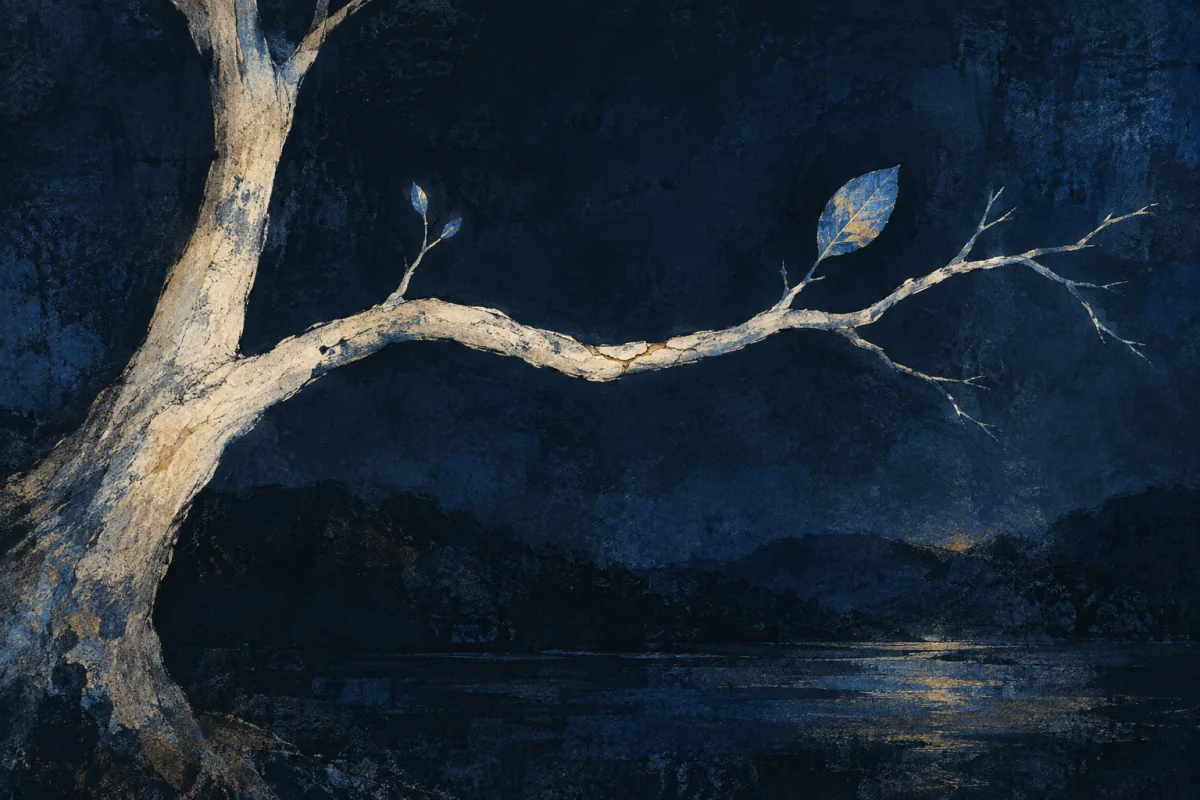
In Plain Sight
Not everyone can stay with one subject long enough to see slow change. This person comes back, compares, and lets the proof build. The watching is not empty waiting. It works because the mind is not rushing to finish. You'd notice this in the person who photographs the same tree every Friday and sees the first weak branch.
The Pattern at Work
Fifty-one Fridays, the same gate, the same three paces in from the fence, the same tree. The photographs are boring and nobody has asked for them. What they contain, by the following March, is the fact that one limb came into leaf eleven days after the rest of the crown and never quite caught up, which is not visible in any single frame and is unmissable when the frames are laid side by side. A tree surgeon called out in June would have seen a healthy tree and said so, correctly, on the evidence available in June. The limb is taken off in the autumn, at the cost of an afternoon, rather than coming down on its own into a lane in the following February.
A ward, and a patient who has been in for three weeks with a condition that is being managed rather than cured. Everything measured is within range and stays within range. One member of staff, across those weeks, has been noticing the walk to the bathroom: the distance from the bed at which the hand goes out to the wall. It was the door frame in week one. It is four feet earlier now. Nothing in the notes has moved, because nothing in the notes measures that, and the observation is raised as a comparison rather than a reading — this, against that, three weeks apart — which is the only form in which it means anything at all.
Both of these are the same act, and it is not attention. It is return.
What the Examples Show
Persistence is the usual word, and it puts the weight on the wrong thing.
Persistence is about effort over time. What is happening here is structural: a fixed point is being maintained so that everything else can be measured against it. The same gate, the same three paces, the same question asked at the same interval. The discipline is not in looking hard. It is in looking from the identical place, again, when there is no reason to expect anything.
Which is why one observation is worth nothing and four are worth a great deal. Slow change gives off no signal at any single moment, and the signal only exists in the difference between two records.
And it explains why this is so often done alone and unasked. There is nothing to report for a long time, and a person who needed the reporting to be interesting would have stopped after a month.
Going Deeper
Any fact about slow change has to be manufactured, because nothing in a human life is built to perceive it. A person cannot see a glacier move, a coastline retreat, a child's spine curve, or a marriage cool. The only instrument that works is a record kept from a fixed position across a span longer than the thing being watched takes to move, and somebody has to want to keep it before anybody knows what it is for.
The courtiers of Kyoto wrote down the date the cherry blossom opened, because they held parties, and the diaries run back past the year 800. Nobody kept them for science. They are now the longest record of spring timing anywhere on earth, and they show the last century bending. Robert Marsham began noting twenty-seven signs of spring on his Norfolk estate in 1736 and his family carried on for nearly two hundred years. The lighthouse keepers' logs. The Dutch water boards, measuring the same stretches of dyke for four centuries. The parish registers.
Every one of those records cost somebody something, and the costs are identical across all of them.
The payoff arrives after the watcher. Marsham did not find out what his numbers meant, and neither did his son.
The record is worth nothing until it is suddenly worth everything, and until that moment it is indistinguishable from a hobby that nobody wants to hear about.
It is fragile in a way that cannot be repaired. Three missed years cannot be filled in later by anybody, at any price, and a gap in the middle destroys value that took decades to build.
And the discovery, when it comes, usually belongs to someone else — a researcher who finds the notebooks, and who is not being dishonest when the paper carries their name.
The Image
The fixed point.
What makes slow change visible is not the subject and not the attention. It is standing in precisely the same place each time. Move two paces and the comparison is gone and a year of work with it.
Carry that one into anything that is drifting too slowly to be noticed — a body, a business, a relationship, a piece of ground.
Where It Stops
Slowness is not the ingredient, and neither is a placid temperament. Several people who do this well are restless everywhere else in their lives and treat the record as the one thing that holds still.
It goes wrong as collecting instead of comparing. A record that is never laid against itself is a pile, and the pleasure of keeping it can quietly replace the point of keeping it, sometimes for years.
It also fails where the thing does not change slowly. Applied to something volatile — a market, a mood, a toddler — the interval is wrong, the differences are noise, and a genuine method produces confident nonsense.
Take the plainer explanation first. Anyone who has been in one place for thirty years accumulates comparisons without meaning to, which is residence rather than method. The test is whether the fixed point was chosen on purpose and kept when nothing was happening.
Where It Pays
Inside a job. Ecology and conservation, agronomy, structural and infrastructure inspection, quality engineering, long-term clinical monitoring, archives, meteorology, and any form of maintenance where the question is whether something is worse than last time rather than whether it is broken now.
The real contribution is that a class of problem gets caught while it is still cheap. Slow failures — corrosion, subsidence, drift in a process, decline in a patient — are not usually missed because nobody looked. They are missed because everybody looked once, saw something within tolerance, and had no second reading to put beside it. It pays badly wherever reporting is quarterly, attention is annual, and nobody holds a job for longer than two years.
Outside one. Gardens, woods, rivers, old buildings, ageing parents, and the long observation of one's own body. This is where nearly all of it is done, without instruments and without anybody asking. The cost worth naming plainly is loneliness of a specific kind: the thing being watched is genuinely interesting and there is nobody to tell, because there is nothing to tell yet, and by the time there is something worth saying the interest has to be explained from the beginning to people who were not there for any of it.
Try This
Choose one thing you can see from where you already are, and a fixed position to see it from.
Once a week, from that exact spot, make one record — a photograph, a sentence, a number. Not a good one. The same one.
The rule that matters is the position, not the frequency. A worse record from the identical place beats a better record from wherever you happened to be standing.
After three months, lay them out together. Most people find they see something they had been walking past daily, which is the evidence — not whether the record felt worthwhile while it was being made, because it will not have.
The fixed point is a tool, not a self. Pick it up where something changes too slowly to notice. Put it down where the thing moves fast enough to watch directly.
If This Isn't You
Most people engage with a thing when it needs them and leave it alone otherwise, which is an efficient way to live. Having no wish to keep a record that pays out after you are gone is entirely reasonable.
Where To Go Next
Its near-twin — Land-Reader. Both build understanding of one place over years. Land-Reader is reading a whole system at once and answering questions about now. This one holds a single subject and answers only one question: compared to when?
Its shadow — Speed-Chaser. Speed-Chaser is at their clearest when the time left is nearly gone. This one has nothing whatever to offer inside an hour, and everything to offer across nine years.
Most often confused with — Slow-Change Watcher. Slow-Change Watcher tracks a moving situation and keeps adjusting the picture. This one keeps the position fixed on purpose and lets the difference do the work.