In Plain Sight
Some people hold a group together through timing. They feel when the pace is slipping and bring everyone back into one beat. This is not just making sound. The rhythm gives bodies a shared track to follow. You'd see this in the person at a pep rally who starts the clap again after it falls apart.
The Pattern at Work
Friday service, and the pass has come apart. Three sections are working at three different speeds, plates are standing under the lamps, and the shouting has started, which makes it worse. One of the chefs begins saying the order of things out loud on a steady count — two on, two off, away, two on — not louder than anyone else and not faster, just absolutely regular. She does not ask for quiet and does not look up. Within about ninety seconds the section next to her has fallen in with it, without appearing to decide to. A minute after that the grill has too. Ten minutes later the pass is clear, and nobody has been told anything they did not already know.
A rowing eight on flat water, four weeks into the season. The boat is checking on every stroke, which feels to everyone in it like a strength problem and is not. The rate comes down. The stroke seat holds something slower and much more even, and does not chase the crew when they rush the slide. For thirty strokes it feels worse, and two of the crew are certain it is wrong. Then eight bodies stop arriving at slightly different moments. The boat stops checking. The same effort, at a lower rate, produces a hull that is noticeably quicker, and the two who were certain say nothing about it afterwards.
Neither of those is about sound, and neither is about morale. A group doing anything physical together has to agree on when, and agreement of that kind cannot be reached by discussion. It has to be supplied.
What the Examples Show
Three explanations get offered for this, and all three miss: musical, good with people, or simply someone with a lot of energy who lifts a room.
Energy is not it. A steady pulse is usually quieter than what it replaces, and the person holding it is often doing very little that anybody notices. What is running underneath is a continuous read of how far the group has drifted, and a correction applied small enough that nobody experiences it as being corrected.
That last part is the whole thing. A tempo that is announced gets resisted. A tempo that is simply present gets joined, because bodies lock to an external pulse without asking permission and largely without noticing.
Which also explains the pull toward being visible. The pulse has to be perceptible to work — heard, seen, or felt through a floor — and so this pattern lives in people who are willing to be at the front of a room, which gets mistaken for wanting to be.
Going Deeper
Whoever keeps the pulse cannot stop.
That is the oldest fact about this role and the least discussed. Everyone else can drop out, recover, come back in. The person holding time has no gap available, and in most traditions plays longer than anyone dances. The obligation is total and one-directional: the group is depending on something it is not aware of depending on.
A djembefola in a West African ensemble is not the loudest player and is not soloing. The job is to hold a pulse that lets several conflicting patterns sit on top of each other without collapsing, and to signal changes to dancers who are not looking at the drummer at all. The atumpan drums in Ghana spoke in the tonal patterns of the language itself, so the time-keeper was also the announcer, and was carrying messages as well as tempo. A Korean pungmul leader walks backwards in front of a moving procession, setting the pace for a village that is following. A Cuban rumbero holds a clave that everything else in the room is measured against — and if the clave slips, everyone is wrong at once, and they are wrong loudly, in public.
Those roles were paid unevenly and respected unevenly, but they were never optional. What they shared beyond the obligation was this: the better the work, the less it was noticed. A group moving together feels to the people inside it like something they are doing themselves, and in a sense they are. The person supplying the track disappears into the result, and hears about it mainly when it fails.
The Image
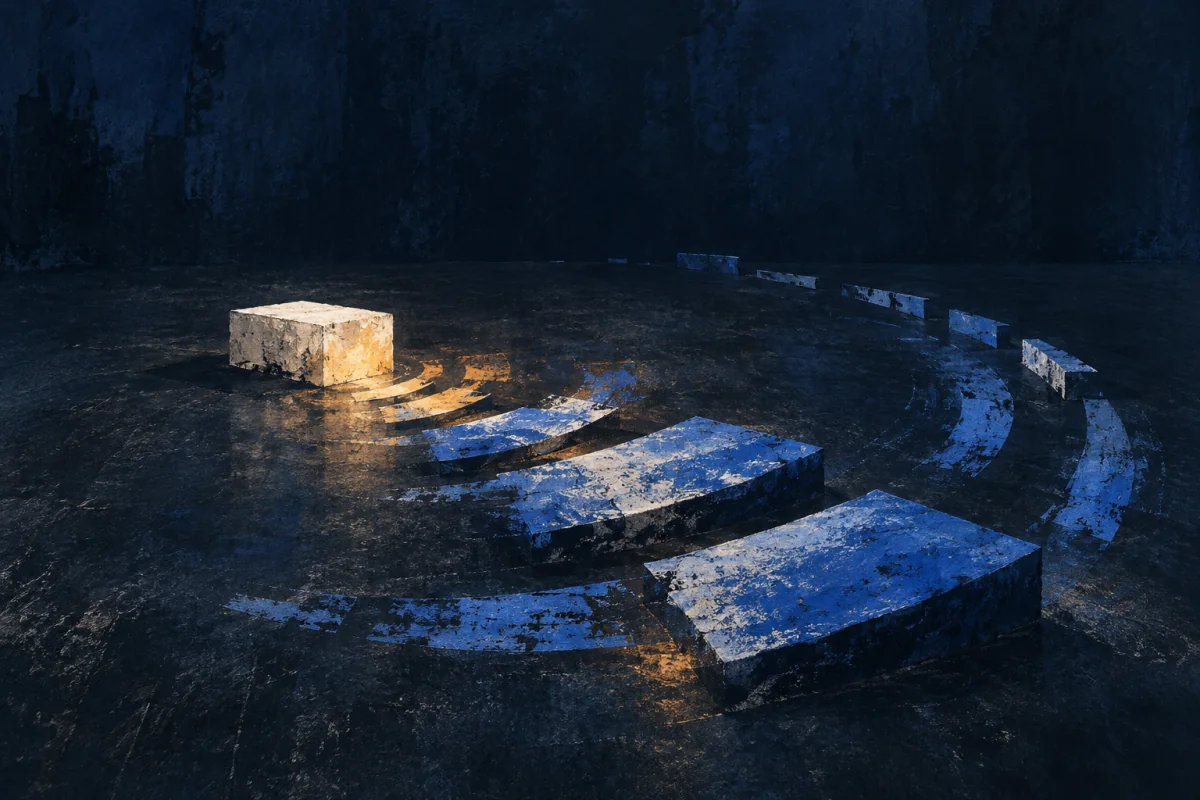
The pulse you can stand on.
Not a sound. A surface. Something regular enough underneath a group that individual bodies stop bracing against each other and start pushing off the same thing.
Carry that one into any situation where people are working hard and getting in each other's way. The question is usually not effort. It is whether anyone has put a floor down.
Where It Stops
Loving music is not this, and neither is a good sense of timing on an instrument. There are superb players whose time is excellent alone and who cannot hold a room, because holding a room means watching it.
It goes wrong as imposing a tempo the group cannot actually carry. A pulse that is right in the abstract and wrong for these bodies on this day produces a group fighting the beat, and the pull to hold it steady is precisely what makes that hard to notice.
There is a second failure, quieter. Some situations need somebody to stop and think, and a steady pulse makes stopping feel like breakage. Work that requires genuine hesitation is not improved by a count.
And the plainer explanation first. Any trained musician, drill instructor or fitness coach will produce this on demand inside their own setting. The test is whether it appears where nothing is being performed — a kitchen, a removal van, four people carrying something awkward up a staircase.
Where It Pays
It pays badly wherever the work is solitary and self-paced, and badly again in anything that needs long uninterrupted thought, where a cadence is an intrusion rather than a floor.
Inside a job. Coordinated physical work of any kind: kitchens, theatre, warehousing, construction, live operations, surgery, sport. Also any team whose problem is described as communication and is actually timing — handovers landing late, two groups working at different speeds and blaming each other.
The real contribution is not motivation. It is that a group stops spending its effort on the friction of being out of step, which is usually a much bigger loss than anybody has measured. Teams routinely add people to a problem that would be solved by everyone arriving at the same moment.
Outside one. Households with several people and a fixed departure time. Sport. Music. Any gathering that has to move as one body, from a funeral to getting four children out of a door.
The cost worth naming is that the role does not switch off, and other people feel the pace being set even when nothing is being counted. In close quarters that can land as pressure. It is worth knowing which rooms want a floor put down and which would rather be left to drift.
Try This
Take one recurring thing this week that involves other people and goes ragged — a handover, a morning departure, a stand-up meeting.
Do not announce anything. Supply a regular marker instead: the same opening sentence at the same moment, a timer, a count, the same physical action at the same point. Keep it absolutely even and do not speed it up when people lag.
Then watch for the join. It usually arrives on the third or fourth repetition, and it looks like people starting to arrive slightly early without discussing it.
If nothing joins after four repetitions, that is real information: the problem was not timing, and no amount of steadiness will fix it.
The floor is a tool, not a self. Put it down where people are colliding. Take it up where somebody needs to stop and think.
If This Isn't You
Many people work best at their own pace and find an imposed one faintly oppressive. That is a way of working, not a missing part, and most careful thought gets done that way.
Where To Go Next
Its near-twin — Group Music Channeler. Both bring a group into one state. The Channeler leads with gesture and voice and is shaping what the group feels. This one supplies time itself, and will carry a room that feels nothing in particular.
Its shadow — Sound-Weaver. Sound-Weaver works alone and follows the sound wherever it goes, with no obligation to anyone's tempo. This one cannot take that freedom without the group coming apart behind it.
Most often confused with — Audience-Singer. Both are at the front of a room. The Audience-Singer is holding attention and the room is looking at them. This one is holding time, and works best when nobody is looking at all.