In Plain Sight
Some people teach outdoors by withholding. They see the thing, say nothing, and steer the group towards it until somebody else spots it. Then the questions start, and the answer arrives from the learner rather than the teacher. It is slower and it sticks. You'd notice this in the guide who stops at a bent stem and waits instead of explaining.
The Pattern at Work
The work starts before anyone arrives. A route is chosen because of what is on it, and the stops are decided in advance: this bank because of what is growing on the wet side, that bend because of what the river did to it. The teaching is built into the ground, so the group encounters the lesson as something they walked into rather than something they were told. A walk that looks casual has usually been laid out carefully, and the teacher knows what is at every stop and roughly what will be noticed first. Almost nothing about it is improvised on the day.
Then comes the hard part, which is silence. The answer is available and saying it would be quicker and would waste the entire setup.
What fills the silence is questions with a direction. Not tests with a right answer waiting, but questions that move attention: what is different about this side, what would have made that mark, what ought to be here and is missing. A good one narrows the search without naming the target, and an experienced teacher can tell from the answers how close the group is and whether to narrow further or leave them longer. The moment of noticing has to belong to the learner, because a lesson delivered as information is forgotten within the week and a lesson somebody found themselves is not. The cost is that it takes four times as long, and a teacher under time pressure will tell rather than wait, every time.
What the Examples Show
It gets read as patience, or as a relaxed style, or as knowing a lot about the outdoors.
The first element is that the lesson is placed in the ground beforehand. The route and the stops are chosen for what they contain, so the group walks into the teaching instead of being handed it.
The second is the withholding. The answer is known and deliberately not given, which costs time and is the whole mechanism, because what somebody finds themselves stays and what they are told does not.
The third is that the questions steer rather than test. They narrow where attention goes without naming the target, and the answers coming back tell the teacher how much longer to wait.
Going Deeper
Teaching by discovery outdoors is old, informal and almost entirely undocumented, which is why it keeps being reinvented.
Hunting and gathering societies teach this way as a matter of course: children accompany adults, are shown very little explicitly, and learn by being present at the right moments with the right questions asked. The same structure survives in apprenticeship everywhere. Written accounts are rare, because the people who do it best are rarely the people who write. In formal education it has been rediscovered repeatedly, through the nature study movement, outdoor education and forest schools, each time arguing against classroom delivery and each time running into the same obstacle, which is that it cannot be scaled or timetabled. A discovery that happens on schedule is not a discovery, and none of it fits into a syllabus.
The costs are structural rather than personal. It is slow, and everything institutional pushes against slow: a curriculum, a group size, a fee, a day that has to contain a set number of things. Outdoor instructors are paid by the day and judged on how much ground was covered. It is impossible to assess conventionally, because the evidence arrives months later and somewhere else. It does not scale past a small group, since the teacher has to track where each person's attention is. And it is thankless in a particular way, because done well the learner remembers finding it and does not remember being taught, which is the point and also means the teacher disappears from their own best work.
The Image
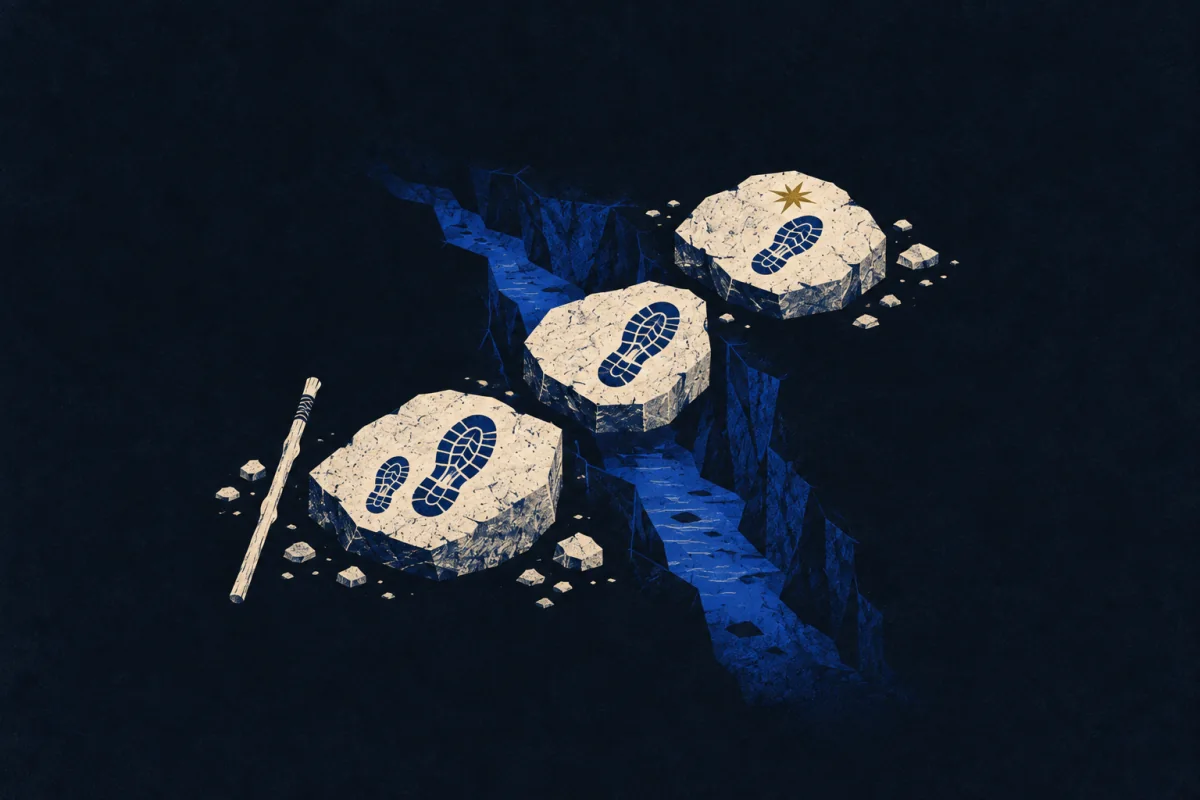
Standing at the stem, saying nothing.
The guide has stopped at something and is just looking at it. Nobody has been told why.
Eventually somebody else crouches down. Then the questions begin, and every one of them points slightly closer without ever arriving. When the answer comes it comes out of the group, and the person who said it will still have it in ten years, which is the only reason anybody stood in a wet field in silence.
Where It Stops
Knowing a lot about the outdoors is not this. Plenty of extremely knowledgeable people teach by telling, and the telling is exactly what does not stick.
It goes wrong as withholding for its own sake. Some things have to be said: a hazard, a rule, a fact nobody could derive. A teacher who makes a group discover something dangerous, or who turns every exchange into a puzzle, has stopped teaching and started performing.
It also fails against time and numbers. A large group, a short session or a syllabus to cover cannot be taught this way, and somebody who insists on it under those conditions will simply get through less and call it depth.
Take the plainer explanation first. Anybody who leads groups outdoors learns to ask a few questions. The test is whether the stops were chosen before the walk began.
Where It Pays
Inside a job. Outdoor and environmental education, field teaching in biology and geography, ranger and interpretation work at reserves and parks, forest school and bushcraft instruction, and the guiding end of wildlife and walking tourism. Also field training in ecology, forestry and land management, where somebody has to bring people to competence on real ground rather than in a room.
What is being bought is knowledge that survives the trip. Anybody can be told what a species is on a walk and will have forgotten by the weekend, while a group that worked it out retains it, and organisations that care about behaviour changing afterwards rather than about a day being delivered will pay for the difference. Reserves, schools and conservation bodies all know which of their guides produce people who come back.
Where it pays badly is almost everywhere else. Outdoor instruction is seasonal, low-paid, and costed by the day, which rewards ground covered rather than anything learned. Few of the posts are permanent, and many are filled again from scratch each season.
Outside one. Scouting and youth groups, teaching your own children, walking clubs, and volunteer training on reserves. The cost worth naming is that the method disappears into the learner, so the teacher is rarely credited with anything.
Try This
Next time you want to show somebody something outdoors, do not point at it.
Stop near it. Look at it yourself. Say nothing for longer than feels reasonable.
If nothing happens, ask one question that narrows the field without naming the thing: what is different about this side, or what would have made that.
Ask a second only if the first did not move them. Then wait again.
When they find it, do not confirm it immediately. Ask how they knew.
Holding the answer back is a tool, not a self. Pick it up where the learner has time and the finding is worth more than the fact. Put it down when something is dangerous, or when somebody simply needs to be told.
If This Isn't You
Plenty of good teachers explain clearly and quickly and are right to. Telling somebody the answer is not a failure of method. It is a different one, and often the correct one.
Where To Go Next
Its near-twin — Field Lesson Guide. Both teach out on the ground rather than in a room. Field Lesson Guide takes the lesson from whatever the ground offers on the day, working from what turns up. This one has chosen the ground in advance for what it contains, and the whole walk is staged.
Its shadow — Walking-Teacher. Walking-Teacher talks while moving, and the movement keeps the conversation going. This one stops and goes quiet, and the silence is the instrument.
Most often confused with — Map-Teacher. Both hand on knowledge about a place. Map-Teacher passes down one place's working knowledge directly, because it took years to gather and cannot be derived. This one refuses to hand anything over, and would rather the learner arrive at less by themselves.