In Plain Sight
Some people hand down the working knowledge of one place. They are not giving a tour. The currents, the turns and the quiet hazards get walked with the learner until the route sits in their body. You'd recognize this in the old pilot who still meets new captains at the dock and takes them out himself.
The Pattern at Work
The new skipper has the charts, the qualifications and a good boat, and the old pilot takes him out anyway, four times, in different weather. What gets handed over on those four trips is not on any chart: that the leading marks are useless after about four in the afternoon because of the sun, that the ebb sets harder than the tables say on the eastern side for reasons nobody has established, and that one bank is soft mud in summer and hard sand after a winter of easterlies. None of it is secret. All of it is the accumulated result of one man doing the same passage several thousand times, and none of it exists anywhere but in him and now, partly, in somebody else.
A grandmother teaches a hill path to a child by walking it, repeatedly, over about three years. She names things: the stone to stop at, the gate that is always wet, the place where the wind changes and a walker thinks they are lost and is not. By the time the child is twelve the route is in her body, and she could walk it in the dark, which she eventually does, in her forties, going to something urgent.
A woodsman shows a new forester the wet corner of a plantation that floods in an ordinary year and takes machinery in a wet one. It is not on the map. It will not be on the map. It is on three people, one of whom is about to retire.
What the Examples Show
It reads as local knowledge, or as an old hand showing somebody the ropes, and those descriptions make it sound like anecdote.
What is actually being transferred is a specific class of knowledge: things that are true of this place and are only discoverable by repetition. Not the geography, which is published, but the behaviour — what this ground does under particular conditions, at particular times, which no survey captures because a survey is a single observation and this is a thousand.
That is why it has to be walked rather than told. A list of hazards is forgettable; a hazard encountered on foot, in the weather that makes it dangerous, with somebody naming it, goes in and stays.
And there is a deliberate patience to it. The teacher waits for conditions. The fourth trip happens in the weather the first three did not have, because the whole point is the exception rather than the ordinary day.
Going Deeper
Every place with a hazard in it has produced people whose job was to hold what the charts could not, and the role has usually been formalised only after somebody drowned.
River and harbour pilotage exists as a licensed profession precisely because local knowledge could not be written down and had to be carried aboard inside a person. Alpine guiding developed the same way. Aboriginal songlines carry route knowledge in a form that is walked and sung rather than drawn. Inuit hunters transmitted ice behaviour by taking the young out onto it. Every mountain rescue team holds an unwritten register of where people actually get into trouble, and it does not match where the map suggests they would, because the map has no opinion about where a tired party will make a bad decision at four in the afternoon.
The consistent difficulty is that this knowledge cannot be stored outside a body.
It dies with people, and it dies quietly: nobody notices the loss until somebody runs aground in a place that three retired men could have warned them about. It also cannot be examined, so institutions that require certification tend to replace it with something written and worse, and the person holding it has no standing in a dispute against a published chart. It requires years of the same ground and years of proximity between teacher and learner, both of which modern working patterns have removed. And it is frequently dismissed as folklore right up until the moment it is proved correct, at which point it is called experience.
The Image
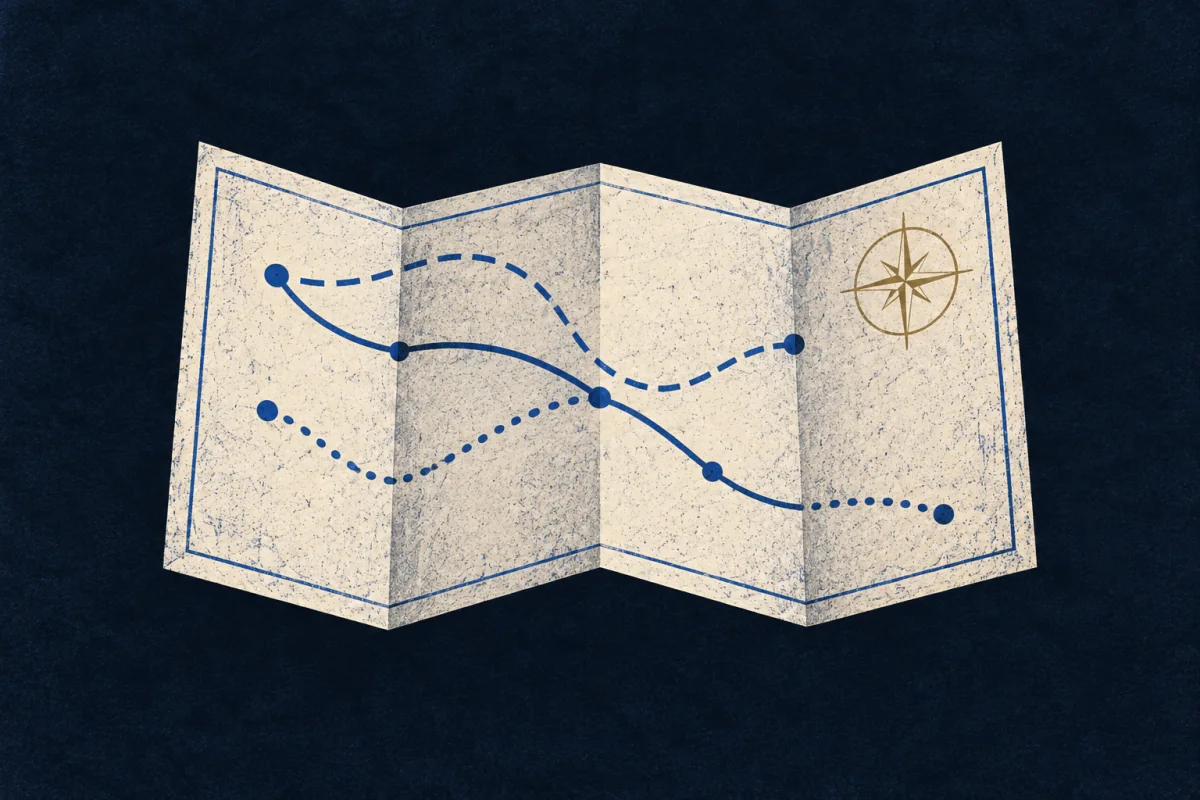
The fourth trip.
The first three were fine. The fourth is the one in the weather that shows what the place actually does, and it is the only one that mattered.
Anywhere somebody is being shown a place, ask whether they have been there in the conditions that make it dangerous. If not, they have been given the chart and told it was the knowledge.
Where It Stops
Knowing an area well is not this. Plenty of people hold a great deal of local knowledge and hand over none of it, because handing it over requires deliberately taking somebody out in bad conditions and narrating.
It goes wrong as never trusting the published version. Charts, forecasts and instruments are frequently right and have improved enormously, and a mind built on hard-won local knowledge can dismiss a correct modern tool out of loyalty to a way of knowing.
It also fails where the place changes. Banks move, paths are rerouted, a new building changes the wind. Knowledge built by repetition over thirty years is knowledge of a place that partly no longer exists, and the teacher is the last person to notice.
Take the plainer explanation first. Any pilot, guide or gamekeeper knows their ground because the job is the ground. The test is whether they take somebody out in it — whether the knowledge is being moved rather than held.
Where It Pays
Inside a job. Pilotage and harbour work, mountain and wilderness guiding, forestry and estate work, farming handovers, fishing, mining, utilities maintenance on a network somebody has walked for decades, and any operation where a specific site behaves in ways the documentation does not capture. Also plant and factory work, where the same problem appears indoors and is called tribal knowledge, usually just before somebody tries to eliminate it.
What is being bought is the prevention of the accident nobody can foresee from the documents. Every organisation with a physical site has a small number of facts that exist only in long-serving people, and it invariably discovers which ones mattered in the six months after they retire. A handover done by walking, in bad conditions, over a season, is the only method that has ever worked, and it is almost never budgeted for.
Where it pays badly is anywhere staff turnover is fast, anywhere the site is genuinely new, and in any organisation that treats a written procedure as the equivalent of a person who has been there twenty years. The second of those is fair enough. The third costs somebody an accident about once a decade, and the accident is always attributed to something else.
Try This
Think of somewhere you know far better than the people around you — a stretch of road, a building, a river, a system at work.
Write down three things about it that are true and are not written down anywhere. Not opinions. Behaviours: what it does in particular conditions.
Then take one person there, in the conditions that make it matter, and show them rather than telling them. Once is usually enough if the conditions are right.
Do it for all three over a year. That is a handover, and almost nobody does it until the week before they leave.
The fourth trip is a tool, not a self. Pick it up where a place behaves in ways no document holds. Put it down where the published version is adequate, because there insisting on the walk is only nostalgia.
If This Isn't You
Most people read the chart, follow the path, and get where they were going perfectly safely, which is what charts and paths are for. Feeling no urge to take somebody out in a gale to show them a bank is an answer, not a negligence.
Where To Go Next
Its near-twin — Field Lesson Guide. Both teach outdoors and let conditions set the lesson. Field Lesson Guide teaches transferable skill and the landscape is only the classroom. This one teaches one specific place, and none of it transfers anywhere else.
Its shadow — Map Translator. Map Translator puts what matters onto a sheet a stranger can carry away. This one holds precisely the part that will not go on a sheet, and hands it over on foot or not at all.
Most often confused with — Craft-Passer. Both move knowledge to the next pair of hands before it is lost. Craft-Passer transmits a skill that will work anywhere. This one transmits a place, and the learner who moves away has nothing.