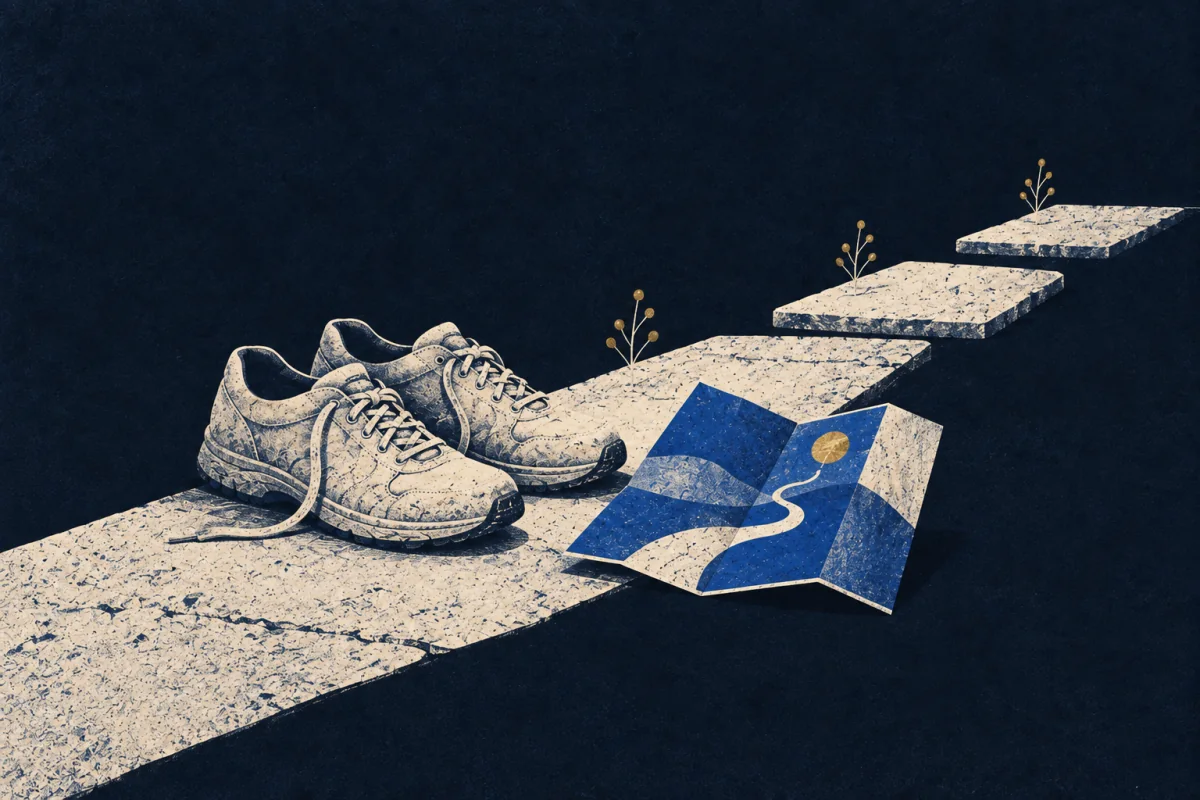
In Plain Sight
Some people teach on the move. The lesson unfolds along a trail, a pavement, a riverbank, the corridor between two buildings, and the walking is not a setting for it but part of how it works. Thinking comes easier in stride, and the pace of the steps sets the pace of the questions. You'd notice this in the one who says come with me rather than sit down.
The Pattern at Work
Something about moving loosens both people. Nobody has to hold eye contact, nobody is being examined, and the silences stop being a problem because the walking fills them.
Out on a path, the teaching keeps getting interrupted by the world and the interruptions turn out to be the material. A heron goes up off the water and the question that was being worked on gets held for thirty seconds and comes back changed, because the pause let the learner get a sentence ahead of themselves. Whatever the eye catches gets narrated into the subject — brickwork, a crane, a hedge cut badly — so the ideas keep acquiring physical anchors. Weeks later the learner cannot recall the explanation but can recall the stretch of towpath it happened on, and the explanation arrives with it.
The pacing matters more than any of the content. A hard question is asked going uphill, where the answer has to be short and nobody can bluff at length. Something painful gets raised on a long flat stretch with the pace steady and nothing to look at, where it can run as long as it needs. The good moment for the real question is generally forty minutes in, when breathing has settled and the learner has stopped performing. A teacher who works this way is managing effort and rhythm as deliberately as anybody managing a classroom, and has almost never described it that way to anybody. Ask one of them what their method is and the answer tends to be that they just find it easier to talk while moving, which is true and is about a tenth of what is going on.
What the Examples Show
It reads as informality, or as restlessness, or as somebody who dislikes sitting still.
The first element is that motion is being used as a tool for thinking. Bodies in stride produce a different kind of talk: less guarded, less finished, more willing to abandon a sentence halfway and start again.
The second is that the environment is being recruited constantly. Whatever appears becomes an example, which means the lesson can never be prepared in full and is partly written by the route.
The third is the pacing of difficulty. Effort, breath and terrain are being used to time the hard parts, so a question lands on the stretch where it can be borne. Very little of this is conscious in the moment, and almost none of it survives being moved indoors.
Going Deeper
Teaching while walking is older than teaching while seated, and it keeps getting rediscovered by people who think they have invented it.
Aristotle's school in Athens took its nickname from the covered walk its teaching happened along. Wandering teachers across early India and the early Buddhist sangha moved for most of the year and taught along the road, with the rains as the only settled season. Japanese pilgrimage routes carried the same arrangement for centuries. Nietzsche insisted that only thoughts arrived at while walking were worth anything, and the German and English walking traditions attached the same claim to their philosophy and their poetry. What is striking is how little any of them left behind about the method itself, as against the ideas they reached by it.
The thing all of them worked around is that this teaching leaves no record and fits no institution, which has cost its practitioners steadily. It cannot be assessed, since nothing about it produces evidence a school would accept, so the people best at it are often rated poorly by whatever rubric their employer uses. It does not scale beyond three or four walkers, because the fifth person cannot hear and the group stops being a conversation. It assumes a body that can walk and ground that can be walked on, which quietly excludes people and gets excused rather than solved. And it is fragile in weather, in cities built for cars, and in any timetable that allocates teaching in forty-minute blocks between rooms.
The Image
The uphill question.
The hard thing gets asked on the climb, where the answer has to be short and nobody has the breath to perform an answer they do not have.
The terrain is doing the work a skilled teacher would otherwise have to do by hand. It shortens, it strips, it makes evasion physically awkward. On the flat afterwards, the real answer usually arrives without being asked for twice.
Where It Stops
Liking a walk is not this, and neither is holding meetings outside. The teaching is genuinely shaped by the movement, rather than merely relocated into it.
It goes wrong as avoidance. Some things need a table, a document, a record and a witness, and a teacher who cannot sit down will keep turning assessment, conflict and anything formal into another stroll where nothing is written and nothing is agreed.
It also fails at numbers. Past four people it becomes a tour, the quiet ones drift to the back, and the whole advantage of the loosened conversation disappears.
Take the plainer explanation first. Plenty of instruction happens outdoors because the subject is outdoors. The test is whether the walking shows up where the subject has nothing to do with it — algebra, grief, a difficult conversation about somebody's work.
Where It Pays
Inside a job. Outdoor and adventure education, field teaching of every kind, guiding, coaching and mentoring, physiotherapy and rehabilitation, chaplaincy, social work and youth work, and clinical supervision. Also large parts of management that nobody writes down, where the walk to the car park is where the actual conversation happens and everybody knows it.
What is being bought is disclosure. People say things while walking that they will not say across a desk, and in any work that depends on somebody being honest about what they do not understand, that difference is the whole job. It also buys attention over a longer stretch than a room can hold, because an hour of walking does not feel like an hour of being taught and nobody starts watching the clock.
Where it pays badly is in institutions that count contact hours in rooms, in any role assessed on written evidence of teaching, and in organisations where a conversation that produced no minutes is treated as a conversation that did not happen.
Outside one. Parenting, friendship, mentoring, grief, and most of the serious conversations that happen in families. The cost worth naming is that a person who teaches this way can find they have no record of years of good work, and nothing to show anybody who asks what they actually did.
Try This
Take one conversation you were going to have sitting down and have it walking instead. Something with a bit of difficulty in it, not small talk.
Pick a route you know well enough not to think about, forty minutes or so, with at least one climb in it.
Ask the hard thing on the climb. Say nothing for the first minute of the descent.
Afterwards, note what got said that you do not think would have been said at a table.
Walking is a tool, not a self. Pick it up where somebody needs to think aloud without being watched. Put it down where the thing needs a record, a decision or a signature, because a path produces none of those.
If This Isn't You
Plenty of people think best sitting still in a quiet room, and move worse for being walked about while trying to work something out. Wanting the table is an answer, not a stiffness.
Where To Go Next
Its near-twin — Field Lesson Guide. Both teach outdoors. Field Lesson Guide is teaching the place itself, and the route is chosen for what it contains. This one is teaching anything at all, and the route is chosen for its rhythm.
Its shadow — Practice Teacher. Practice Teacher builds skill through repetition in one place, with the learner corrected over and over. This one never repeats a lesson, because the route and the day supply half of it.
Most often confused with — Long-Walker. Both are out on foot for hours. Long-Walker walks for the walking and is usually alone. This one is only walking because somebody else is learning alongside.