In Plain Sight
Some people work on the same few seconds of sound until it does what it should. Not louder, not stranger. A breath shortened, a pause opened, a word moved a fraction earlier, and the line suddenly means what it was meant to mean. You'd notice this in the friend who replays one moment of a recording over and over before saying anything.
The Pattern at Work
The unit of work is much smaller than anybody expects. Not the track or the scene, but a syllable and the silence on either side of it.
Most of what a sound editor does is timing. A performance that sounds flat is usually not badly performed but badly spaced: the answer comes too fast to have been thought about, or a breath lands where it interrupts. Moving a phrase by a fraction of a second changes what the listener believes about the speaker, and the listener will attribute the change to the performance rather than to the edit. Nobody hears the shift as a shift. They only hear a person who sounds certain, or hesitant, or unbearably tired. The same applies to music, where a drum a few milliseconds behind the beat feels relaxed and the same drum ahead of it feels urgent.
The rest is a judgement about what to remove. Breaths, room tone, mouth noise, the tail of one word overlapping the start of the next: all of it can be taken out, and an over-edited recording sounds clinical and dead because the removals are what made it human. So the decision is never simply whether something is a flaw. It is whether taking it out costs more than leaving it in, and that has to be settled by listening to the result rather than by looking at the waveform, which will happily show a clean edit that sounds wrong. An editor who cannot leave a flaw alone will produce something technically perfect that nobody wants to listen to.
What the Examples Show
It gets read as technical skill, or as a good ear, or as patience with fiddly software.
The first element is that the unit is tiny. A syllable, a breath, the space before an answer. Whole meanings turn on distances too small to notice as distances.
The second is that timing carries the emotion. Where a sound sits relative to the one before it decides whether a line reads as confident or unsure, and the listener will credit that to the performer.
The third is that removal has a limit. Flaws can all be taken out, and a recording with all of them taken out sounds inhuman, so every cut is a judgement about cost rather than about correctness, and the limit sits in a different place for every recording.
Going Deeper
Editing sound only became possible when sound became a physical object that could be cut.
Magnetic tape arrived after the war and turned a recording into something a person could hold, mark with a pencil and cut at an angle with a razor. That single change created the studio as a place where a performance is assembled rather than captured, and it created this trade. Before it, a bad take meant another take. Tape also made multitrack recording possible, which split a performance into parts that could each be moved. Digital editing later removed the physical limits and made everything reversible, which sounds like pure gain and was not: the discipline that came from a cut being permanent went with it, and the number of possible versions became effectively infinite.
The costs are specific. The work is invisible when it succeeds and blamed when it fails, so there is no upside and a permanent downside. It is done alone, at length, on headphones, at a level of attention that is genuinely exhausting and looks from outside like sitting down. Hearing damage is an occupational risk and ends careers. The hours follow other people's deadlines, which means the editing happens after everyone else has finished and before the morning. Rates have fallen as the tools got cheaper, and much of the work is now freelance and paid per project. And the infinite-version problem is real: with no physical limit on revision, a person who cares can lose days to a passage nobody else will ever notice, and no one will tell them to stop.
The Image
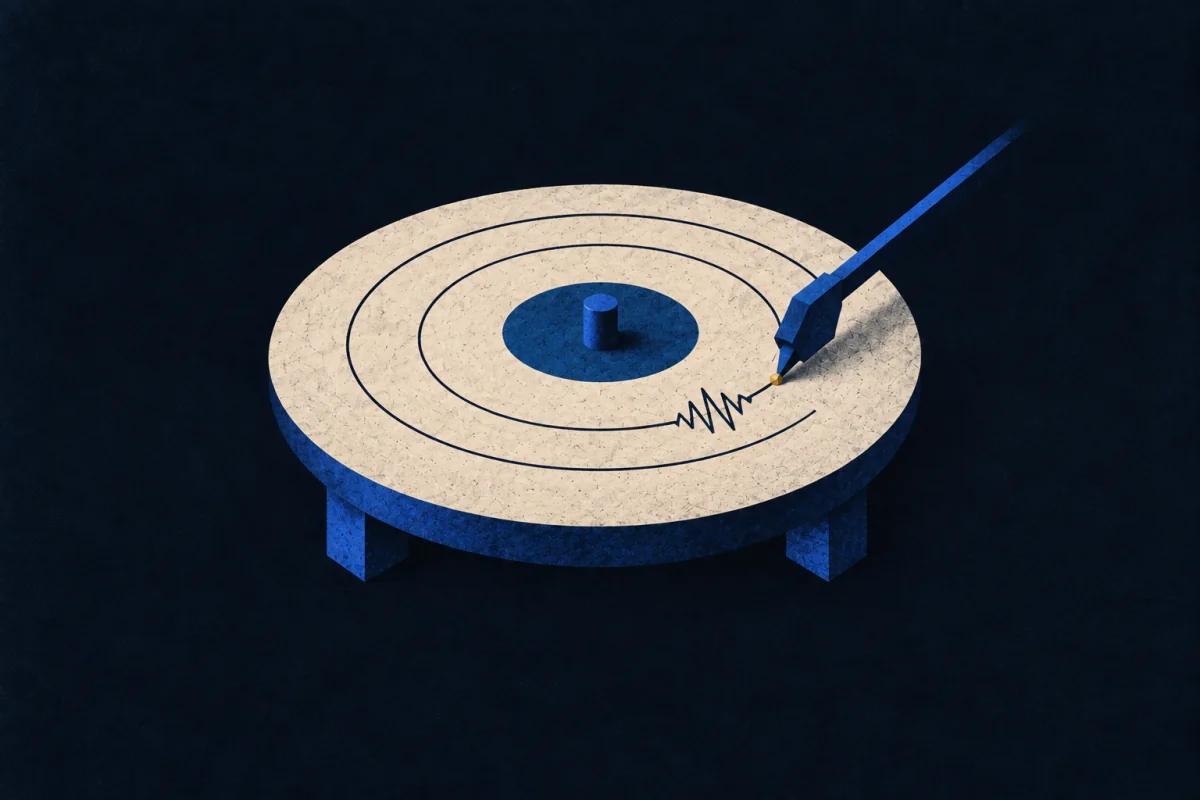
The same four seconds, again.
A loop playing over and over while one edge of it moves by a hair, and then again, and then again.
From outside it looks like someone stuck. What is actually happening is a comparison too fine to hold in memory, so it has to be made by repetition, this version against that version, until one of them stops being a version and simply sounds like the line.
Where It Stops
Loving music is not this, and neither is having good hearing. The skill is in judging what a change does to a listener, which is a different thing from enjoying the result.
It goes wrong as endless revision. With nothing physical to stop it, the work can absorb any amount of time, and somebody who cannot decide that a thing is finished will keep improving it past the point where anybody can tell.
It also fails where the flaw is the point. A live recording, a field recording or an honest rough demo loses the reason it exists once it is smoothed, and a person who edits by reflex will ruin them and be surprised.
Take the plainer explanation first. Anybody who edits audio for a living gets fast at it. The test is whether the decisions are about what the listener will feel rather than about what the waveform shows.
Where It Pays
Inside a job. Sound editing and mixing for film, television, radio and podcasts; dialogue editing and post-production recording; music production and mastering; audiobook editing; game audio. Also the sound side of advertising, where a few seconds carry the whole spend.
What is being bought is a recording that nobody notices. An audience thinking about the sound has stopped following the story, and every production knows the difference between a programme that holds and one that does not, even when nobody can say why. Broadcasters and studios pay for people who can make that difference reliably, on schedule. Film and television are the exception in this trade, where the craft is respected and paid accordingly.
Where it pays badly is in the volume end. Podcast and audiobook editing is often priced per finished hour by people who have no idea what it involves, and the tools being cheap has persuaded clients that the work is easy. Turnaround expectations have shortened at the same time, and the rate has not followed.
Outside one. Editing recordings for a band, a choir, a family archive or a community radio slot. The cost worth naming is that once you edit, you hear edits everywhere, and a lot of listening stops being listening.
Try This
Record yourself saying four or five sentences about anything. Listen back once.
Now take out the breaths. All of them. Listen again and notice what happened to the person speaking.
Put half of them back, and move one pause so that it comes before a word rather than after it. Listen a third time.
The sentences have not changed. What changed is how certain the speaker sounds, and you did it with silence.
Shaping the gaps is a tool, not a self. Pick it up where a few seconds have to land properly. Put it down when the roughness is the reason somebody recorded it in the first place.
If This Isn't You
Plenty of people hear a recording, take in what was said and think no further about it. Not noticing the seams is what the work is for.
Where To Go Next
Its near-twin — Score-Maker. Both work out how sound should sit in time. Score-Maker decides it before it exists, writing what players will then perform. This one works on a recording that already happened, moving what is there rather than specifying what should be.
Its shadow — Sound Shaper. Sound Shaper works on the character of a sound: how it sits, how it feels, what colour it has. This one works on where it sits in time and what is taken out, and the two can disagree completely about the same recording.
Most often confused with — Sound-Weaver. Both assemble a finished thing out of separate sounds. Sound-Weaver is building a texture from parts that were never together. This one is repairing and timing a performance that was, and the goal is for nothing to seem assembled at all.