In Plain Sight
Some makers build an instrument toward a sound they can already hear. They are not copying a plan. They tap the wood, thin it, tap again, and let what they hear decide the next cut. You'd notice this in the builder who scrapes a soundboard for a week and will not say how much is left to take off.
The Pattern at Work
The front of the violin has been at the right thickness according to the measurements for three days, and it is still on the bench being scraped. Every few minutes it gets picked up, held at one corner, and tapped with a knuckle. The maker is listening for something she cannot name in advance and will know when she hears, and the reason the measurements cannot settle it is that this particular piece of spruce is slightly stiffer across the grain than the last one, so the number that was right for that one is wrong for this. Taking off two tenths of a millimetre too much cannot be undone. The whole risk of the instrument lives in the last hour of a month's work.
The organ has been installed for five weeks and has not been played to anybody yet. What is happening instead is voicing: each pipe adjusted, by hand, to this building — its stone, its height, its emptiness, the fact that on a Sunday it will hold three hundred coats and sound different. A stop that was perfect in the workshop is wrong here, and there are two thousand pipes.
A drum maker rejects four hides for one that is barely distinguishable to anyone else, then mounts it, listens, takes it off and remounts it at a slightly different tension. The head that goes on is the fifth attempt at the same operation.
Nothing in any of that is finishing work. It is the decision itself, made late and by ear, on material that has the last word.
What the Examples Show
The obvious reading is craftsmanship, or patience, or a very fine set of hands.
The hands matter and the ear governs. What is actually running is a standard held in hearing — a sound the maker can produce internally but cannot describe or measure — and a long physical process steered entirely by comparison against it. Each cut is a test. The object talks back, and the next cut depends on what it said.
The reason it has to work that way is in the material. Wood, hide and metal vary from piece to piece by more than the tolerance that matters, so a plan can get the object to approximately right and no further, and approximately right is the difference between an instrument a player keeps and one they sell on.
That also explains the unwillingness to say how much is left. It is not mystique or evasion. The answer genuinely is not known until the last tap, because the last tap is the measurement.
Going Deeper
Stradivari and the workshops around him in Cremona left no written method, and three centuries of analysis have established a great deal about the varnish and the arching while failing to close the gap. Aristide Cavaille-Coll voiced organs to the buildings they stood in and treated the church as part of the instrument. Javanese gamelan smiths tune an entire set to itself rather than to any external standard, so the set is internally perfect and will not play with another one. Japanese taiko makers hollow a single trunk and then wait, sometimes for years, for the wood to settle before the heads go on, because a drum built on timber that is still moving will come apart in its own time.
All of them worked toward a sound rather than a specification, and paid the same bill for it.
The standard cannot be transferred. It has to be rebuilt inside each new maker's hearing over a decade, which makes the craft slow to teach and easy to lose — several of those traditions have been interrupted and never properly recovered. The work is also invisible in the finished object: a buyer hears the instrument and sees the varnish, and has no way to perceive the month of decisions that made it sound like that. The cost of the last hour never goes away either; after thirty years, the final cut still carries the whole instrument. And the sound is judged by players, who are the right judges and who will describe what they want in words that mean nothing physical at all.
The Image
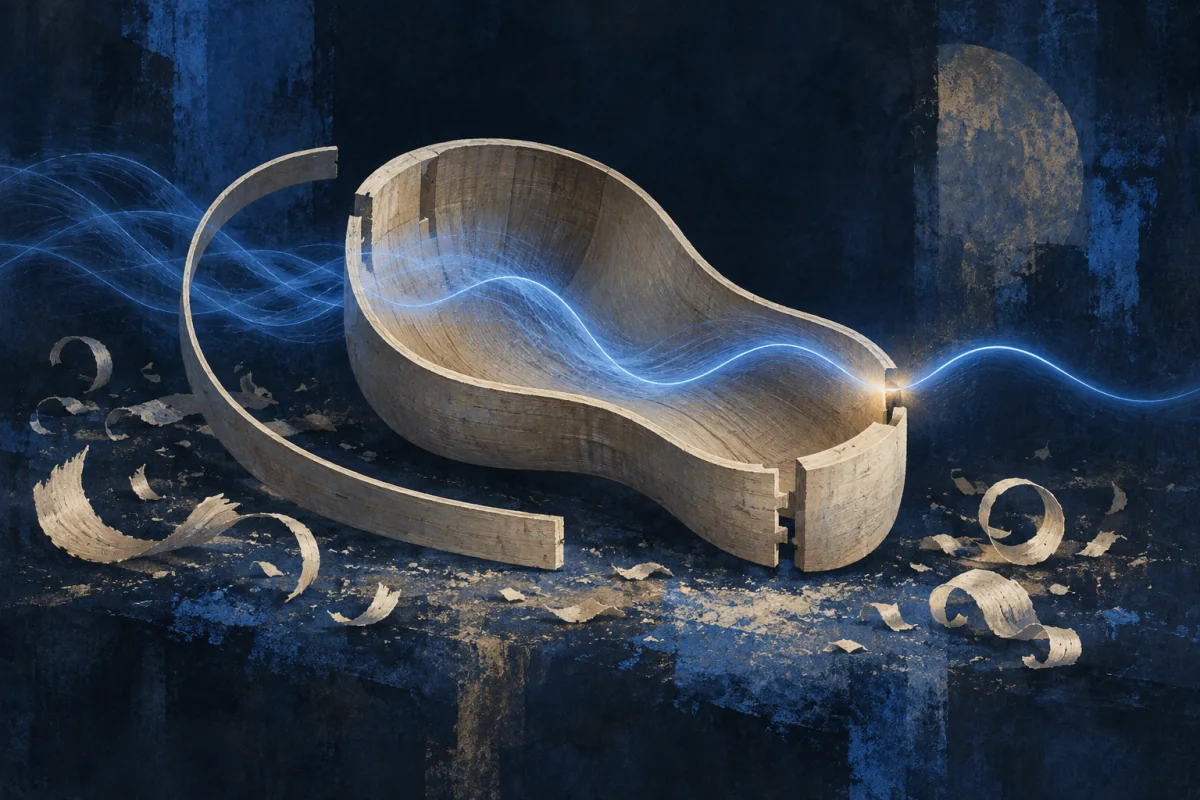
The tap.
A knuckle on a piece of wood, listened to, then two more scrapes, then another tap. It is the smallest possible unit of the work: a question, an answer, a change.
Everything about the instrument is decided in a few hundred of those, and none of them can be written down in a way that helps the next person.
Where It Stops
Loving music is not this, and neither is playing well. A great many fine players have no feel whatever for what makes an instrument sound as it does, and some of the best makers are indifferent performers.
It goes wrong as never releasing the object. There is always another scrape available and the standard never quite arrives, so a maker can hold an instrument on the bench for a year past the point where it was excellent, and the risk of taking off too much rises with every session.
It also fails wherever the output has to be consistent. Work that must produce forty identical units cannot be steered by ear, and this pattern in that setting either slows the line or quietly starts making them different.
Take the plainer explanation first. Anyone trained in instrument making taps and listens because the training demands it. The test is whether it appears elsewhere — on a room, a floorboard, a wine glass, a tool that sounds wrong when it is about to fail.
Where It Pays
Inside a job. Instrument making and repair, organ building and voicing, piano regulation, bell founding, speaker and audio hardware design, architectural acoustics, and the tuning end of any craft where the test is what something sounds like rather than what it measures. Also quality work in manufacturing where a fault announces itself audibly long before it shows up in a gauge.
What is being bought is the last five per cent. A plan and good hands get an object to the point where it is technically correct, and technically correct instruments are common and cheap. The difference that a player pays a year's wages for is entirely in decisions that no drawing contains.
It pays badly at volume, badly against a delivery date, and badly in any organisation where a specification is the authority and an unrepeatable judgement by one person is treated as a risk to be designed out.
Outside one. Repairing, restoring and setting up instruments for other people, and the long private education of listening. The cost worth naming is that the standard does not switch off: a badly set-up instrument in somebody else's hands is uncomfortable to sit near, and saying so is almost always worse than not saying so.
Try This
Find something in your house made of thin wood — a drawer bottom, a shelf, the back of a cupboard, a wooden spoon.
Hold it loosely at one corner and tap it. Then hold it firmly and tap it again. The second sound is dead, and the difference between the two is most of what an instrument maker is working with.
Now do it with three objects and put them in order by how long the sound lasts. That ordering is the beginning of the standard.
Then leave it alone for a week and see whether you can still hear the difference, because that is the part that takes years.
The tap is a tool, not a self. Pick it up where material has the last word. Put it down where the thing only has to be the right size.
If This Isn't You
Most people buy an instrument that plays, play it, and give the wood no thought at all, which is what instruments are for. Hearing no difference between two pieces of tapped spruce is an answer, not a deafness.
Where To Go Next
Its near-twin — Wheel-Potter. Both work a material that varies and correct by feel as they go. Wheel-Potter is answering to a form under the hands. This one is answering to something heard, and will accept an ugly object that sounds right.
Its shadow — Word-Smith. Both carry a private standard nobody else can check. Word-Smith's material is language and can be revised endlessly at no cost. This one's material is wood, where the scrape that goes too far ends a month's work.
Most often confused with — Hand Shaper. Both shape wood with great care. Hand Shaper knows the thing is right by looking at it. This one knows by tapping it, and would sand away a beautiful curve if the note asked for it.