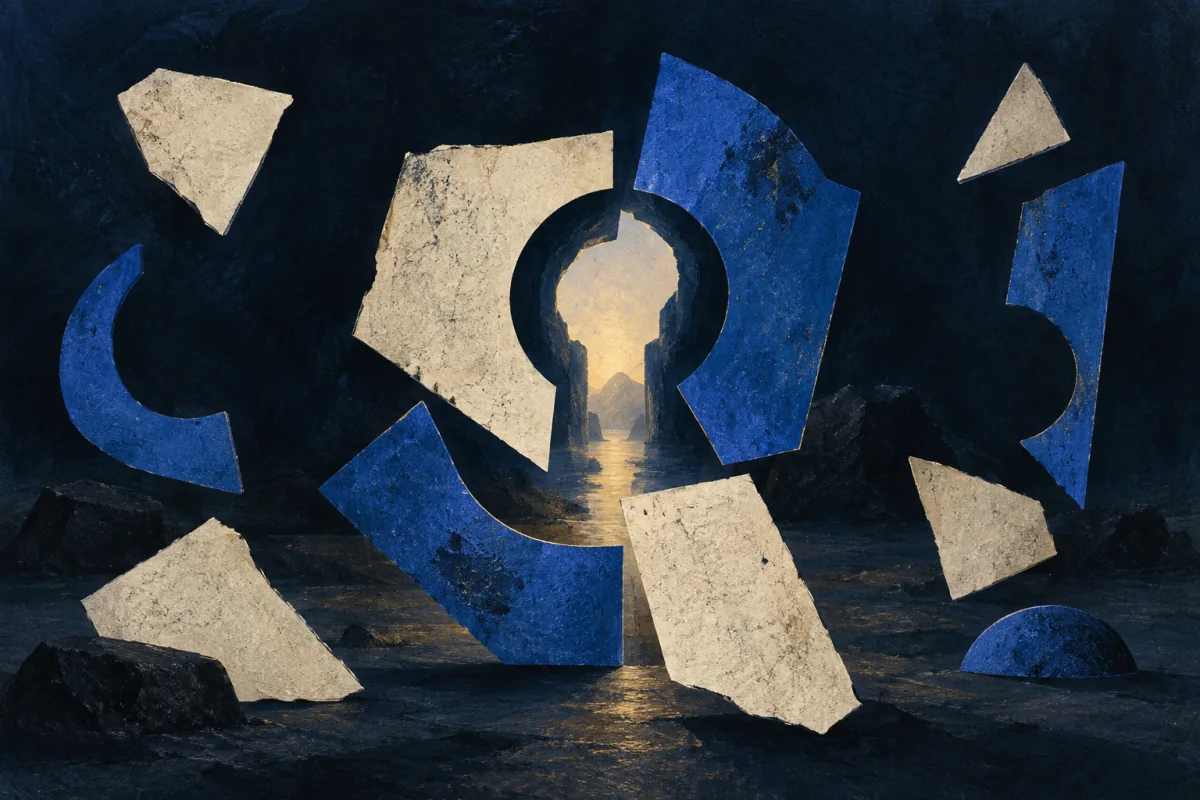
In Plain Sight
A person with this pattern keeps working when meaning is hidden. They are not guessing for fun. They test each clue because the right pattern will unlock the rest. You'd spot this in whoever reads a confusing group chat twice, notices one missing reply, and figures out why the plan went sideways.
The Pattern at Work
Three people in a group chat are now not speaking and nobody can reconstruct why. The thread runs to four hundred messages. One of them reads the whole thing twice, and on the second pass stops caring what was said and starts caring about the gaps. There is a nine-hour silence in the middle of a Tuesday that nobody remarks on. Before it, a question. After it, a change of subject by somebody else. The question was never answered, and everything afterwards is two people behaving as though it had been answered differently. The row is not about the row.
A finance team has a spreadsheet exported nightly from a system nobody maintains, and one week the columns arrive shuffled with no header row. Two people say it is unrecoverable. A third works it out in an afternoon from structure alone: one column has exactly twelve distinct values, one is always 0 or 1, two of them sum to a third, and the dates are the only monotonic field. None of that required knowing anything about the business. It required assuming that a shape was there.
A woman inherits a notebook her grandmother kept for thirty years, in a personal shorthand nobody in the family can read. She does not start by guessing at words. She counts. The commonest symbol appears at the start of about one line in seven, which is roughly how often a date would. Two symbols only ever appear together. From four such footholds she has a third of it inside a month, and the rest comes slower.
What the Examples Show
The obvious reading is cleverness, and all three involve it. It is not the operative thing, and the second scene proves it: the person who cracked the spreadsheet knew less about the business than the two who gave up.
What is actually running is an assumption, held stubbornly, that a structure exists and is findable. That assumption changes what gets looked at. Somebody who thinks a thing might be meaningless looks at content and gives up when it makes no sense. Somebody certain the structure is there looks at frequency, position and absence — none of which require understanding anything — and works inward from where the material constrains itself.
The second half is starting from the smallest foothold rather than the most interesting question. Not what does this say, but what appears most often and where. The nine-hour silence, the column of twelve values, the symbol at the start of one line in seven: none of those is meaning. Each is a shape, and shapes are what get levered.
Going Deeper
Champollion did not translate the Rosetta Stone by knowing Egyptian. He noticed that certain groups of signs were ringed, guessed that the rings marked royal names, and matched a handful of letters from names he already had in Greek. Six or seven characters bought the rest of a writing system.
Michael Ventris was an architect, not a linguist, which is usually mentioned as a curiosity and is the point. He worked on Linear B for years by building grids of which symbols could follow which, assuming the language had a regular syllable structure, and it turned out to be Greek, which every expert had ruled out. He got there by refusing to start from meaning.
Bletchley worked the same way at industrial scale. The crib was the whole method: guess that a message contains a routine phrase, such as a weather report, and use the constraint to strip out possibilities. The Voynich manuscript is the honest entry on the other side of the ledger, having consumed a century of this instinct and produced nothing.
The costs are specific. Most of the work yields nothing at all, over long periods, with no way to tell an unsolved problem from an unsolvable one. The field is full of people who found a pattern that was not there, and the stubbornness that carries somebody through eleven fruitless weeks is what makes that failure possible. And the habit does not stay in its box: a mind that reads silences as data will read them in conversations too, where a nine-hour gap usually means somebody was asleep.
The Image
The repeat.
Anything with meaning in it repeats. A letter, a phrase, a routine, a format, a habit of the person who made it. Whoever hid it could not stop that happening, because a message with no regularity in it cannot be read by the recipient either.
So the question is never what does this mean. It is what occurs more often than chance allows, and where.
Where It Stops
Enjoying puzzles is not this. A puzzle is built to be solved and guarantees an answer exists, which is the guarantee the real version does not come with.
It goes wrong as finding structure in noise. This is the occupational disease: given enough attention any material will yield a pattern, and the person most likely to find a false one is the person most confident a true one is there.
It goes wrong again as treating people as ciphers. A friend who has gone quiet is not a message with a key, and analysing them instead of asking is inaccurate and a way of avoiding the conversation.
It also fails where the material is genuinely thin. Some things cannot be recovered, and a pattern-finder keeps going long past the point where the honest answer is that there is not enough here.
Take the plainer explanation first. Anyone in cryptanalysis does this because it is the discipline. The test is whether it appears on a grandmother's notebook, with nobody asking.
Where It Pays
Inside a job. Cryptanalysis and security, data forensics and recovery, reverse engineering, legacy systems and undocumented formats, fraud analytics, archival and manuscript work, and the large amount of ordinary technical life that consists of making sense of something nobody documented. The contribution is that material written off as unrecoverable turns out not to be, which is a category that includes an enormous amount of institutional memory. Half of what any long-lived organisation knows is sitting in a format nobody can open, guarded by nothing but the absence of documentation.
It pays badly wherever the answer is needed by Friday, and badly again in work where everything is documented and the structure is simply handed over.
Outside one. Family papers, old photographs with writing on the back, inherited records, genealogy, puzzle communities, and the quiet business of working out what actually happened in a family from the order of the letters. The cost worth naming is the sink: this work has no natural stopping point, and an evening can become a month without any decision having been made. The second is the habit above — reading people's silences as signal is a mistake this pattern makes more often than most, and it is the one that costs the most.
Try This
Take something you have that is partly unreadable. Bad handwriting, an old file with no header, a photograph with scribble on the back.
Do not try to read it. Count instead. What appears most often? What appears only at the beginning of things? What two things never occur apart? Write down three observations about shape that involve no guessing at meaning whatsoever.
Then see whether any of them gives you a foothold. Often none does, and that is the honest result and the one worth sitting with, because knowing when there is not enough material is the half of this that nobody practises.
The repeat is a tool, not a self. Pick it up where a structure was imposed by somebody. Put it down when a person has simply gone quiet, and ask them instead.
If This Isn't You
Most people meet something unreadable, conclude it is unreadable, and spend the afternoon on something else, which is usually correct and always cheaper. Feeling no pull toward a page you cannot read is an answer, not a gap.
Where To Go Next
Its near-twin — Evidence Mapper. Both reconstruct something from material that will not speak. The Evidence Mapper works on residue that nobody arranged, where the honesty of the object is what makes it readable. This one works on something a person structured on purpose, and the maker's habits are the way in.
Its shadow — Riddle Maker. The Riddle Maker hides a structure and builds a road back to it for somebody else to walk. This one walks roads built to keep people out, or not built at all — the exact inverse of the same machinery.
Most often confused with — Truth-Seeker. Both refuse to accept a text as it arrives. The Truth-Seeker walks a claim back to its source and asks whether it holds. This one takes the text entirely as given and asks only what shape it is, which is a different question and frequently the only one available.