In Plain Sight
Some people hold a whole pattern in their head and then build it line by line. The plan is settled long before the work looks like anything, because each line locks in what the next one can be. They check the joins rather than the surface. You'd notice this in the one who plans a knitted yoke on paper first and never has to unpick it.
The Pattern at Work
The commitment happens at the start, and it happens all at once. Setting up a loom means deciding the width, the density, the colour order and the structure of the cloth before a single row of it exists, and threading several hundred ends through the correct slots in the correct sequence. An error made there does not show up until the weaving is well underway, and by then the only remedies are to live with it or to take the whole thing off and begin again.
So the planning is not a preliminary stage to be rushed through. It is most of the work. A pattern has to be worked out as a grid, tested for whether the threads interlace often enough to hold together, and checked for what happens at the edges, where the design meets the selvedge and either resolves or does not. Somebody with this pattern will sit with squared paper as long as it takes and is comfortable spending two days on something that produces no cloth.
Then the execution is rhythm and vigilance at the same time, which is an odd pairing. Most of it is repetition: the same sequence of treadles, the same beat, hour after hour, and the rhythm has to stay even because an uneven beat shows as bands in the finished cloth that no amount of finishing will remove. But underneath the rhythm something is being watched continuously — a thread going slack, a broken end, a mistake in the sequence three rows back — and caught early, because the cost of catching it late doubles every row.
And there is the plain fact of the length of it. Weeks for one cloth, most of it looking identical to the day before.
What the Examples Show
It gets read as patience, or as a hobby, or as a kind of meditative calm, which badly misdescribes the amount of arithmetic involved.
The first element is total commitment up front. The structure of the whole piece is fixed before any of it exists, so the thinking is concentrated at the beginning and almost nothing can be changed afterwards.
The second is that the pattern is worked out as a grid and tested on paper for whether it will physically hold, which is a structural question and not an aesthetic one. A beautiful design that does not interlace enough falls apart in the wash.
The third is even rhythm under continuous inspection. The hands repeat while the eyes hunt for the broken end, and the two run at once without either interrupting the other.
Going Deeper
Weaving is one of the very oldest complex technologies and it has repeatedly turned out to be about information as much as about cloth.
The drawloom, developed in China and later in Persia and Byzantium, could weave a figured pattern because somebody had encoded that pattern in the harness beforehand, and it needed a second person, usually a child, sitting above the loom pulling cords in sequence. The Jacquard mechanism replaced that person with punched cards in the early nineteenth century, and those cards went on to shape the design of early computing machines, which is why the connection between weaving and programming is a matter of lineage rather than metaphor.
The social history is harsher than the technical one. Handloom weaving was skilled, respected, often done at home, and was destroyed within a generation by power looms. The weavers of Lyon rose twice in the 1830s over collapsing piece rates, and in Bengal the trade was dismantled by imported cloth. What survives now sits in craft markets, heritage schemes or the luxury end, and the rest is done in factories by people with no say in the pattern.
The costs now are those of any long-form making. The setup is unpaid in practice, because buyers price the cloth and not the two days of threading. The error cost is brutal and lands entirely on the maker. Shoulders, wrists and eyes take the strain. And the work is solitary in a way that gets romanticised by people who have not done six weeks of it, with nothing to show anybody until near the end.
The Image
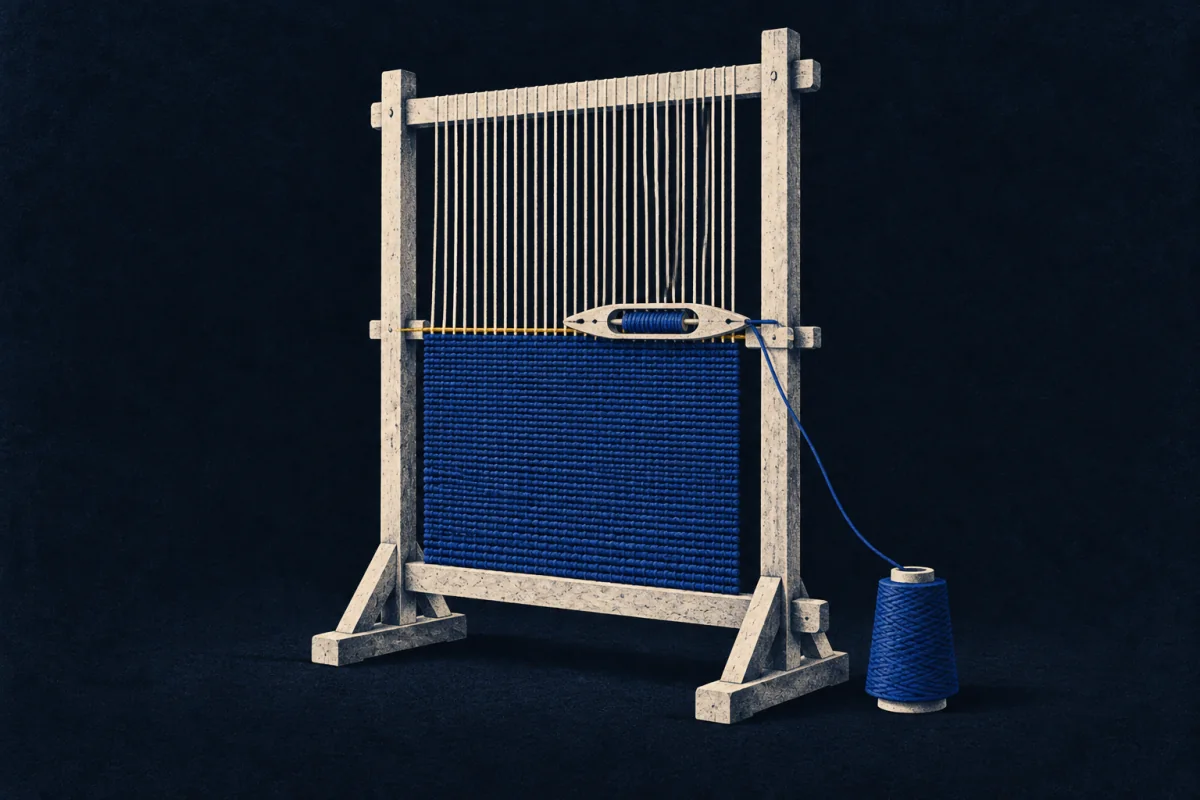
Threading before weaving.
Two days at the back of the loom, and not one row of cloth to show for it.
This is where the piece is actually decided. Every mistake made here is a mistake you will be living with for six weeks, and none of it is visible in the finished thing. If you want to know whether somebody really does this, watch what they are willing to spend before anything appears.
Where It Stops
Enjoying textiles is not this, and neither is having capable hands. The defining move is committing to a structure before it exists, and plenty of skilled makers work the opposite way and are right to.
It goes wrong as an inability to start. There is always one more thing to check in the draft, and somebody who cannot tolerate the possibility of an error in the setup will plan indefinitely and weave nothing.
It also fails when the same approach is taken to work that wants revision. Writing, cooking and most design improve by being changed halfway through. A person who front-loads every decision because that is how cloth behaves ends up defending a plan that stopped being right several weeks ago.
Take the plainer explanation first. Anybody who weaves gets methodical about setup, because the loom enforces it. The test is whether the same front- loading shows up in things that would forgive a change of mind.
Where It Pays
Inside a job. Handweaving and textile design, industrial loom setting and technical textiles, carpet and tapestry work, passementerie, and the sample-making end of the fashion supply chain. Also tailoring where cloth is specified rather than bought, and any manufacturing role where a long run has to be set up correctly before it starts.
What is being bought is a setup that does not have to be redone. In a production setting, a loom threaded wrong is not one wasted piece, it is a wasted run plus the downtime to rethread, and a technical weaver who gets the draft right the first time is the difference between a profitable order and a scrapped one. In craft work the same thing appears as a maker whose pieces come off the loom finished rather than nearly finished.
Where it pays badly is anywhere the cloth is sold by the metre against imported prices, which is almost everywhere. The setup time is invisible to the buyer and gets absorbed by the maker as a matter of course.
Outside one. Guilds, community studios, family production and anybody with a loom in a spare room. The cost worth naming is that the work is assumed to be relaxing, so the hours are never counted as hours and the pieces are expected as gifts.
Try This
Next time you take on something long and repetitive, spend the first session producing nothing.
Write out the whole structure before you start. Not a sketch — the actual sequence, with the awkward parts resolved. Where does it end? What happens at the edges? What is the repeat, and does it come out even?
Then find the one decision that cannot be changed later, and check that one twice.
Only then begin, and hold the pace steady rather than fast. Watch for the small fault while your hands keep going.
Front-loading is a tool, not a self. Pick it up where the work locks behind you as you go. Set it down where a thing can be revised cheaply, because there planning it all first just makes you slower and more attached.
If This Isn't You
Plenty of people would rather start and see what happens, and in most work that finds a better answer than planning would have. Improvising is not carelessness. It is a bet that revision is cheap, and usually it is.
Where To Go Next
Its near-twin — Row-by-Row Builder. Both build a whole by accumulating identical small steps in strict order. Row-by-Row Builder can usually undo and redo a section. This one cannot, because the cloth locks behind the work, and the whole approach is shaped by that.
Its shadow — Print-Hand. Print-Hand puts all the work into one matrix and then multiplies it identically, many times. This one puts all the work into one setup and then produces a single continuous thing that can never be repeated exactly.
Most often confused with — Fit Shaper. Both work with cloth and plan before cutting. Fit Shaper starts from finished cloth and solves the puzzle of making it fit one particular body. This one makes the cloth itself and is finished before that question is asked.