In Plain Sight
This person works at the spinning center, where the hands never stop adjusting. They are not fighting the clay. They feel how thick a wall is through the fingertips and correct it before the eye sees any wobble. You'd find this in the one who sits down at a wheel and loses four hours.
The Pattern at Work
A restaurant has ordered thirty bowls and she is making thirty-eight, because some will not survive. The eighth one goes on the wheel at about four minutes: the rim goes soft, the wall runs away from her, and the whole thing folds over in under two seconds. She does not stop, swear or examine it. She cuts it off, throws the clay back into the bin, and puts up the ninth, and the ninth is better than the seventh was, because what the eighth told her was that she was two seconds late with the left hand and a fraction too wet. The entire correction happens without a sentence being formed about it. By the twentieth the bowls are close enough to identical that a stranger would call them machine-made, and they are not identical at all, and she can pick out the twenty-second from across a room.
A beginner at the next wheel has been doing this for five weeks and is still fighting. He centres the clay by force, which works, and then loses the form every time as soon as the wall gets thin. What changes, when it changes, is not a technique he is taught. He stops trying to hold the clay still and starts letting his hands travel with it, which is a smaller movement and a completely different intention, and the first time it happens he cannot say what he did. The pot rises. He spends the next two years learning to do it on purpose.
What the Examples Show
The quick reading is patience, or good hands, and neither accounts for the eighth bowl being useful rather than lost.
What is running is continuous correction inside a closing window. The clay gets wetter and weaker every second it is worked, so the material is always moving toward collapse, and the skill is staying slightly ahead of it. A movement that would be right four seconds ago is wrong now. No amount of instruction substitutes for the hours: the information arrives through the fingertips faster than language can keep up.
The second half is what a failure is for. The folded bowl is not waste; it is the only feedback available, read immediately and with no emotion attached. A person who stops to be disappointed has lost the thread of what the clay was telling them. Throw it back, put up the next, carry the correction forward in the hands.
Going Deeper
The potter's wheel is about five and a half thousand years old and is among the first machines anybody built. What it gave was not decoration but speed at scale, and almost every settled society arrived at it independently, which is a fair indication of how much pottery a population needs.
The remarkable thing is that the technique has not been improved. A Korean onggi maker building a jar taller than a person, a village potter in Rajasthan, a studio thrower in Devon — all are doing the same thing with the same tools, because the constraint is not technological. The clay behaves how it behaves, and the only instrument fine enough to read it is a hand. Bernard Leach and Shoji Hamada spent their lives arguing about most things and agreed on that one.
It is also a craft where the standard is impossible to explain. Leach wrote a manual that is mostly useful to people who can already throw, and every teacher since has run into the same wall: the thing to be transmitted is a sensitivity in the fingertips that has no vocabulary attached to it.
The bill comes in three parts. The body pays first — backs, wrists and hands, on a machine that requires being hunched over it — and most career potters are managing an injury by fifty. The loss rate is constant and permanent; hours of work go back into the bin as a matter of routine, and anybody who cannot do that lightly will not last. And the skill is invisible in the result. A well-thrown bowl looks simple, and looking simple is the achievement, which means the finished object is a poor witness to what it took.
The Image
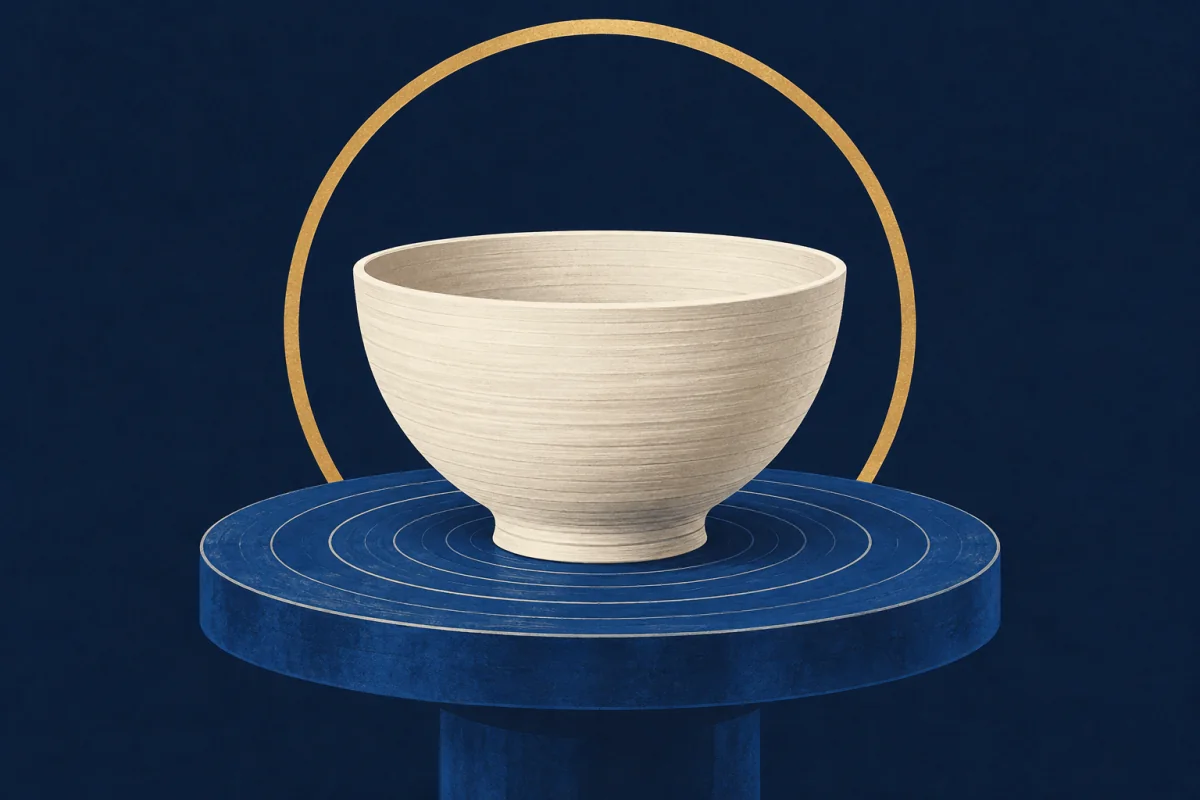
The wall you cannot see.
The thickness of the side is decided from the inside, by two fingers that cannot see anything, while the whole thing turns. By the time the eye detects a wobble, the correction is already late by a second.
Most skilled work has something like this in it: a dimension read by touch because looking is too slow. Worth asking which of the things you do are judged by eye and which by hand.
Where It Stops
Liking making things is not this, and neither is being unhurried. Throwing is not a slow activity; it is a fast one done for a long time.
It goes wrong as attachment to the piece on the wheel. The moment a pot becomes too valuable to lose, the hands tighten, and tight hands make exactly the failure that was being feared.
It goes wrong again as flow that produces nothing. The hours pass very pleasantly, and a person can throw for a decade without the pots improving, because the feedback is only useful if it is actually being read.
It also fails wherever the work cannot be restarted. This pattern is built for a material that can go back in the bin, and it transfers badly to situations where the eighth attempt costs somebody else money.
Take the plainer explanation first. Anybody trained in a craft has some version of continuous correction. The test is the specific one here: whether failure is read as information within about two seconds and without a word.
Where It Pays
Inside a job. Production pottery and ceramics, obviously, but the same continuous-correction pattern earns in glassblowing, forging, plastering and rendering, confectionery and sugar work, live sound mixing, and anything else where the material is changing while it is being worked and there is no pausing to think. The contribution is throughput at a standard: a thrower who can make thirty-eight to get thirty is worth a great deal more than one who makes each pot carefully, because in these trades the carefulness is what produces the wobble.
It pays badly where each piece is precious, and badly again on anything that can be paused, measured and resumed, which is most of manufacturing and all of design.
Outside one. Pottery as a practice, cooking at the point where timing matters more than recipe, gardening, playing an instrument, and any activity where four hours pass without being noticed. The cost worth naming is physical and cumulative, and it arrives long after it was incurred. The second is that a person who has learned to let a failure go in two seconds on a wheel does not always transfer that to the rest of their life, where people are not clay and cannot be put back in the bin and started again.
Try This
Take any skill you have where you usually stop to examine a mistake.
For one session, do not stop. When something goes wrong, note it wordlessly, start the next attempt immediately, and let the correction happen in the doing rather than in the thinking. Ten attempts, no pauses.
Then compare the tenth with the third. Most people find the improvement is larger than it is when each failure gets analysed, which is not an argument against thinking. It is a finding about which parts of a skill are actually reachable by thought.
Continuous correction is a tool, not a self. Pick it up where the material is moving and restarting is cheap. Put it down where an error costs somebody else something, and go back to stopping and looking.
If This Isn't You
Most people want the thing they are making to survive, and stop when it goes wrong, and get a result that way. Feeling no pull toward a material that is always about to collapse is an answer, not a gap.
Where To Go Next
Its near-twin — Row-by-Row Builder. Both do long handwork and hold the whole shape while making one part. The Row-by-Row Builder works in discrete steps that can be paused and unpicked. This one has no step and no pause, and once the wall is thin there is no going back.
Its shadow — Object-Restorer. The Restorer's discipline is reversibility, working slowly on something that exists and must not be lost. This one destroys eight to get thirty, and would say a material you cannot afford to lose teaches nothing.
Most often confused with — Vision Builder. Both work alone for hours and lose track of the afternoon. The Vision Builder holds one picture steady across decades. This one holds a form steady for ninety seconds, thirty-eight times, and has no interest in the decade.