In Plain Sight
Some people cannot make a plan until the counting is done. They walk the ground, sample it properly, and come back with a figure and an honest range around it. They are not trying to shrink what is possible. They are trying to keep the decision off a guess. You'd notice this in the one who counts the chairs before a community meal, then quietly moves two tables.
The Pattern at Work
The move that defines this is going out. A number can be estimated from a desk by taking last year and adjusting it, and most numbers are, which is why so many of them are wrong in the same direction every year. Somebody with this pattern will not accept a figure they have not gone and looked at, and the looking is physical: paces across a field, a count in a marked square, a hand in the grain, a walk of the whole boundary rather than the near end of it.
Then the method has to be honest, and this is the part that separates the pattern from enthusiasm for clipboards. Counting everything is usually impossible, so a sample stands in for the whole, and a sample is only worth anything if where it was taken was not chosen. The instinct to walk to the good part of the field and count there is almost irresistible and it ruins the figure completely.
So the squares get placed by pacing out a fixed interval, including the ones that land in the bad patch by the gate.
And the answer comes back with its uncertainty attached. Not a single clean number but a figure and a spread, with the spread stated plainly enough that whoever is deciding can see how much room they have. This is the least popular part of the job, because people asking for a number want a number, and handing back a range reads to them as hedging when it is the opposite. The person who says roughly eleven tonnes, and could be as low as nine, is being far more useful than the one who says eleven and means it, but they rarely get treated that way in the room.
What the Examples Show
It gets read as pessimism, or as slowing things down, or as an unwillingness to commit, which is nearly the reverse of what is going on.
The first element is physical verification. The figure comes from the ground rather than from last year's figure with a percentage applied, which is the ordinary way numbers get produced and the ordinary reason they drift.
The second is sampling that resists the pull toward the good patch. Where the counts happen is decided before anybody looks, and the counts that land somewhere disappointing are kept in, which is the whole difference between a sample and an anecdote.
The third is reporting the spread. The uncertainty travels with the number instead of being stripped off to make it sound firmer, so the person deciding knows what they are standing on.
Going Deeper
Counting what is there before acting on it is one of the oldest administrative acts, and most of the machinery of states grew out of it.
Egyptian officials measured fields after each flood because the boundaries had literally moved and the tax depended on the area. The rope stretchers who did it gave geometry some of its earliest practical problems. The Domesday survey counted ploughs, mills and livestock across England in a matter of months. Chinese dynastic land surveys and the Inca accounting recorded on knotted cords served the same purpose: an administration that cannot say what exists cannot collect, plan or feed anybody.
The agricultural version is still alive and unglamorous. Crop yield estimation, livestock condition scoring, forest timber cruising, fisheries stock assessment and rangeland carrying capacity are all the same act, and all of them depend on somebody willing to walk a transect in bad weather and record what is in the quadrat rather than what was expected.
The costs are mostly social. This is the person who arrives with a smaller figure than the one already in the plan, and the reaction to a number is usually a reaction to whoever delivered it. Being right in April about a harvest that disappoints in September earns no credit, because by then the disappointment has other explanations. The work is solitary, outdoors, poorly paid relative to the decisions it underwrites, and structurally thankless: when the reckoning is good, nothing dramatic happens, and nothing dramatic happening is the hardest result in the world to claim credit for.
The Image
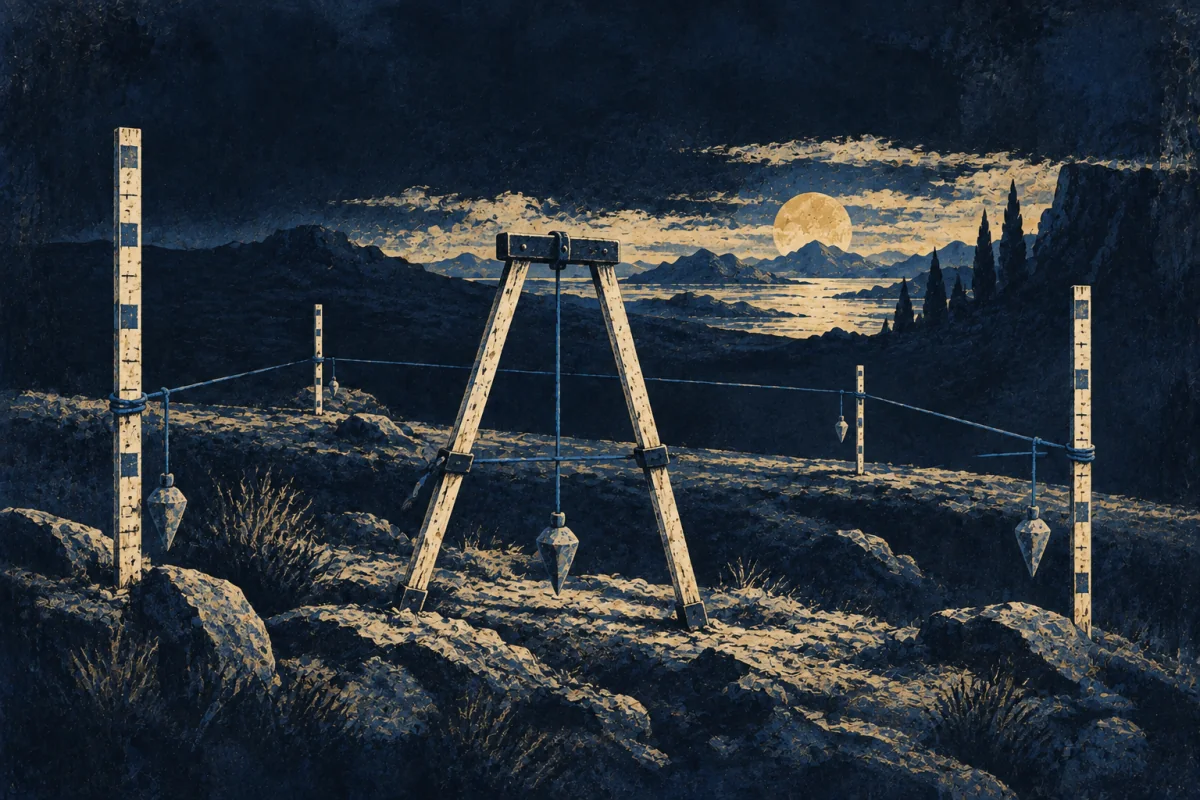
Counting the bad corner too.
The square lands by the gate where the crop is thin, and it gets counted anyway.
Everything in you wants to move it two metres. That is the whole test. A sample that skips its own bad patches is not a sample, it is a hope with a clipboard, and the number it produces will be wrong in the direction that is most expensive.
Where It Stops
Liking spreadsheets is not this, and neither is caution. The defining act is physical verification, and plenty of careful people never leave the office.
It goes wrong as counting that never resolves into a decision. There is always another sample to take, and somebody who keeps taking them past the point where the answer has stabilised is not being rigorous, they are avoiding the moment where the figure has to be handed over and stood behind.
It also fails when applied to things that do not count. Morale, trust and whether a partnership will hold are not quantities, and a person who insists on measuring them produces a number that looks solid and means nothing, which is worse than admitting the judgement was a judgement.
Take the plainer explanation first. Anybody responsible for a budget learns to check figures. The test is whether they go and physically look when everybody around them is content with last year's number.
Where It Pays
Inside a job. Agronomy and crop consultancy, livestock and rangeland assessment, forestry mensuration, fisheries stock assessment, land surveying, quantity surveying, stocktaking and inventory control, and the field end of statistics and humanitarian needs assessment.
What is being bought is the difference between a plan built on a real figure and one built on a comfortable one. A harvest contracted on an optimistic estimate means buying grain at spot price to meet it. A building priced off a wrong take-off means a loss on the whole job. In relief work an inflated headcount means supplies in the wrong place. The reckoning costs a few days and prevents failures that cost a season.
Where it pays badly is anywhere the honest figure is unwelcome for reasons that have nothing to do with accuracy, which is a great many places. The honest number and the wanted number diverge, and the person holding the honest one becomes an obstacle rather than an asset.
Outside one. Committees, clubs, smallholdings, family events and any group that keeps over-ordering or under-ordering. The cost worth naming is that this person is given the counting permanently once they have done it well once, and it is never treated as work.
Try This
Next time you are about to plan around a number you did not produce, go and check one piece of it physically.
Pick something small enough to actually count in twenty minutes. The chairs. The stock on the shelf. How long the walk really takes.
Decide before you start where you are going to look, and then look there, including the parts you suspect will be disappointing. Do not move the sample.
Write down what you found and the range you would put around it, then compare it with the number everybody has been using.
Counting the ground is a tool, not a self. Pick it up before a decision that is expensive to reverse. Set it down where the thing cannot be counted, because there a number is a costume and a plain judgement is more honest.
If This Isn't You
Plenty of people would rather commit on a rough figure and adjust as they go, and in fast-moving work that is often right. Preferring momentum is a real answer. Not everything survives being measured first.
Where To Go Next
Its near-twin — Tally-Hand. Both keep an accurate count where others estimate. Tally-Hand keeps a running record of what passes through, continuously, so the total is always current. This one goes out and establishes what exists at a single point in time, and then stops.
Its shadow — Volume-Thinker. Volume-Thinker judges quantity by eye and is usually close, without counting anything. This one distrusts exactly that ability, including their own, and the two argue every time.
Most often confused with — Evidence Mapper. Both insist on going to the source. Evidence Mapper is tracing where a claim came from and whether it holds. This one is producing a quantity that did not exist before they went out and made it.