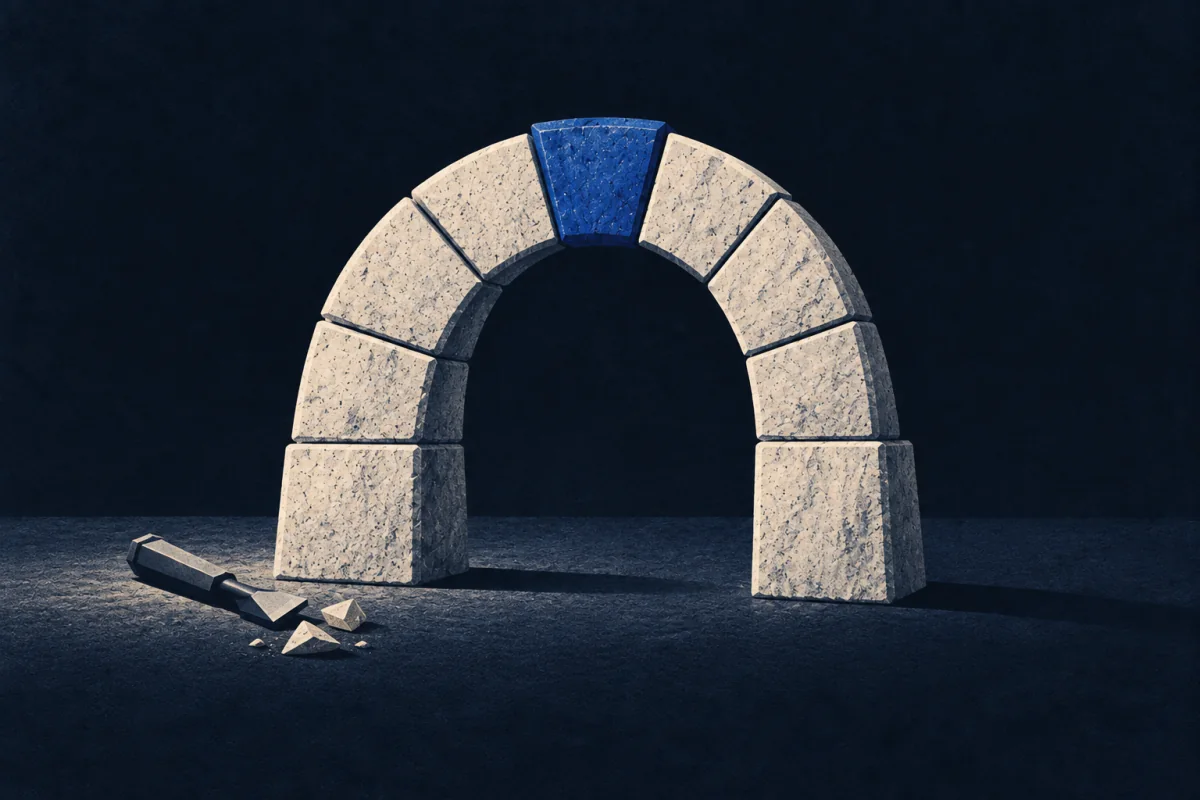
In Plain Sight
Put some people near a heap of stone and they start turning blocks over. They are looking for the face that will sit flat and the edge that will carry weight. A gap that seems small today becomes a crack later, so nothing gets forced. You'd notice this in the neighbour who rebuilds a garden wall and keeps rotating one block until it stops rocking.
The Pattern at Work
The work begins with sorting, not with building. A pile of stone is not a supply of identical units; it is a set of individuals, each with a face that wants to be down, a face that wants to be out, and several that want nothing. Somebody with this pattern walks the pile before lifting anything and builds a rough map of what is there. By the time the first course goes down they already know roughly which stones are corners, which are through-stones tying the two skins together, and which are filler that must never be allowed near the face.
Then it becomes a question of load, held in the head rather than on paper. Every stone put down changes what the next one can be, because weight has to travel through the wall and into the ground without finding a path that concentrates it. The rule about crossing joints is simple to say and hard to do with irregular material: no vertical line may run through more than two courses, because a continuous joint is a crack that has not happened yet. Holding that constraint while also choosing for shape, for face and for the stone that is actually in reach is the whole skill.
The third thing is the tolerance for slow. A stone is tried, taken out, turned, tried again. A cut is made a hair at a time, because material removed does not come back. Somebody watching from a distance sees a person doing almost nothing for long stretches.
What the Examples Show
It gets read as patience, or as craft nostalgia, or as strength, which it certainly requires but which explains none of the decisions being made.
The first element is sorting before building. The pile is read as a set of particular stones with particular uses, which means a large part of the work is finished before anything is lifted into place.
The second is thinking in load paths. Each placement is judged by where it sends weight, not by how it looks, and the rule against continuous vertical joints is applied constantly against material that never quite cooperates.
The third is the time horizon. The test of the work is not whether it stands today but whether it stands after forty winters of water getting in and freezing, which is a standard almost nothing else in ordinary life is built to.
Going Deeper
Stone building is among the oldest continuous trades there is, and much of what it knows was never written.
Dry stone walling, which uses no mortar at all and depends entirely on friction, gravity and correct placement, runs across Ireland, Scotland, the Balkans, the Andes and Japan, and in many of those places the walls standing now were built before anybody alive was born. The medieval European mason's lodge trained by long apprenticeship and marked finished blocks with a personal mason's mark, so that work could be traced and paid for. The knowledge moved by hand and by watching, and the vocabulary stayed local: what one valley calls a through-stone the next valley calls something else entirely.
The trade has been squeezed from both ends. Concrete and blockwork do most of what stone used to do, faster and for less money, and the remaining stone work is often a thin facing glued to something else. Conservation and heritage work keeps a real version alive, but it is a small market and the training route into it is thin.
The costs land on the body and on the wallet. Silica dust from cutting causes lung disease that appears decades later, and protection on small sites is inconsistent at best. Hands, backs, knees and shoulders wear out early. The work is weather-dependent and often seasonal, priced against block laying by people who cannot see the difference, and the parts that take longest are exactly the parts nobody will ever see. A wall built correctly looks the same on the day it is finished as one built badly. The difference shows up in thirty years, by which time the person who built it is long gone and unnamed.
The Image
Turning the block again.
The stone is lifted out, rotated, and offered to the gap a fourth time.
It looks like fussing and it is the job. A stone that rocks will be carrying weight on two points instead of a face, and that is where the wall will fail. Nobody watching can see the difference between the third try and the fourth. The wall can.
Where It Stops
Liking stone is not this, and neither is being able to lift heavy things. Plenty of strong, willing people build walls that come down, because the decisions are about weight paths and not about effort.
It goes wrong as perfectionism with no budget attached. A job priced for three weeks and given eight is a loss, and a person who cannot leave a hidden course alone will run every project into the ground and then blame the client for not valuing quality.
It also fails when transferred whole to other materials. Timber moves, steel flexes, and concrete is poured rather than placed. The instincts that serve stone actively mislead in all three, and somebody who does not notice becomes the person who overbuilds everything.
Take the plainer explanation first. Anybody who builds walls for years gets slower and more careful. The test is whether the care shows up on the courses that will be buried and never inspected.
Where It Pays
Inside a job. Stonemasonry and dry stone walling, heritage and conservation building, monumental and memorial work, architectural stone cutting, hard landscaping at the high end, and the restoration side of construction generally. Also quarry work where blocks are selected by hand rather than crushed for aggregate, and the training side of conservation trades.
What is being bought is a structure that does not need to be revisited. On a conservation contract, a wall that has to be taken down and rebuilt costs several times what it cost to build, and scaffolding is usually the largest line on the invoice. A person who gets it right the first time is worth a great deal to anybody who owns the building for longer than five years.
Where it pays badly is ordinary domestic work, priced against a block wall by somebody comparing a number on a quote. The hours that go into getting the hidden courses right are invisible on the page and get read as padding.
Outside one. Smallholdings, allotments, farms, community gardens and anywhere with old walls and no budget. The cost worth naming is that this person ends up rebuilding everybody's wall on weekends, for the price of lunch, and the asking never stops once it has started.
Try This
Next time you are stacking anything — firewood, boxes, books on a deep shelf — stop treating the items as interchangeable.
Pick one up and find the face that wants to be down. Set it so it does not rock. If it rocks, take it out and turn it rather than wedging something underneath.
Then look at the vertical lines forming as you go, and break them. Never let a gap in one layer sit directly above a gap in the layer below.
Stand back after every few layers and look at where the weight is going, not at how it looks.
Placing for load is a tool, not a self. Pick it up where a thing has to stand for years. Set it down for anything temporary, because there the right answer is fast and rough and good enough.
If This Isn't You
Plenty of people stack things until they stay up, get on with their day, and are perfectly right to. Not everything needs to outlast you. Building for the moment is a real answer, not a lack of care.
Where To Go Next
Its near-twin — Stone Mark Etcher. Both work stone by hand over long stretches. Stone Mark Etcher is cutting a surface so that it carries a message or an image, and the test is what can be read. This one is placing mass so that it carries weight, and the test is whether the thing is still standing in forty years.
Its shadow — Row-by-Row Builder. Row-by-Row Builder works in uniform units that are all the same, where the discipline is in keeping the sequence exact. This one has no two units alike, and the discipline is in choosing.
Most often confused with — Form-Shaper. Both make solid things that hold a shape. Form-Shaper is after the shape itself and will fight the material to get it. This one starts from what the material will already do and works within it.