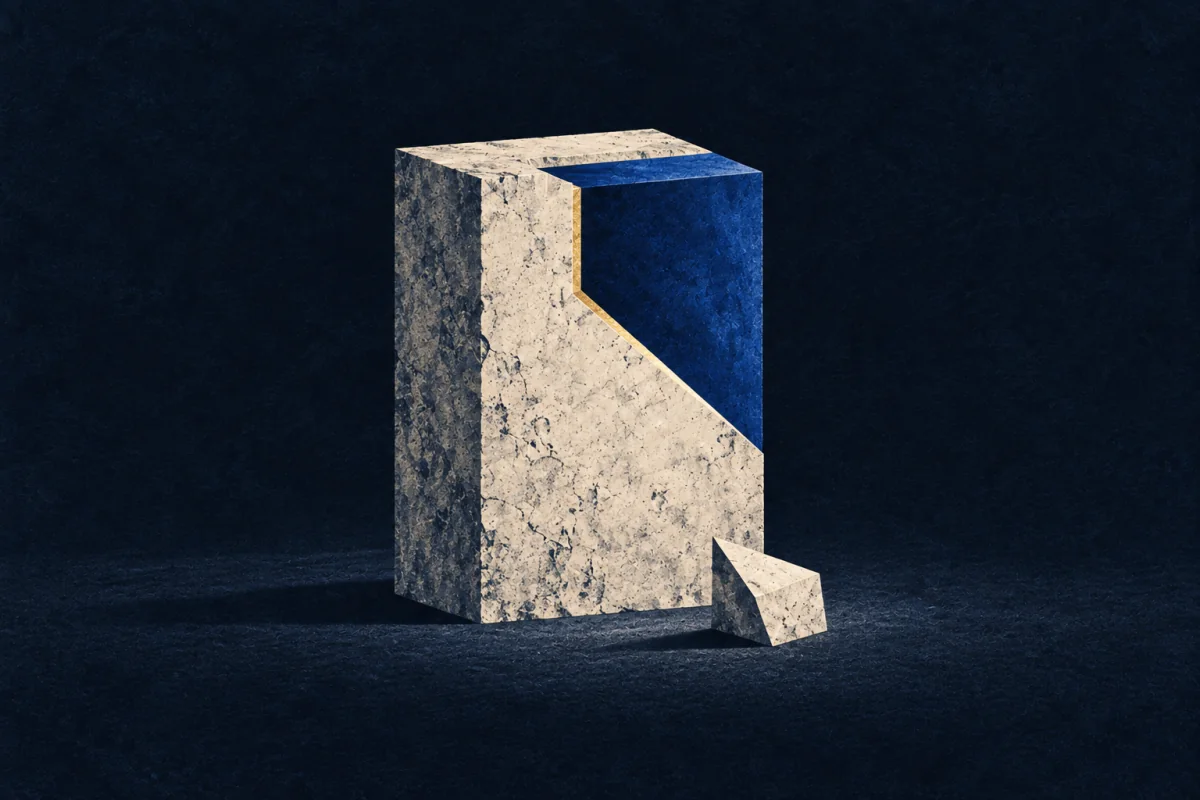
In Plain Sight
Some people make by taking away rather than adding. They are not in a hurry about it. The finished figure is held in mind for weeks while the block gives way, and nothing removed can be put back. You'd notice this in the one who reads a boulder for where it wants to break before lifting a chisel.
The Pattern at Work
The block has been in the yard for four months and nothing has been done to it, which the neighbours find funny. What has been happening is that it has been looked at, walked round, wetted to bring out the bedding planes, and tapped in a dozen places to hear where it is sound. Stone has a grain and a direction it splits in, and a figure laid out across the wrong axis will lose an arm in year three of its life rather than in the workshop, which is worse. The layout that is finally marked is not the one that was intended. It is rotated about fifteen degrees to bring the thin part of the figure along the strong direction.
The carving itself is subtractive and that changes everything about the order of work. It goes down in stages across the whole piece — rough, then closer, then closer — rather than finishing any part, because a finished area is a constraint on everything not yet cut, and a carver who completes a face early has nailed their own hands together.
A lettercutter cuts an inscription in the wrong stone and knows by the third letter, because the chisel is reporting something about crystal size that the polished surface did not show and no supplier's description mentions. The whole slab is wrong. It has been paid for, delivered and lifted into the workshop, and the only useful response is to stop now rather than at letter forty.
None of it can be undone. That single fact organises the entire craft.
What the Examples Show
It gets read as patience, which is true and is the least interesting part of it.
Two things are actually running. The first is that the material has a structure that cannot be seen and must be inferred: bedding, grain, hidden flaws, how it will weather in this climate and on this orientation. Reading that is half the skill, and it is why four months in the yard is work rather than delay.
The second is planning under irreversibility. Everything in this craft is sequenced to preserve options for as long as possible, which is why the whole piece comes down together rather than one part at a time. The discipline is identical to any other field where mistakes cannot be undone, and stone carvers tend to be recognisable in those fields because they think in the same order.
And the timescale is long enough to change what the work is for. A thing that takes a year and lasts five hundred is not made for the person who commissioned it.
Going Deeper
Carving stone is among the oldest deliberate work there is, and almost everything known about most of it comes from the objects, because the people left no other record.
Egyptian sculptors worked to grids and conventions that held for three thousand years, which is a way of managing irreversibility by removing choice. Greek workshops roughed out at the quarry to avoid carting several tonnes of stone that was going to be cut away anyway. Medieval masons travelled between cathedral lodges carrying templates and marks, and the marks are how their work can now be traced. Michelangelo described the figure as already being in the block, which gets read as a romantic claim and is closer to a plain working account of how subtractive planning feels from inside it. Indian and Cambodian temple carving worked whole facades by coordinating hundreds of hands to one grain-aware layout.
The costs are consistent and physical.
Stone dust destroys lungs, and did so for centuries before anybody established why or thought to ask. The work is slow, heavy and poorly paid relative to the time it takes, and a single mistake in the final week can waste a year. The timescale also means the carver frequently does not see what they made in place, and certainly does not see it weather. And the craft has been shrinking for a century as machine cutting takes the repeatable work, leaving conservation, lettering and a small amount of original commission, which is enough for rather few people.
The Image
Down together, not finished in parts.
The whole piece brought to the same rough state, then the same closer state, then the same closer state again. Never one area completed while the rest is untouched.
Anything irreversible is best done this way, and almost nobody does: the temptation is always to finish the part you understand, which quietly removes every option you had not thought of yet.
Where It Stops
Liking sculpture is not this, and neither is patience in general. The specific thing is planning against irreversibility in a material with a hidden structure.
It goes wrong as never starting. Reading the block is genuinely work, and it is also the safest place to stand, so a carver can spend a year on preparation for a piece that is never begun.
It also fails in additive work. Clay forgives everything, which this pattern finds slightly unserious, and the habits that protect a block produce cautious, over-planned work in a material that wanted to be played with.
Take the plainer explanation first. Any trained carver reads grain, because the apprenticeship is grain. The test is whether the same thinking appears elsewhere: somebody who works down together rather than finishing parts, in a kitchen, a garden, a piece of writing.
Where It Pays
Inside a job. Architectural and monumental carving, conservation and cathedral works, memorial and lettercutting, sculpture, quarry and dimension stone work, and the technical end of restoration where new stone must be matched to old. Also any trade where a material is expensive and cannot be recovered: veneer, structural timber, cut glass, dressmaking in cloth that cannot be replaced.
What is being bought is a way of proceeding when errors are permanent. That is rarer than it sounds and transfers a long way — demolition, surgery, irreversible engineering decisions, anything where the option to undo does not exist. Somebody trained on stone sequences differently from everybody else in the room, and will notice when a project is about to finish one part too early.
Where it pays badly is in anything iterative, anything with a short deadline, and in any process that expects to see progress weekly, since a month spent looking at a block produces nothing whatever to photograph and reads to a client as a month of nothing.
Outside one. Garden walls, memorials, lettering for a family, anything cut once and meant to stay. The cost worth naming is dust and time in roughly equal measure, and the fact that a year of work can be ended by twenty minutes of inattention in the final week.
Try This
Take something you can only do once this week — a cut in expensive material, a message you cannot unsend, a decision with no reverse gear.
Before doing it, write down which parts of it are still open and which will close the moment you act. Most people find they are about to close three things in order to settle one.
Then find the version that settles the one and leaves the other two open, even if it is slower and less satisfying.
Do it three times. The habit, not the instance, is what transfers.
Down together, not finished in parts is a tool, not a self. Pick it up where nothing can be undone. Put it down where the material forgives, because there it will only make you slow.
If This Isn't You
Most people make, adjust, and make again, which is how nearly everything gets built and is far more forgiving of being wrong. Feeling no pull toward a material that never forgives is an answer, not a timidity.
Where To Go Next
Its near-twin — Hand Shaper. Both work material by hand toward a form and stop by feel. Hand Shaper can add, adjust and rework in most of its materials. This one cannot, and every habit of the craft follows from that.
Its shadow — Stone Mark Etcher. Stone Mark Etcher chooses a found surface in the world and leaves most of it alone. This one starts from a quarried block and removes most of it.
Most often confused with — Wheel-Potter. Both shape material by hand against a form held in mind. Wheel-Potter works fast, against a clock, in a material that will take another attempt. This one works for a year in one that will not.