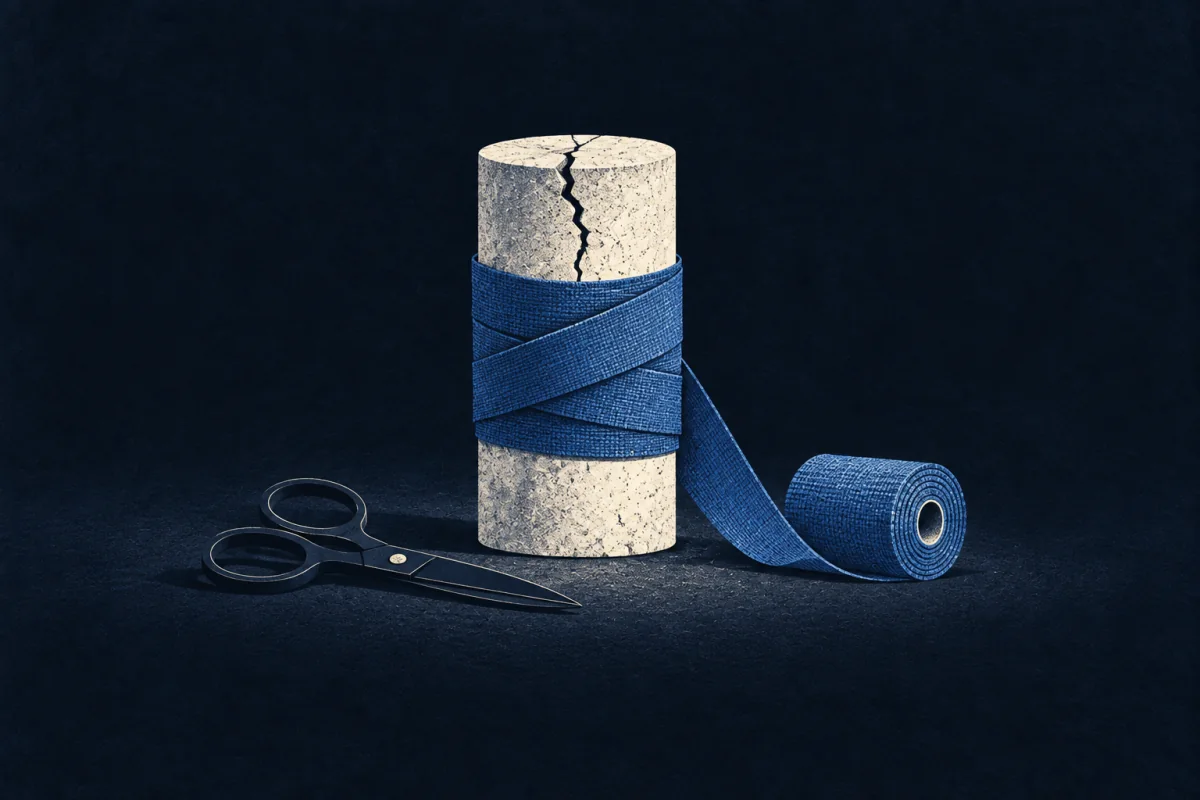
In Plain Sight
Some people move toward the injury while everybody else steps back. The hands get busy, rinsing and pressing and lifting, and the voice stays flat and ordinary. Whatever is happening to the room does not get into them. You'd notice this at the picnic, where one person is pressing a cloth to a cut and still talking normally.
The Pattern at Work
The first thing is closing the distance. Most people at an accident move back half a step without deciding to, and the whole difference is being the one who moves the other way.
After that it is order. Something is bleeding, something hurts, somebody is shouting, and none of those are equally urgent. Pressure goes on the bleeding before anything is cleaned, the cleaning happens before anything is covered, and the shouting is left alone entirely until the rest is done. Somebody with this pattern is working a sequence that is ranked by what causes harm fastest rather than by what is most upsetting to look at, and will ignore a dramatic graze to deal with a small deep wound nobody is looking at.
The hands and the voice run separately. While the fingers are doing something unpleasant the voice stays level and slightly boring, describing what is happening in plain words, because a running commentary at an ordinary volume takes a great deal of fear out of a situation. Bystanders get given specific jobs — hold this, find a clean cloth, stand at the gate and wave them in — partly because the jobs need doing and partly because a person with a task stops adding to the noise.
And there is a clear end to it. The work stops at the point where somebody better equipped arrives or the thing turns out to be beyond what hands and a cloth can do, and knowing that line is as much a part of this as any of the rest.
What the Examples Show
It gets read as being good in a crisis, or as a strong stomach, or as bossiness.
The first element is the direction of movement. Stepping in rather than back is the rarest part and everything else depends on it; the skills are teachable and the closing of the distance mostly is not.
The second is that the order is by harm, not by drama. What looks worst is not what matters most, and the sequence followed is ranked against damage rather than against appearance or noise.
The third is that the voice is doing separate work from the hands. Plain narration at ordinary volume, and tasks handed to whoever is nearby, remove most of the panic from the space without anybody being told to calm down.
Going Deeper
Putting hands on an injury quickly is old work, and for most of history it was not done by doctors.
Barber-surgeons handled wounds, fractures and bleeding across medieval and early modern Europe while physicians handled theory, and the split lasted for centuries. Battlefield care produced most of the practical advances, from Ambroise Paré abandoning boiling oil in the sixteenth century to the ambulances volantes that Dominique Larrey ran for Napoleon, which introduced the idea that the injured should be reached where they fell rather than waiting for the fighting to end. The organised first aid movement followed from the same recognition after Solferino, when Henri Dunant found thousands of wounded men with nobody willing to approach them. Work on why bystanders freeze has since confirmed the thing every one of those systems was built around: the person who acts first is the variable, and once one person moves, the others stop being spectators and follow.
The costs are physical and carried alone. There is blood, and the ordinary human reaction to it does not disappear, it gets postponed, which means it arrives an hour later when everybody else has stopped paying attention. There is exposure to being wrong, and the fear of blame is real enough to keep trained people standing still. Most of all there is never knowing the end: the person is handed over and the story stops, so a lifetime of this leaves somebody with dozens of unfinished accounts and no way to find out whether any of it helped.
The Image
Two steps forward.
Everyone in the room has taken a half step back, including you. The difference is what you do next.
You will not feel calm. You will feel exactly what everybody else feels, and you will move anyway, and the moving is what puts the feeling somewhere manageable. Afterwards, an hour later, when the ambulance has gone and somebody is making tea, it turns up and you shake. That is the order it happens in, and it is not a fault in the method.
Where It Stops
Being unbothered by blood is not this, and neither is having done a course. Plenty of people are steady at the sight of an injury and still stand there, and plenty of certificates sit in wallets belonging to people who freeze.
It goes wrong as doing too much. The instinct to act keeps going past the point where hands help, and moving somebody with a back injury or persisting with a wound that needs a hospital causes harm that waiting would not have.
It also fails as taking over. A person who owns every incident stops anybody else from learning, and a group with one designated pair of hands is a group where nobody else will step forward when those hands are elsewhere.
Take the plainer explanation first. Most people will hold a cloth on a cut if asked. The test is whether it happens unasked, for a stranger, when nobody would have blamed them for staying put.
Where It Pays
Inside a job. Paramedic and ambulance work, emergency nursing, military and remote medicine, lifeguarding and mountain rescue, workplace and event first aid, and the practical end of veterinary work. Also nursery and school staff, prison and custody care, and any trade where injuries happen far from a hospital.
What is being bought is the gap before proper care arrives. Bleeding controlled in the first minutes, a burn cooled immediately, an airway kept open: these decide outcomes far more than anything that happens later, and they are done by whoever is present rather than by whoever is qualified. Workplaces know this in the abstract and it is why first aiders exist on paper, but the ones who actually work are a much smaller group than the ones on the list.
Where it pays badly is at the volunteer and workplace end, where the role is unpaid, added to somebody's real job, and accompanied by a genuine fear of being held responsible. Even in the paid trades the pay is poor relative to what it asks of a body over twenty years.
Outside one. Families, sports clubs, building sites, festivals and any gathering with children or tools in it. The cost worth naming is that this person is called for everything, including the things that needed nobody.
Try This
Learn the three things that actually change outcomes, and practise them until your hands know them: hard direct pressure on bleeding, cold running water on a burn for a long time, and how to put somebody on their side.
Then, next time something small happens near you, notice your own half step. Everybody takes it. Take one forward instead.
Give two people jobs out loud. Hold this. Wave them in.
Say what you are doing in a flat voice while you do it, mostly for the person you are doing it to.
Going toward it is a tool, not a self. Pick it up in the minutes before anybody better arrives. Put it down when they do, and when the injury is past what hands and a cloth can reach, because carrying on there is how help becomes damage.
If This Isn't You
Plenty of people go faint at a cut and are the right person to ring for an ambulance and keep the children busy. Knowing which of those jobs is yours in advance is worth more than pretending to the other one.
Where To Go Next
Its near-twin — Triage-Mind. Both rank injuries by urgency under pressure. Triage-Mind sorts across many people and decides who waits, mostly without touching anyone. This one works on one body with its hands and does not choose between casualties.
Its shadow — Quiet-Sitter. Quiet-Sitter stays beside somebody and deliberately does nothing, because presence is the whole treatment. This one cannot be still and its value is entirely in the doing, and each would be wrong in the other's situation.
Most often confused with — Disaster-Hand. Both go toward physical trouble. Disaster-Hand works on the wreckage, for hours, with whatever comes to hand. This one works on the wound, in minutes, and stops the moment a hospital is in reach.