In Plain Sight
Some people teach through the body itself. The movement gets demonstrated, the student's copy gets watched, and an elbow gets adjusted by hand. Far more is shown than said, and what does get said is usually a count, a cue or a correction. You'd notice this in the one whose worn studio still fills before dawn.
The Pattern at Work
Demonstration is done at two speeds and that is the whole first move. Once at proper tempo so the shape is visible, then slowly, exaggerated at the point that matters, so the part that is usually invisible can be seen. Most students copy what they noticed rather than what happened, and the slow version is aimed precisely at what they did not notice.
Then the copy is watched for one thing at a time. A movement has a dozen faults available and correcting more than one produces somebody thinking about a dozen things and doing none of them. So the fault that is upstream of the others gets picked — usually weight, balance or where the eyes are — and everything else is ignored until it is fixed, at which point several of the other faults have often gone on their own.
Correction is made with hands rather than with words, where that is appropriate and welcome. An elbow moved four inches teaches in one second what a paragraph does not teach at all, because the student feels the correct position rather than constructing it from a description. What language remains is short: a count, a cue, a single word at the moment it is needed.
And the teaching is repeated far past the point of boredom. The same correction, the same week, for months, because a movement is not learned when it can be done but when it happens without attention under pressure. That is why the same correction is repeated long after everybody involved is tired of it.
What the Examples Show
It reads as dance or sport instruction, or as somebody who is good at showing people things.
The first element is demonstration calibrated to what the student cannot see. Showing at two speeds, with the significant moment exaggerated, is a technique rather than a style.
The second is correcting one fault at a time, chosen for being upstream of the others. This is a diagnostic judgement and it is what separates effective teaching from a list of things somebody is doing wrong.
The third is that language is minimal by design. Physical learning is disrupted by explanation, so what is said is reduced to counts and cues, and the hands carry the rest. A teacher who talks a great deal is usually teaching themselves rather than the student.
Going Deeper
Teaching movement by showing is the oldest teaching there is and has almost never been written down successfully.
Dance and martial traditions everywhere pass technique from body to body, with notation systems that exist and are used mostly by scholars rather than by teachers. Apprenticeship in physical trades worked the same way, with the learner at the next bench watching. Classical Indian dance and Japanese performing arts formalised long relationships in which the teacher's body is the text. Sports coaching is the modern version, and the arrival of video changed a great deal of it by letting students see themselves for the first time, which closed a gap that teachers had been bridging by hand for centuries.
The costs are consistent. Touch is central to the method and is now appropriately regulated, which has made an effective technique harder to use and has left many teachers working with an instrument they are reluctant to reach for. The work is physically punishing across a career: demonstrating a movement thousands of times damages the demonstrator, and most teachers in these fields are working through injury. Pay is poor almost everywhere outside a small professional layer. And the knowledge is tacit, so when a teacher stops, what goes with them is not recoverable from any recording, because the recording shows the movement and not the correction. Everything valuable in this teaching happens in the gap between what a student did and what they were about to be told, and no camera has ever captured that.
The Image
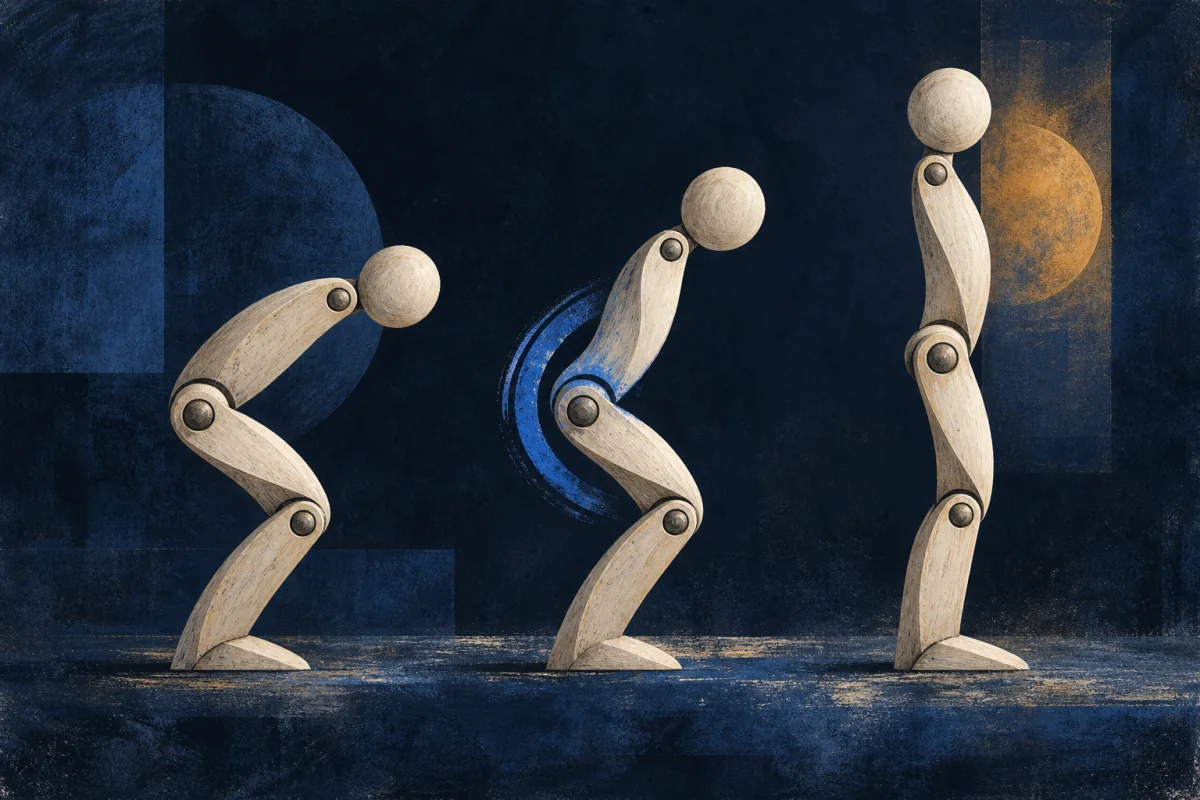
One fault.
The single thing that is wrong, chosen out of a dozen, because fixing it will fix four of the others.
The temptation is to name everything, and a student told six things does none of them. The judgement about which fault sits upstream is the actual competence, and it is why an experienced teacher says less than a beginner would and gets further.
Where It Stops
Being able to do the thing is not this, and neither is being encouraging. Plenty of superb performers teach badly, because they never had to diagnose a fault they did not have.
It goes wrong as reproduction. A teacher can build every student towards their own body, which is a particular height, a particular set of proportions and a particular injury history, and it does not transfer.
It also fails without consent around touch. Hands-on correction is powerful and is not available by default, and a teacher who has not built the habit of asking is relying on a technique they should not be using.
Take the plainer explanation first. Anybody coaching a physical skill demonstrates and corrects, because the subject requires it. The test is whether the instinct appears off duty — watching a stranger lift something badly and having to resist the urge to adjust their back.
Where It Pays
Inside a job. Dance and martial arts teaching, sports coaching, physical theatre and circus training, physiotherapy and rehabilitation, occupational therapy, instrumental teaching, surgical and clinical skills training, and manual trades instruction. Also safety and manual handling training in industry, where the whole content is how a body should move.
What is being bought is a skill that survives pressure. Anything learned by description falls apart when somebody is tired or frightened; what is trained into the body does not, and in surgery, sport and safety-critical work that difference is the entire point of the training. Organisations that have discovered it the hard way tend to protect their teachers carefully.
Where it pays badly is in most teaching of the arts, which is hourly, unsociable and dependent on individual students continuing. It pays badly wherever a course is sold on completion rather than on capability, and in any setting that assumes video can replace a person in the room.
Outside one. Clubs, studios, gyms, workshops and the large amount of this done by people passing on something to a friend or a relative. The cost worth naming is the body: a career spent demonstrating is a career spent accumulating the injuries the students never see.
Try This
Teach somebody a physical thing you can do, and do it without explaining.
Show it once at normal speed. Then show it slowly, exaggerating the one moment that matters.
Let them try. Then pick exactly one thing to correct — the one you think is causing the others — and correct it by moving them, if that is welcome, rather than by describing it.
Say nothing else. Let them try again.
Most people find the temptation to add a second correction is overwhelming, and that resisting it is what makes the first one work.
Teaching by showing is a tool, not a self. Pick it up where a body has to learn something that words cannot carry. Put it down where the person needs to understand why, because there a demonstration answers a question they did not ask.
If This Isn't You
Plenty of people learn best from a clear explanation and find being physically corrected intrusive rather than helpful. Wanting it described is an answer, not a stiffness.
Where To Go Next
Its near-twin — Body-Trainer. Both work on what a body can do. Body-Trainer is building condition and capability, and programmes the work. This one is teaching a specific movement, and the whole craft is in demonstration and correction.
Its shadow — Years-Long Guide. Years-Long Guide works almost entirely in language and diagnosis over years. This one says as little as possible and fixes an elbow with a hand, and each would find the other's method oddly indirect.
Most often confused with — Practice Teacher. Both build skill through repetition. Practice Teacher is structuring the work so that the reps do the learning. This one is intervening inside them, one fault at a time, with hands.