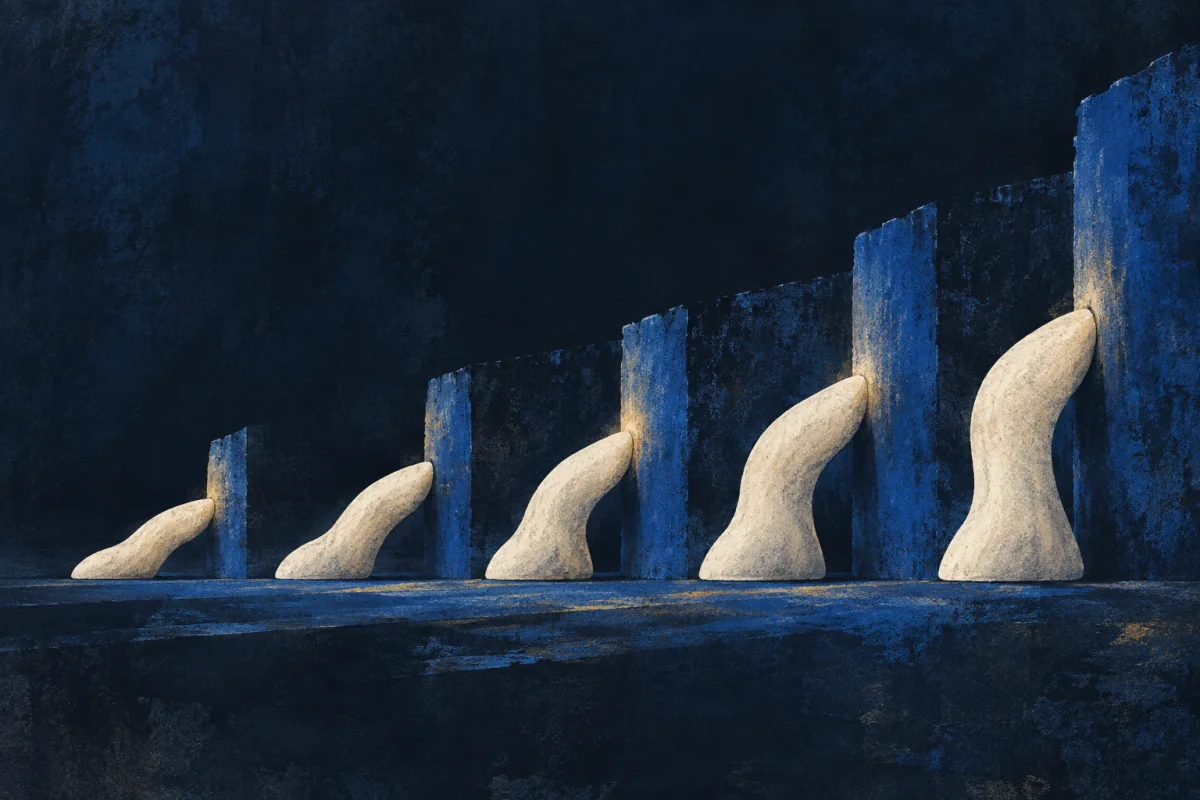
In Plain Sight
Put this person near effort, and they start shaping it into practice. They do not push bodies just to prove toughness. They repeat the right move until strength becomes reliable. You'd recognize this in the coach who stops a drill after one sloppy step, resets the feet, and makes the next try slower.
The Pattern at Work
Six weeks after the knee operation the patient wants to run, and the physiotherapist will not let him walk normally yet. What happens instead is eleven minutes of standing on one leg with his eyes shut, then sitting down, then standing up again without using his hands, then a rest that is longer than he thinks is reasonable. He is bored and slightly insulted. What is being rebuilt is not the muscle, which will come back on its own, but the reflex that catches the body when the ground is uneven — and that reflex only forms when the leg is fresh. Trained tired, it learns the limp instead, and the limp will still be there in two years. He runs in the spring, without the limp, and never quite believes that eleven minutes of standing still on one leg had anything at all to do with it.
The boxing gym is loud and the coach stops the session forty minutes early. A sixteen-year-old has been throwing the same combination for half an hour and somewhere around minute twenty-five his back foot stopped turning. Everything since has been practice at not turning the foot. The coach does not give a speech about effort; he has the boy throw it eight more times at half speed, watching the foot, and then sends him home. The next session starts with the same eight, slow. Three months later the foot turns under pressure, in a fight, when nobody is watching it, which was the entire object.
What the Examples Show
The reading offered is motivation. A person who gets others to work hard, who believes in them, who shouts the right things at the right moment.
Effort is the cheap part. Almost anyone can generate a hard hour, and a hard hour done wrong installs a fault that will need a year to remove. What is actually running is a continuous judgement about the quality of each repetition, and a willingness to stop the session at the exact moment the quality goes — which is usually well before the person feels finished, and always before the point where the work feels impressive.
That judgement has to survive social pressure in both directions. The learner wants to keep going, and the room respects sweat. Stopping early looks like softness and is the opposite of it.
Going Deeper
The problem is old and specific: a body can be made stronger or it can be taught, and the conditions for the two are not the same. Strength wants fatigue. Learning wants freshness. Every tradition has had to work out how to get both without spoiling either.
Milo of Croton and the calf is the oldest version of the story, and the point of it is progression rather than brute effort. The wrestlers of the Indian akhara built their days around repetition in the cool hours and rest in the heat, and Gama trained that way for decades. Shaolin monks drilled a single stance for months before anything else was permitted. Japanese kata carries the same conviction into a different room: the form is repeated until it can be produced under exhaustion, because it will have to be. Arthur Lydiard sent runners on slow miles that other coaches thought were wasted.
All of it is arranging somebody else's repetition, and it costs the arranger in the same way each time. The work is done in a season the learner is impatient with, and the payoff arrives so much later that it gets attributed to talent, to the newer coach, or to the learner's own character. The person holding the standard is the one saying no — no, slower, again, that is enough — inside a room that has come to work. And a mind trained on movement quality does not switch off at the door, so watching a child be taught badly, or a friend lift badly, becomes a small ongoing discomfort with no polite outlet.
The Image
The last good rep.
In every set there is one repetition after which the movement stops being the movement and becomes a strained approximation of it. Everything before that builds the skill. Everything after it builds something else, usually a compensation the body will keep.
The whole of the work is noticing where that repetition fell, and stopping there — including in rooms with no weights in them at all.
Where It Stops
Toughness is not this, and neither is having been good at the thing personally. Some fine athletes cannot coach: what their own body did well it did unsupervised, and they have nothing to hand over.
It goes wrong as never letting anyone off the basics. There is a point where the fundamentals are in and the person needs to go and fail at the real thing, and a mind organised around clean repetition can always find one more block of foundation work. Held too long, that produces someone who is beautiful in training and lost in a contest.
It also fails where the learner has not chosen the effort. This pattern needs somebody who actually wants the outcome. Turned on a person who does not, it becomes nagging about form, and the form was never the argument.
Take the plainer explanation first. Any qualified coach or therapist does a version of this inside their qualification. The test is whether it appears without one, in a garden, with a child, on a skill nobody is being paid to teach.
Where It Pays
Inside a job. Coaching and physiotherapy are the obvious homes. The same thing runs in surgical skills training, in fire and military drill, in aviation simulator work, in music practice, and in any trade where a hand movement has to hold up when the person is tired and frightened.
The contribution is not that people improve faster. It is that what they learn survives pressure. An enormous amount of training produces performance that works in the room it was learned in and disappears the moment conditions change, and the difference between the two is almost entirely a matter of what state the body was in while it was learning.
It pays badly wherever the measure is intensity, attendance or volume of work completed.
Outside one. Teaching a child to swim, ride, skate or catch. Helping a parent recover after a fall. Any club where people turn up to get better at something on a Tuesday. The cost worth naming is that encouragement is what most people want and correction is what this pattern has to offer, and the two are regularly mistaken for coldness. There is a second one, which is that the timescale does not fit a favour — this is a season's work, and it gets asked for as an afternoon's.
Try This
Pick something physical you already practise — an instrument, a lift, a stroke, a stretch.
Do it eight times. Then keep going and watch for the repetition where it stops being the same movement. Do not stop the set; just note the number. Most people are surprised by how early it comes, and by how much of their usual session happens after it.
Next time, end the set there and add a second set later instead.
Do that for three weeks and judge it on whether the movement holds up on a tired day, not on how the sessions felt.
The last good rep is a tool, not a self. Pick it up where a skill has to survive pressure. Put it down when somebody is moving for the pleasure of moving, which needs no supervision at all.
If This Isn't You
A great many people get strong, skilled and fast without anyone arranging their repetitions, and coaching everything in sight is its own kind of nuisance. Feeling no pull toward the quality of somebody else's tenth attempt is an answer, not a gap.
Where To Go Next
Its near-twin — Fit Shaper. Both work on bodies over time. Fit Shaper is changing what the body is — its condition, its shape, what it can bear. This one is changing what the body knows, and would accept a weaker athlete who moves correctly.
Its shadow — Arena-Player. Arena-Player exists for the contest and treats preparation as the price of entry. This one treats the contest as a test of the preparation, and is already thinking about Monday.
Most often confused with — Route-Changer. Both teach by watching rather than explaining. Route-Changer is locating where a mind stopped following. This one is locating where a body stopped executing, and will work on it for a year without the learner understanding anything new.