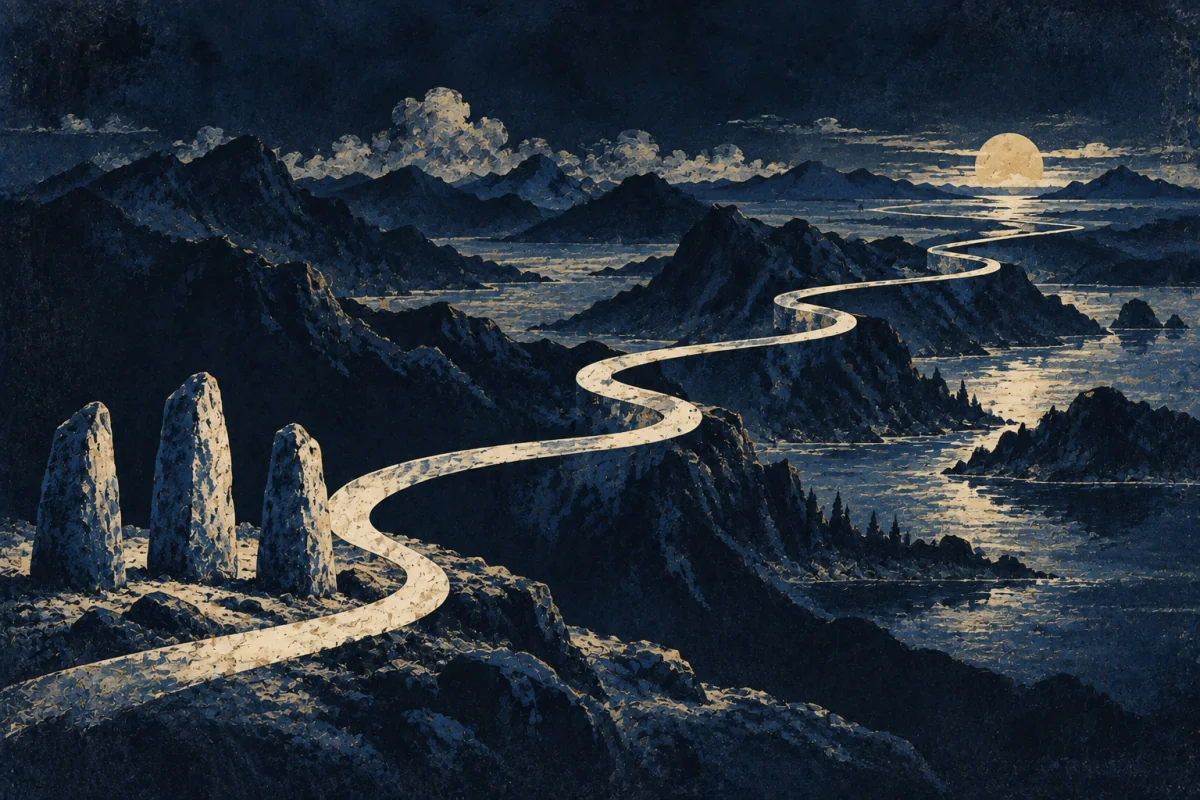
In Plain Sight
Some people are pulled to the far edge of the known map, where the way through has to be built from the ground rather than remembered. The whole journey is held in the head: landmarks, sky, water, the shape underfoot. The line gets revised as the country reveals itself. You'd notice this in the one who can still point home from anywhere.
The Pattern at Work
The route is constructed rather than followed. Standing somewhere nobody has described, the question is which of the available lines will go: this ridge looks continuous and may not be, that valley is easier and may end in something impassable, the ground to the left is harder and is certainly crossable. The choosing is done on what terrain generally does — water finds a way down, ridges connect, scree below a crag means the crag sheds — and it is revised every time more of the country becomes visible.
Position is held continuously and without instruments. Not as coordinates but as a running sense of direction and distance from things: the river is behind and to the left, the big hill is four hours back and slightly north, home is that way. It is built by paying attention while moving rather than by checking, and the people who have it can be woken at three in the morning and still point correctly.
Landmarks are chosen for what they will look like from the other side, which is the part inexperienced people get wrong. A distinctive rock is useless if it is unrecognisable in reverse, so the good ones pick shapes that work from several angles and check what they look like while walking away from them.
And the plan is provisional by design. Anybody rigid about a line will push into something that will not go, so the whole method is committing to a direction and staying loose about the route taken to hold it.
What the Examples Show
It reads as a sense of direction, or as adventurousness, or as somebody who simply does not get lost.
The first element is that terrain is read for what it will do rather than recalled. The route is generated from general principles about how ground behaves, which is why it works in country the person has never seen.
The second is continuously maintained position. Direction and distance from known things are held while moving, unconsciously, and the ability to point home is the visible sign of a whole background process.
The third is that landmarks are selected for their return view. The reading includes what the country will look like coming back, which is an entirely different picture and the thing that kills people who did not think about it.
Going Deeper
Moving through unmapped country is how most human expansion happened, and the people who did it rarely wrote anything down.
Polynesian voyagers navigated open ocean by swell, star and bird over distances that seemed impossible to the people who later mapped it, and the knowledge was held in systems taught by apprenticeship. Aboriginal Australian songlines encode route and country in a form that carries across enormous distances. Arctic peoples read snow form, ice and wind direction to move reliably in landscape with no fixed features. The named European explorers of the eighteenth and nineteenth centuries were, almost without exception, guided by people who already knew the ground and who appear in the accounts as servants. What runs through all of it is that the reading was systematic rather than intuitive. Swell patterns, snow forms and the behaviour of water were taught, tested and argued about, in traditions with vocabulary and apprenticeship, and calling any of it instinct was always a misunderstanding by people who had not been taught.
The costs are stark. The work has always been genuinely dangerous, and the failures are not recoverable: getting it wrong somewhere with no help means dying of something ordinary. The skill has been comprehensively displaced by satellite positioning, to the point where it is now a hobby, and it degrades fast without use. It was systematically uncredited, so the knowledge that made most famous journeys possible sits under somebody else's name. And it suits people who are poorly adapted to staying anywhere, which shapes lives in ways that fall mostly on the people they leave behind.
The Image
The backward look.
Turning round while walking away from a landmark to see what it will look like on the return.
Everybody notices the distinctive rock going out. Almost nobody checks whether it is recognisable from the other side, and from the other side most things are not. It costs four seconds and it is the single habit that most reliably separates people who come back from people who are searched for.
Where It Stops
Liking the outdoors is not this, and neither is being fit. The reading is about generating a route in unfamiliar ground, which is a different skill from following one well.
It goes wrong as overconfidence in country that does not follow the rules. Terrain reasoning works because ground behaves predictably, and in places where it does not — heavily glaciated, karst, ground altered by fire or flood — the same confident reading walks people into trouble.
It also fails as an unwillingness to turn back. The whole method depends on abandoning a line that will not go, and the people this reading kills are almost always the ones who were committed to a route rather than to a direction.
Take the plainer explanation first. Anybody navigating regularly holds position, because the activity requires it. The test is whether it runs without trying — in a city, on a train, underground — and whether they can point home from a place they have never been.
Where It Pays
Inside a job. Expedition and wilderness guiding, mountain and polar work, search and rescue, field science in remote country, surveying and prospecting, military reconnaissance, and documentary and expedition support. Also the planning end of anything that has to operate where maps are poor or out of date.
What is being bought is the ability to operate where the route does not exist yet. Most outdoor competence assumes a path or a plan; when neither is available, the number of people who can produce a safe line through unfamiliar ground drops sharply, and that scarcity is what is being paid for.
Where it pays badly is in guiding generally, which is seasonal and priced against operators who go where the routes are known. It pays badly wherever satellite navigation is assumed to have solved the problem, which is everywhere until it fails, and in research support roles where the person holding the ground knowledge is the lowest paid on the team.
Outside one. Walking, mountaineering, sea kayaking, and the very large amount of this done for nothing by people who simply want to see what is over there. The cost worth naming is that it takes a person away, repeatedly and for long stretches, and the households behind these journeys carry the absence.
Try This
Go somewhere unfamiliar and deliberately do not use a map or a phone.
Before setting off, fix one direction and one distant feature. Then walk for an hour, and every ten minutes stop and point to where you started without thinking about it.
Every time you pass something distinctive, turn round and look at it from the other side.
At the end, check how far off your pointing was. Most people are much closer than they expect, and the ones who are wildly wrong were talking.
Building a route is a tool, not a self. Pick it up where there is no path and somebody has to make one. Put it down when the line will not go, because committing to a route rather than a direction is the specific mistake this reading exists to avoid.
If This Isn't You
Most people follow the path, arrive, and enjoy the day without once wondering what is over the next ridge. Staying on the route is an answer, not a timidity.
Where To Go Next
Its near-twin — Wayfinder. Both know where they are and how to get on. Wayfinder works ground they have a relationship with, and the knowledge is accumulated. This one is in country nobody has described, generating the route from how terrain behaves.
Its shadow — Lamp-Hand. Lamp-Hand gives decades to one small unvarying duty in one place. This one is constitutionally unable to stay, and each regards the other's life as a kind of waste.
Most often confused with — Map-Edge Walker. Both go past where most people stop. Map-Edge Walker is drawn by the unknownness itself and is often uninterested in arriving. This one is solving a route, and the pleasure is in the country going where it was reckoned to.