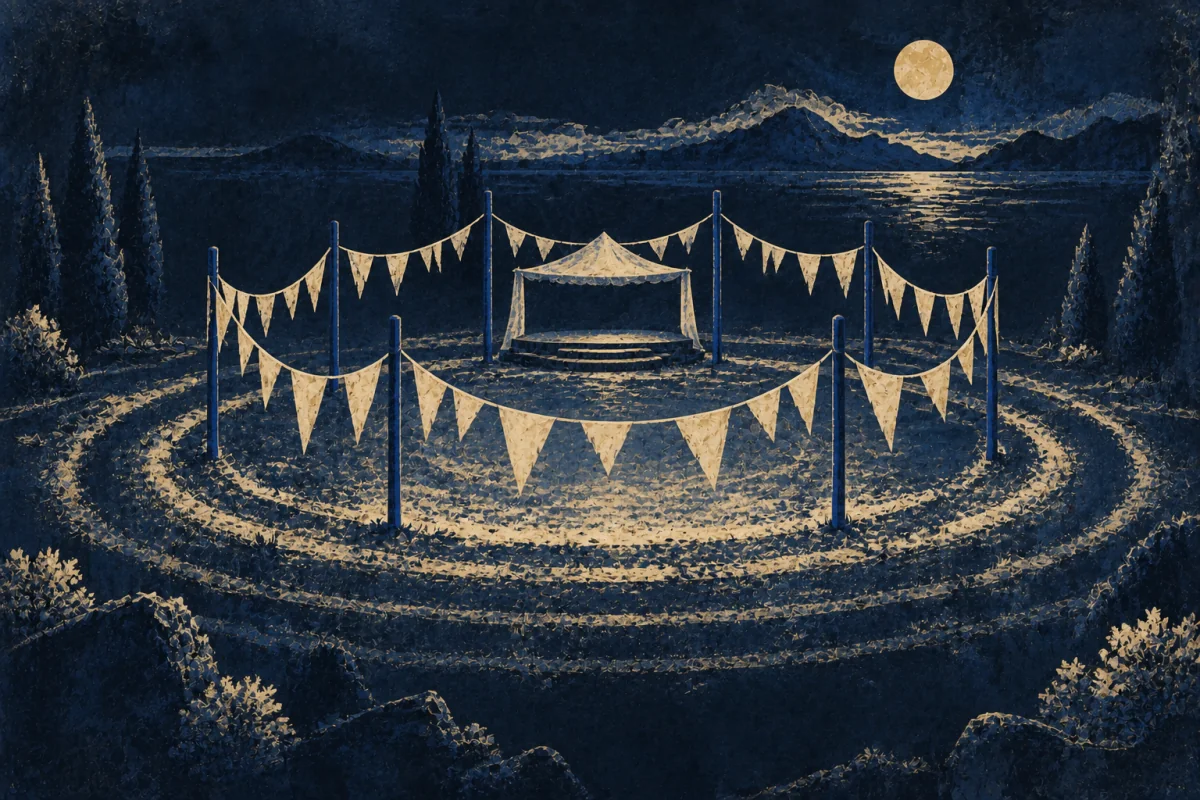
In Plain Sight
Some people build a recurring public gathering. A fair, a festival, a carnival, a set of games, returned to year after year until it becomes part of what a place is. Vendors, permits, music, crowd flow and spectacle all sit in one head, and the same person turns up to do it again next season. You'd notice this in the one whose name is on the founding plaque.
The Pattern at Work
The first year is the easy one. Enthusiasm, favours and novelty carry it, and a great many people can produce one good event. What separates this from running a party is the second year, when the favours have been used, the novelty has gone and somebody has to do the unglamorous work of making it a thing that happens annually.
The apparatus is enormous and invisible. Permits, licences, insurance, road closures, waste, toilets, stewards, first aid, power, and a relationship with a council that has to be rebuilt whenever the officer changes. None of it is interesting and all of it is where these events die. Somebody running one well has a year-round administrative burden attached to three days in August.
Crowd flow is the design problem nobody outside notices. Where people enter, where they queue, where they bunch, what happens when it rains and four thousand people want to be under the same canopy. The layout is doing safety work and atmosphere work at once, and most of the difference between a good site and a bad one is decisions made on a plan in February.
And the whole thing compounds only if it repeats. Year three is where suppliers give better terms, the council stops being difficult, the regulars arrive expecting it and the local objections quieten. Getting there requires running two years at a loss, in most cases funded personally, which is the actual barrier and the reason so few of these things reach their fifth birthday.
What the Examples Show
It reads as event management, or as community spirit, or as somebody who likes throwing a party.
The first element is that the unit is a recurrence rather than an event. Every decision is made against whether it can be done again next year, and the value accrues only through repetition.
The second is that most of the work is administrative and defensive. Permits, safety and relationships with authorities take the bulk of the year, and almost none of it is visible on the day.
The third is that the site layout carries the experience. Flow, queuing and shelter decide how a crowd feels, and they are designed months in advance by somebody who has watched crowds behave badly before.
Going Deeper
Recurring public gatherings are among the oldest civic institutions and they are consistently precarious.
Charter fairs in medieval Europe were granted by licence and ran for centuries, becoming the commercial calendar of whole regions. Carnival traditions across the Mediterranean and the Caribbean were organised by neighbourhood associations that rebuilt themselves annually. Village feast days and highland games were held together by committees whose membership overlapped with everything else in the place. Modern festivals follow the same arc: founded by one or two people, dependent on them for a decade, and either institutionalised or lost at the point where those one or two people stop.
The costs are heavy and mostly carried personally. The financial risk sits with the founder in the early years, and a wet weekend can end both the event and the person's own finances. Liability is real, since the founder is responsible for the safety of thousands of people, and the regulatory burden has grown faster than the resources of small events. The work is seasonal and unrelenting: the year after one event is the year before the next, and there is no quiet season in it. And succession almost never happens, because what holds the thing together is a set of relationships in one person's head, and the second generation inherits a name and not the arrangement. The fairs that ran for four hundred years managed it by becoming legal entities with charters and officers, which is unromantic and is the only mechanism that has ever reliably worked.
The Image
February.
A plan of a field, on a table, with the entrances and the drink queues drawn in.
Nobody at the event will think about it. How long anybody waits, whether the crowd bunches at the wrong corner, where people go when it rains: all of it is decided in that room, six months early, by somebody imagining four thousand people who are not there yet.
Where It Stops
Liking festivals is not this, and neither is being good at parties. The work is recurrence, administration and risk, and the enjoyable part is about two per cent of it.
It goes wrong as growth for its own sake. Each year is expected to be bigger, and somewhere in that the event stops being the thing it was, usually two years before anybody says so out loud.
It also fails as a one-person institution. An event that depends entirely on its founder is an event with a date on it, and the ones that last are the ones where somebody built a committee they found irritating.
Take the plainer explanation first. Anybody running an event handles permits and layout, because the job requires it. The test is whether the person comes back and does it again, for the fourth time, in a year when nobody would have minded if they had not.
Where It Pays
Inside a job. Festival and event direction, venue and site management, local authority events roles, tourism and destination management, sports event organisation, and the production side of arts and music. Also markets and fairs, conference organisation, and the growing business of running recurring gatherings for organisations that cannot do it themselves.
What is being bought is an event that happens again. A one-off is a project; something that recurs for ten years becomes an asset for a town, with a measurable effect on trade, housing and how a place is regarded, and the people who can produce that are few enough to be known by name in their sector.
Where it pays badly is in the founding years, which are typically unpaid and frequently funded personally. It pays badly wherever public funding is awarded for new initiatives rather than for continuing ones, which is a standing problem, and in any arrangement where the founder carries the liability and an institution takes the credit.
Outside one. Village fetes, community carnivals, club fixtures and every annual thing held together by two or three people. The cost worth naming is that those people never attend their own event, and after twenty years they are usually the only ones who remember what it took.
Try This
Take something that happens once and try to make it happen twice.
A gathering, a market, a match, a meal. Anything with more than a dozen people and a date.
Do it, then immediately do the two unglamorous things: write down everything that went wrong while it is fresh, and fix the date for next year before anybody has recovered.
Then do it again, and watch how much easier the second one is and how much less anybody thanks you for it.
That gap is the whole of this work.
Making a thing recur is a tool, not a self. Pick it up where a place would be better for having something to come back to. Put it down when it has become an institution that can carry itself, because staying past that is holding on rather than building.
If This Isn't You
Most people turn up, enjoy the day, and have no idea anybody spent February drawing queues on a map. Not running it is an answer, not an apathy.
Where To Go Next
Its near-twin — Gathering Caller. Both bring a community together around an occasion. Gathering Caller convenes people, often for a particular moment or purpose. This one is building a recurring institution with permits, vendors and a site plan, and the convening is one part of it.
Its shadow — From-Nothing Starter. From-Nothing Starter loves the first year and is bored by the third. This one considers the first year the least important, and the whole value to be in what happens after.
Most often confused with — Stage-Companion. Both run complicated live events. Stage-Companion is executing a timed sequence on the day, from the side, in real time. This one spent the year making the day possible and may not be doing anything visible while it happens.