In Plain Sight
This person keeps one long build going for years, mostly alone. They are not waiting for a team or an audience. They return to it week after week because the whole shape is already clear to them and only the work is missing. You'd find this in the neighbor whose back garden hides something a museum would want.
The Pattern at Work
A retired teacher has been building an orrery in his garage since 2009 — a working model of the solar system, brass, geared, about four feet across, with the outer planets on arms that swing past the car. He is not a machinist and was not one in 2009. He taught himself to cut gears because the gears he needed have ratios nobody sells, and the ratios are not negotiable, since the point of the thing is that Saturn takes twenty-nine years to come round. Nobody commissioned it. He has shown it to perhaps eleven people. When asked how long it will take he says another two years, and has been saying that for a decade, and is not being evasive: the answer keeps being true because the thing keeps growing into the space he has.
A hillside above a Welsh village has been terraced by one woman over twenty-two years, stone by stone, up a slope too steep to get machinery onto. She started it after an illness, with no plan on paper, and she can describe the finished thing exactly — where the water runs, which beds get the last of the evening sun, what the top wall does when the weather comes from the north. Roughly two-thirds exists. Her family have learned not to ask when it will be done. She works most afternoons, and the wall she is building this year was decided in about 2011. The stone comes off the hill itself, which is why a season gains her twenty feet.
What the Examples Show
The quick reading is obsession, said kindly and meaning something unkind. The more interesting fact is one both scenes share: neither is working toward a version they will show anybody.
What is running is an unusually complete picture held privately over a very long time. The picture does the work a client and a deadline do for everybody else: it settles what comes next, and it survives the years when nothing visible happens. That is why the gear ratios are not negotiable and the wall was decided in 2011. There is a specification; it simply has no copy.
The second half is the missing audience. Both could have found one and did not, because the thing is not being made to be received. Attention brings opinions, opinions bring compromises, and a compromise in a private work is not a trade-off but a corruption of the only standard in play.
Going Deeper
Ferdinand Cheval was a French postman who picked up an oddly shaped stone in 1879 and spent thirty-three years building a palace in his garden out of stones he carried home in a wheelbarrow, to a design nobody else ever saw whole. Simon Rodia spent thirty-three years on the Watts Towers in Los Angeles, working alone with hand tools, and then in 1955 gave the lot away to a neighbour and left. Nek Chand built a secret rock garden on government land outside Chandigarh for eighteen years, working after his shifts, knowing it was illegal and could be bulldozed. The Sagrada Família is the institutional version: an architect who knew he would not see it, working at the pace the vision required rather than the pace a life allows.
The common structure is not eccentricity. It is that the work has no external clock. Nothing arrives to say this is finished, this is enough, this is the version we ship, and so completion has to be judged from inside against a picture that only one person holds.
That produces its own erosion, and it is not the one people assume. The danger is not loneliness; most of these builders were sociable enough. It is the absence of correction — twenty years of decisions with nobody able to say that one was wrong, which is liberating for exactly as long as the picture is good. Families pay the difference, in afternoons and in money that went into brass. And the ending is rarely kind. Rodia walked away. Cheval was refused burial in his own creation. This work is usually understood, when it is understood at all, by people who arrive after the builder has gone.
The Image
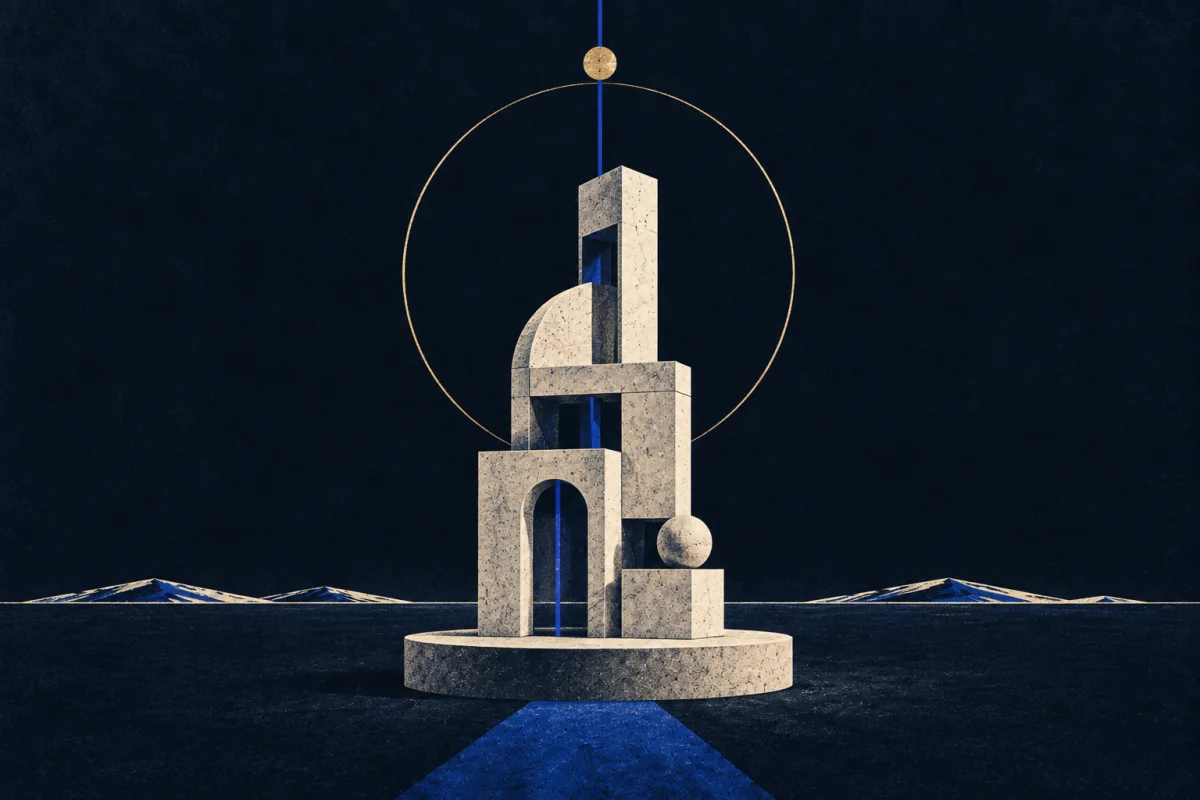
The private commission.
Somewhere there is a client who has specified this thing exactly: its dimensions, its finish, the year it must be right by. The client is not reachable, does not pay, and will not accept a substitute. The client is the person doing the work, which is why the brief has never been written down and has never been unclear.
Hold that up to anything you keep returning to with no audience. Who commissioned it, and what did they actually ask for?
Where It Stops
Having a hobby is not this, and neither is being a perfectionist. A hobby can be put down for a season. This cannot, because the thing is not a way of spending time; it is going to exist.
It goes wrong as a build with no end condition. There is a difference between a work that takes twenty years and one that has quietly become a way of not finishing, and from outside they look identical. The tell is whether the picture grows exactly as fast as the work does.
It goes wrong again as a bill other people pay. Afternoons, money and the absence of somebody present but committed elsewhere are real costs, and the private commission has no mechanism for noticing them.
It also fails anywhere the work must be shared. A vision that cannot be explained cannot be delegated.
Take the plainer explanation first. Any craftsman working to their own standard will look like this on a Sunday. The test is the decade.
Where It Pays
Inside a job. This one sits awkwardly in employment and is worth saying so plainly: the pattern is built for work that has no client. Where it does earn, it earns in the long solitary stretches other people cannot sustain — a lifetime instrument or telescope build, restoration of a single ship or building, a research programme with a twenty-year horizon, archival or cataloguing work at a scale nobody funds properly, the deep and largely unwatched part of a craft. The contribution is that things get made which no schedule would ever have permitted. Museums hold objects that exist only because one person would not stop.
It pays badly under any sprint, and badly again wherever the work must be visible in quarters.
Outside one. Gardens, boats, instruments, model railways, houses rebuilt by hand, archives, the book nobody asked for. This is where the pattern belongs and where most of its results come from. The cost worth naming is the household one above. The second is quieter: a person who has kept one picture steady for twenty years has poured a great deal into something that cannot answer back, and when it is finished — if it is — the day after is genuinely hard, because the client has no second commission ready.
Try This
Take the thing you keep going back to and write down the finished version.
Not a plan. A description of it as it will be: dimensions, materials, how you will know it is done. One page.
Then look at whether the page is complete. If it is, you have a specification and a useful question: what would have to be true for this to be finished in three years rather than thirty. If the page runs out halfway, that is not a failure — the picture is still forming, and the work is partly how you are forming it.
The private commission is a tool, not a self. Pick it up for the work that has no client. Put it down at anything with a deadline and somebody waiting.
If This Isn't You
Most people make things for a reason, finish them, and move on, which is how nearly everything anybody uses came to exist. Feeling no pull toward a twenty-year project in a shed is an answer, not a gap.
Where To Go Next
Its near-twin — Lone Composer. Both work alone for years against a private standard. The Lone Composer makes something that exists to be performed; the solitude is method, not aim. This one's work may never be seen, and that changes nothing about it.
Its shadow — From-Nothing Starter. The From-Nothing Starter also sees a whole thing before it exists, then finds people and money and puts it into the world. This one tells nobody, and would regard the people and the money as the beginning of losing it.
Most often confused with — Row-by-Row Builder. Both work at a pace nothing around them moves at. The Row-by-Row Builder has a pattern and a blanket that will be finished in June. This one has no pattern anybody could follow and no June.