In Plain Sight
Some people treat cord, line and lashing as a medium for thought. A sequence of crossings can hold a load, a count or a record, and the fingers learn the patterns until the knot and its meaning are the same object. A stranger's work can be read back like a paragraph. You'd notice this in the one who cannot pass a loose string without working it.
The Pattern at Work
The hands know a vocabulary and the choosing happens below thinking. A hitch that grips harder under load is not the same as one that can be released while loaded, and both are wrong where the line will be shock-loaded. A knot that will be untied in the rain at night is a different choice from one that will be cut. Somebody who works this way selects in about a second and would need ten minutes to explain the reasoning.
Lashing is where it becomes structural. Three poles and a length of cord make a rigid frame if the wrapping and the frapping are right, and a heap of sticks if they are not, and the difference is a matter of tension and sequence rather than of strength. A good lashing gets tighter as the structure settles, which is a genuine piece of engineering done with hands and string.
The recording half is the part most people have never met. Crossings, spacings and colours can carry counts, dates, accounts and even narrative, and a person who knows the system can read somebody else's cord as information rather than as an object. It is an entire technology of memory that runs on material almost everybody has.
And there is the ordinary compulsion underneath all of it: a loose string is picked up, worked, tied and untied, without any purpose, for as long as it is in reach. Ask why and the answer is usually that the hands were doing it, which is true and is also how the vocabulary was built in the first place.
What the Examples Show
It reads as being handy with rope, or as a scouting habit, or as fidgeting with string.
The first element is that a vocabulary is being used rather than a technique. There are many knots, each with specific properties, and the selection is a judgement about load, release, material and conditions.
The second is that it is structural thinking in a flexible material. Rigidity is produced out of something with none, by sequence and tension, which is a form of engineering that leaves no drawing.
The third is that cord can carry information. Knots record as well as hold, and where a system exists the record is readable by anybody who learned it, which puts this closer to writing than to craft.
Going Deeper
Cord is one of the oldest technologies and has done far more than hold things together.
Inca khipu recorded census, tribute and accounts in knotted cord across an empire, in a system that is still only partly understood and was administered by specialists trained for it. Polynesian navigation and rigging depended on lashing work of enormous sophistication, since a lashed hull flexes where a nailed one breaks. Sailors everywhere carried a working vocabulary of dozens of knots, with whole categories for specific tasks, and the knowledge was trade knowledge rather than folklore. Surgical knot-tying is the same skill under different conditions and is still taught by hand, one person to another, because a diagram has never produced anybody who could do it.
The costs sit in how completely it has been displaced and how little of it was written. Fasteners, adhesives and manufactured fittings removed most of the practical need within a century, so a body of knowledge that was once universal is now a hobby with a few professional survivals. Where it was a notation, as with khipu, colonial destruction removed both the records and the people who could read them, and what remains is largely undeciphered to this day. The knowledge is tacit: knots can be diagrammed but the tension and the finish cannot, so a book produces somebody who knows the shape of a knot and not the knot itself. And it is invisible until it fails, at which point it fails completely and somebody is usually hurt.
The Image
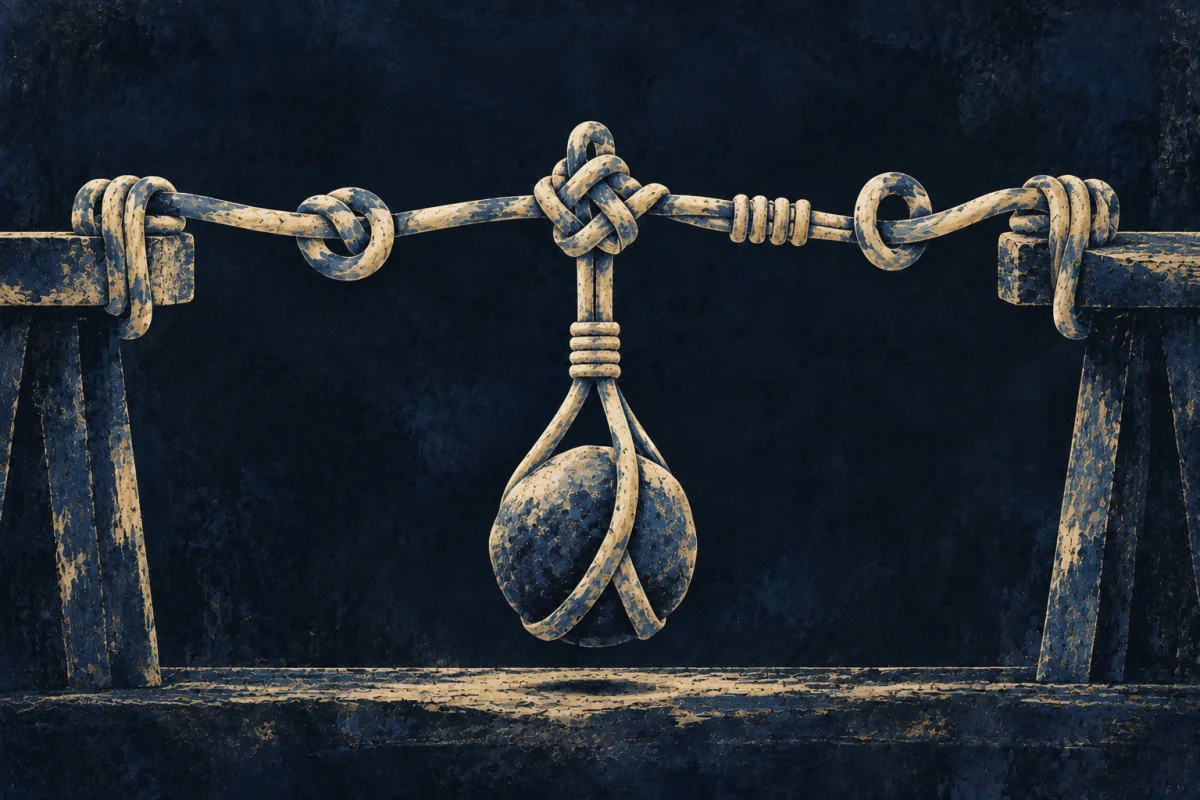
Tighter under load.
A lashing that grips harder the more weight the structure takes.
Nothing about it is obvious and everything about it is deliberate: the direction of the turns, the order, the frapping that pulls the whole wrap in. Done right, the load does the work of holding itself. Done wrong, the same cord and the same poles come apart, and the difference is invisible until the weight goes on.
Where It Stops
Knowing a few knots is not this, and neither is being handy. The distinguishing thing is a vocabulary with reasons attached, and the ability to read somebody else's work.
It goes wrong as over-engineering. A lashing where a screw would do, three knots where one would hold, and a satisfaction in the solution that has stopped being about the problem.
It also fails when the material has changed. Modern synthetic lines behave differently from natural fibre, and knots that held for centuries slip in slick rope, which has caught out a great many experienced people.
Take the plainer explanation first. Anybody who works with rope professionally knows knots, because the job requires them. The test is whether the hands work a string with nothing at stake — a cable, a shoelace, a piece of packaging on a table.
Where It Pays
Inside a job. Sailing and marine work, rigging for theatre, film and construction, arboriculture and rope access, climbing and mountain instruction, rescue services, fishing and net work, surgery, and traditional boatbuilding and thatching. Also anywhere loads are secured for transport, which is a great deal more of the economy than most people notice.
What is being bought is a fastening that does exactly what is needed and can be undone when it must be. The cost of getting this wrong is measured in dropped loads and injuries, and in rope access and rescue it is measured in lives, which is why those trades test it rather than assume it.
Where it pays badly is anywhere it is a small unrecognised part of a larger job, which is most places. It pays badly in the traditional crafts that still depend on it, and there is essentially no work at all in the recording side, which survives now only as scholarship.
Outside one. Boats, camping, allotments, roof racks and every household with something to tie down. The cost worth naming is mild and universal: this person is called whenever anything needs securing, and will redo somebody else's knot in front of them without noticing they have done it.
Try This
Learn three knots for their properties rather than their shapes: one that holds a loop that will not slip, one that grips a rail and can be undone under load, and one that joins two ropes of different thickness.
Then use each one on something real that has weight on it.
Then, a week later, untie them. How easily a knot comes undone after a week under load is most of what distinguishes a good choice from a bad one, and nobody ever tests for it.
Working in cord is a tool, not a self. Pick it up where something has to hold and then let go. Put it down where a bolt would be safer, because a lashing chosen for the pleasure of it is a load waiting to fall.
If This Isn't You
Most people tie a knot, it holds or it does not, and they get on with the day without ever learning a second one. Not seeing cord as a medium is an answer, not an incompetence.
Where To Go Next
Its near-twin — Sea-Hand. Both live in line and lashing. Sea-Hand works a whole deck, where knots are one part of gear, catch and weather. This one is interested in the cord itself, and would be found tying things a long way from any boat.
Its shadow — Tally-Hand. Tally-Hand keeps counts on paper or in notches, where the record is plainly a record. This one puts the count into something that is also a working object, and the two purposes are not separable.
Most often confused with — Steady-Hand Mender. Both do precise work with the fingers. Steady-Hand Mender is restoring something to how it was. This one is building a temporary structure that is meant to be taken apart again.