In Plain Sight
Some people are held by the long arc of forge work. Fire, metal, hammer, water, and a competence that accumulates across decades and then has to be handed forward intact. Heat is read by colour, steel by sound, and a student by the hand on the tongs. You'd notice this in the one still correcting an apprentice's grip after fifty years at it.
The Pattern at Work
The reading is sensory and fast. Colour in the fire says temperature within a narrow band, and the right colour for one steel is the wrong colour for another. Sound says as much: a piece that rings differently under the hammer has changed inside, and the change happens before anything is visible. Somebody with decades of this is adjusting continuously on information that arrives through eyes, ears and the weight coming back up the handle.
Timing governs everything else. Metal is workable for a short window and then it is not, so the sequence has to be planned before the piece goes into the fire, and a hesitation costs a heat. That is why experienced smiths look unhurried: everything has already been decided, and what looks like calm is the absence of anything left to think about.
The teaching is inseparable from the work. An apprentice stands at the next anvil for years, and most of the instruction is one sentence at a time while both are working. What gets corrected first is almost never the technique. It is the grip, the stance, where the feet are, how the body is set up to deliver a blow, because everything else is built on those and a bad habit learned early will limit somebody for thirty years.
And the timescale is the point. The craft is longer than any working life, so the material at the end of a career includes things learned from somebody now dead and handed to somebody who will use them long after.
What the Examples Show
It gets read as blacksmithing, or as traditional craft, or as somebody who has been doing the same thing for a very long time.
The first element is that the reading is multi-sensory and continuous. Colour, sound and the feedback through the hammer are all being used at once, and none of it transfers from a book.
The second is that everything is decided before the heat. The visible work is execution of a plan made in advance, which is why competence in this trade looks like slowness.
The third is that transmission is built into the practice. The apprentice at the next anvil is not an addition to the work; the craft only exists in a form that can be handed on by working alongside, and a generation missed is a generation lost.
Going Deeper
Smithing is among the oldest specialised trades and has been repeatedly reduced to a fraction of its former size.
Village smiths were essential to agricultural economies everywhere, making and repairing everything a settlement needed, and the position carried real standing. Japanese swordsmithing formalised a lineage system in which techniques passed through named schools with long apprenticeships. West African smiths held social positions distinct from other trades, often hereditary and often set slightly apart from everybody else. Industrial production removed nearly all of it within a century, leaving architectural ironwork, tooling, bladesmithing and restoration as the surviving fragments. What went with the village smith was not only the making. It was a place where a child could stand and watch for ten years without anybody arranging it, and nothing has replaced that.
The costs sit around scarcity and transmission. There are very few full-time positions, so most people practise at a small scale, teach, or do something else for money. The training cannot be shortened, which sits badly with every modern funding model and every employer's timescale, and a four-year course produces somebody at the beginning rather than the end. The work is physically punishing — hearing, lungs, backs, burns — and the damage accumulates invisibly for twenty years before anybody names it. And the knowledge is fragile in the exact way that matters: a technique that skips one generation is not recovered from photographs, and several have already gone that way, reconstructed afterwards by people guessing intelligently from finished objects.
The Image
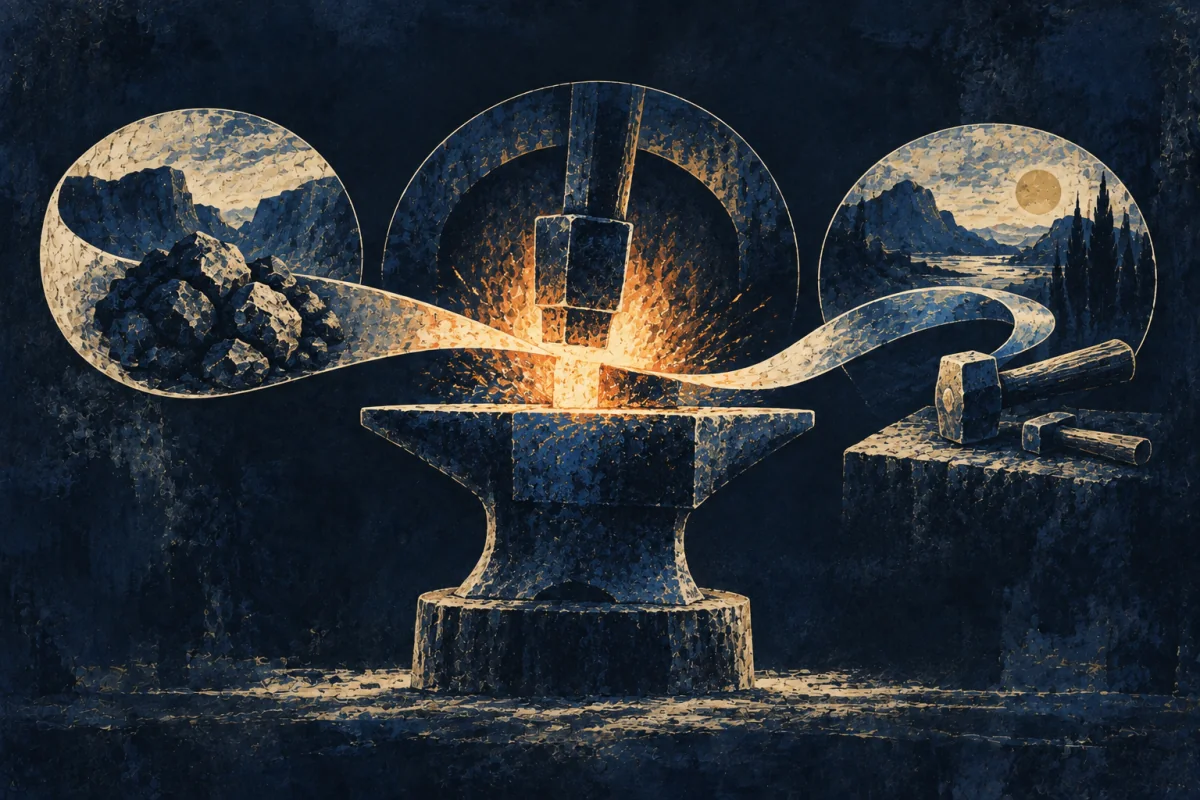
The grip.
The first correction an apprentice receives, and the one that gets made again for five years.
It has nothing to do with the object being made. It is where the hand sits, how the hammer is allowed to fall, whether the shoulder is doing work the arm should. Everything that comes later is built on it, and a smith with a bad grip will be fighting their own body at sixty for something nobody corrected at twenty.
Where It Stops
Liking hand tools is not this, and neither is enjoying making things in metal. The reading takes years to build and most of it is unavailable to somebody working alone from videos.
It goes wrong as reverence for the old way. Some traditional methods are superior and some are simply what was available, and a smith who cannot tell the difference will spend a career doing things the hard way and calling it integrity.
It also fails as a refusal to make a living. There is a strong pull towards work that is beautiful and unsellable, and a shop that cannot fund itself stops existing, which takes the teaching with it.
Take the plainer explanation first. Anybody working a forge reads colour and sound, because the material demands it. The test is whether the attention appears away from the fire — in the sound of any struck thing, in how somebody else is holding a tool.
Where It Pays
Inside a job. Architectural and artistic ironwork, bladesmithing, toolmaking and specialist manufacture, farriery, restoration and conservation of historic metalwork, film and theatre armoury, and teaching within all of them. Also heavy industry roles where forging knowledge is still needed, and metallurgical and failure analysis work that benefits from somebody who has actually worked the material.
What is being bought is judgement about material that instruments describe and do not replace. A smith who can tell by sound and colour what a piece is doing brings something a specification cannot supply, and in restoration and one-off fabrication that judgement is the entire commission.
Where it pays badly is throughout the craft side, where hours are long, commissions are irregular and clients compare hand-forged prices with manufactured ones. It pays badly in teaching, which is what actually keeps most smiths solvent, and in any arrangement that treats a decade of training as equivalent to a short course.
Outside one. Small forges, historical societies, community workshops and the very large amateur world that now carries much of the craft. The cost worth naming is that the knowledge sits in a small number of people, and each one who stops without an apprentice takes a piece of it away permanently.
Try This
This works without a forge. Take any repetitive physical skill you have and look at the foundation rather than the technique.
Find somebody who does it well and watch only their feet, their grip and their shoulders. Not what they are making. How they are standing.
Then do it yourself and check your own stance against theirs.
Almost everybody discovers a habit they cannot remember acquiring, and that is the thing a proper apprenticeship would have caught in the first month.
Working the long arc is a tool, not a self. Pick it up where something takes decades and has to outlive you. Put it down where nobody is coming after, because a craft held by one person who teaches nobody is already finished.
If This Isn't You
Plenty of people admire the work, buy the object, and have no wish to spend fifteen years learning to hear steel. Not wanting the long arc is an answer, not a shallowness.
Where To Go Next
Its near-twin — Steel-Smith. Both work hot metal to a high standard. Steel-Smith is focused on the piece and on getting this one right. This one is focused on a craft that has to arrive intact in another century, and the piece is partly a teaching instrument.
Its shadow — Bench-Improviser. Bench-Improviser solves the problem in front of them with whatever is to hand and owes nothing to tradition. This one is carrying a method, and improvising is the thing that loses it.
Most often confused with — Craft-Passer. Both hand a trade to the next generation. Craft-Passer will teach whatever skill they have to whoever will learn. This one is tied to a specific long craft and is at the bench for decades whether or not anybody is watching.