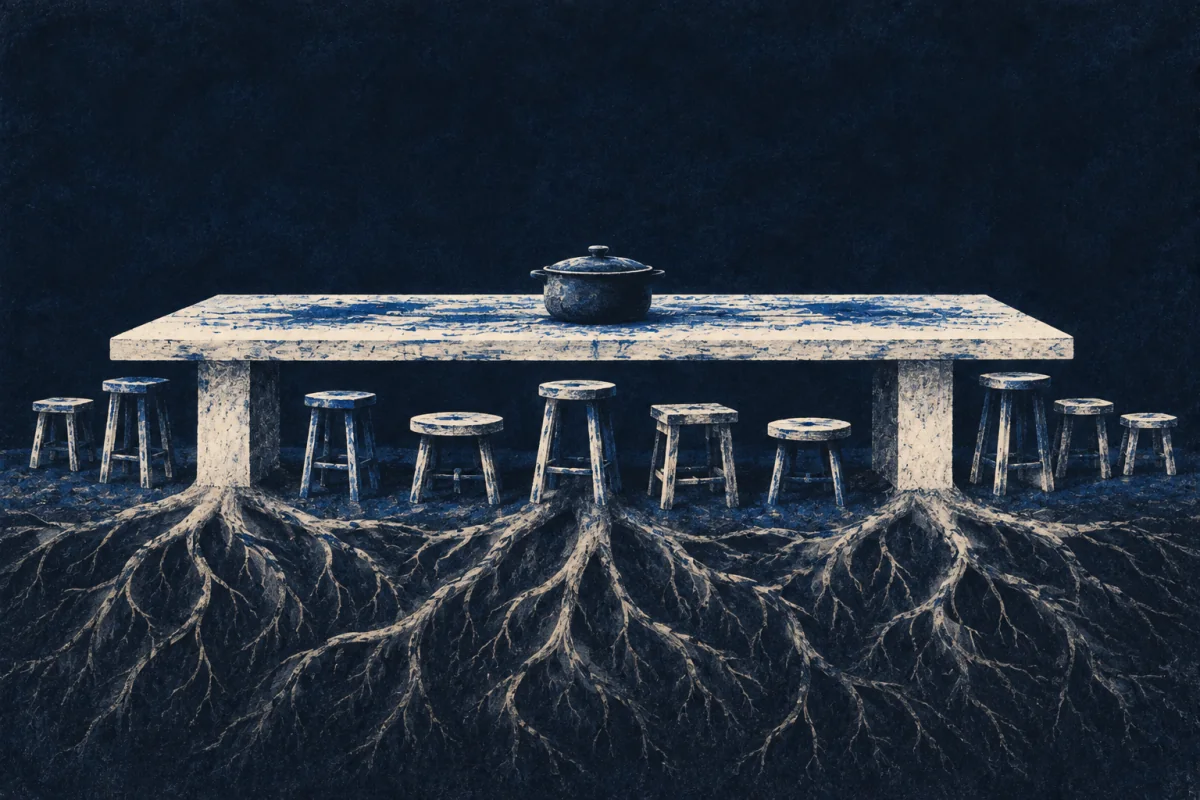
In Plain Sight
Some people hold a household together not for a season but for decades. Births, deaths, weddings and returns, all routed through the same kitchen. Who needs what, who is owed what, who is drifting: all of it is tracked, and the long arrangement gets adjusted quietly. You'd notice this in the one whose recipes are still being cooked after she has gone.
The Pattern at Work
The unit is a family across generations, and the work is keeping the connections live. That is done through a running set of small approaches: the call made to the nephew who has gone quiet, the invitation issued to the in-law nobody else would think of, the visit timed for the week somebody will be at their worst. None of it looks like anything. Over forty years it is the difference between a family and a set of people with a surname in common.
The ledger is the part nobody sees. Who helped whom in 1987 and has never been repaid. Which two have not spoken since a funeral and why. Who is struggling and will not say. Who is the one everybody assumes is fine. Somebody holding this has an accurate and entirely unwritten account of several dozen relationships, including their history, and adjusts what is asked of each person accordingly.
Occasions are the instrument. A family that gathers stays a family, so the gatherings are engineered: who is seated where, who is asked to bring what so they have a role, which year somebody is quietly not invited because it would be worse for everybody. The kitchen is where this is decided, usually by one person, and mostly without discussion.
And the transmission runs alongside. Recipes, stories, how things are done here, who we are: it is handed to whichever grandchild is standing at the elbow, and it is entirely deliberate even when it looks like nothing more than cooking.
What the Examples Show
It reads as being the heart of the family, or as somebody who likes having everybody round, or as what grandmothers do.
The first element is that the timescale is generational. Decisions are made about relationships that will matter in thirty years, and the results are not visible for most of that time.
The second is that an unwritten ledger is being kept. Obligation, history and need across dozens of people are tracked continuously, and almost none of it is ever stated aloud.
The third is that the work is done through occasions and small approaches rather than through conversation. Nothing is addressed directly; a visit, an invitation or a job at a gathering does the work that a discussion would make worse.
Going Deeper
Holding an extended family across generations has been one of the largest unpaid jobs in most societies, and it has almost never been named as one.
Joint family households across South Asia gave a senior woman authority over food, money, marriages and disputes for twenty or more people, formally recognised within the household and invisible outside it. Italian, Greek and Irish families have run the same arrangement without the formal recognition. Matrilineal and matrifocal households across West Africa and the Caribbean put the same role at the structural centre of a family rather than at its edge. Anthropologists have a name for the pattern, kin work, and it is remarkably consistent: one person doing most of it, usually unacknowledged, and everybody else able to name exactly who it is.
The costs are consistent too. It is unpaid, unending and invisible, and the person doing it is assumed to enjoy it, which forecloses the question of whether they would like to stop. It absorbs an enormous amount of a life, particularly the years after children have left, which is exactly when somebody might otherwise have had time of their own. It falls overwhelmingly along one line in most families rather than being shared. And there is no succession: the role is not handed over, it is discovered vacant, and families typically fall apart within a few years of the person who held it dying, which everybody finds surprising and nobody predicted, although it is the most predictable thing about the whole arrangement.
The Image
The call to the nephew.
Made for no reason, every few months, to somebody who has gone quiet and is not going to call first.
Nothing is discussed and nothing is resolved. It takes eleven minutes. It is why that person is still at the funeral in twenty years, and it was made by somebody keeping an account nobody else knew existed.
Where It Stops
Being sociable is not this, and neither is hosting well. The work is a long account of many relationships and a steady set of interventions in them.
It goes wrong as control. The same person who holds a family together can decide who belongs in it, and a family with one centre can be a very hard place for anybody who does not fit the arrangement.
It also fails as self-erasure. The role can absorb a person completely, and there is a common and quiet version of this where somebody has no life outside it and has stopped noticing that they wanted one.
Take the plainer explanation first. Somebody in every family does the organising, often whoever is nearest. The test is whether the ledger extends past obligation — to people they gain nothing from, in branches of the family that would never notice if they stopped.
Where It Pays
Inside a job. Community development and outreach, care coordination, family and social work, school family liaison, alumni and membership relations, congregational and pastoral work, and the long relationship side of fundraising. Also any role in a small organisation that depends on somebody holding the history of who is connected to whom.
What is being bought is a network that stays intact over years. Organisations routinely discover that their relationships all ran through one person and that nothing survived their leaving, which is the same failure families have, and the ones that understand it pay to keep such people rather than treating them as administrative. What is being retained is an account of who is connected to whom, which cannot be rebuilt from records.
Where it pays badly is in the family itself, which is unpaid by definition, and in workplaces where relationship work is invisible next to measurable output. It pays badly wherever this is treated as a personality rather than a function, which means it is never in a job description and never replaced.
Outside one. Families, congregations, villages, long friendships and diaspora networks held together across continents. The cost worth naming is succession: nobody is trained, nobody volunteers, and a family usually finds out how much was being carried at exactly the moment it stops.
Try This
Write down every person in your extended family or wider circle, then mark the ones you have not spoken to in a year.
Then mark who would notice if you never spoke again.
Pick two from the first list and make contact for no reason at all. Not an invitation, not an occasion. Eleven minutes.
Then do it again in three months to the same two people. The second call is where this actually starts, and almost nobody makes it.
Holding a family is a tool, not a self. Pick it up where people who share a history would otherwise drift apart. Set it down in pieces, deliberately, because the version that depends entirely on you ends when you do.
If This Isn't You
Plenty of people love their family, see them when they see them, and let the connections take care of themselves. Not keeping the ledger is an answer, not a coldness — though it is worth knowing who is keeping it.
Where To Go Next
Its near-twin — Order-Of-The-Hearth. Both hold a household. Order-Of-The-Hearth runs it as an operation — money, schedules, standards, logistics. This one runs the relationships across generations, and may be indifferent to whether the calendar works.
Its shadow — Inner-Walker. Inner-Walker turns inward and needs long stretches alone. This one is oriented entirely outward, at several dozen other people, and rarely examines their own position in it at all.
Most often confused with — Gathering Host. Both bring people together. Gathering Host is making an occasion work while it is happening. This one is using occasions as a tool over decades, and cares much more about who came than about how the evening went.