In Plain Sight
In a group, they turn skill into something another person can practice. They are not just showing off what they know. They break the work into steps because a skill grows through repeated tries. You'd recognize this in the neighbor who fixes the loose chair slowly, making someone else hold the tool for the final turn.
The Pattern at Work
Showing somebody how to do a thing and teaching them to do it are different activities, and only one of them leaves the room with two people who can.
A chair with a loose leg, and a neighbour who could have fixed it in four minutes. He takes twenty-five. He does the awkward part himself — getting the old glue out, which requires knowing how much force the joint will take — and then hands over the clamp and the final turn, and lets it be done slightly wrong before saying anything. The chair is mended. More usefully, the person holding the clamp now knows what too tight feels like in the wrist, which cannot be described and has to happen once.
A kitchen, a new commis, and a cut she has been fumbling for a week. The chef does not demonstrate faster. He clears the board of everything except one onion, takes the knife away, and has her do the movement with an empty hand forty times while he watches the elbow rather than the fingers. Then the knife goes back. The problem was never the blade.
A climbing club on a Tuesday evening. The instructor teaching a knot asks each person to tie it deliberately wrong first, and then to pull on it and watch it fail on the mat, where failing costs nothing. Everybody laughs. Nobody in that room will ever tie it wrong without noticing, because they have seen what wrong looks like from the outside, which is information that a correctly tied knot simply does not contain.
What the Examples Show
Read quickly, this is patience and generosity, and all three have both. Neither explains the forty empty-handed repetitions or the deliberately bad knot.
What is running is decomposition. A skill that looks like one movement is broken into a unit small enough to be repeated, failed at, and felt — and the unit chosen is almost never the one the learner thinks they are struggling with. The commis believed the problem was her grip. The elbow was upstream of the grip, and no amount of practice on the grip would have reached it.
The second half is handing over the moment of consequence. In each scene the teacher deliberately gives away the part where it can go wrong: the final turn, the knife, the knot that fails. That is uncomfortable and it is the whole method, because a skill is not transferred by watching. It arrives in the hands of somebody who was allowed to get it wrong while it still cost nothing.
Going Deeper
The guild answer to this ran for centuries and was brutally simple: put the learner in the workshop for seven years and let the work teach them, with a master responsible for the result. Nothing was written down. The sequence was managed by what the apprentice was allowed to touch, which moved outward from the sweeping to the fitting to the finishing as the cost of their mistakes could be absorbed.
Japanese craft traditions formalised the same thing from the other end. A minarai learns by watching before being permitted to do, and the phrase used is closer to stealing the skill with the eyes than to being taught it — which sounds mystifying until one notices that the master is controlling exactly what is visible, and in what order. Medicine compressed it into a slogan, see one, do one, teach one, and the third term is the important one: nobody is held to have the skill until they have handed it on.
All of it costs the person doing the passing in the same currencies. The work goes slower and looks worse while a learner is on it, which is a visible price paid against an invisible return. The learner's mistakes land on the teacher's name, and in a trade with any liability attached that is not a small thing. And the whole aim is to become unnecessary, which most institutions reward poorly and some punish, since the indispensable person is the one who kept the knowledge in their own hands.
The Image
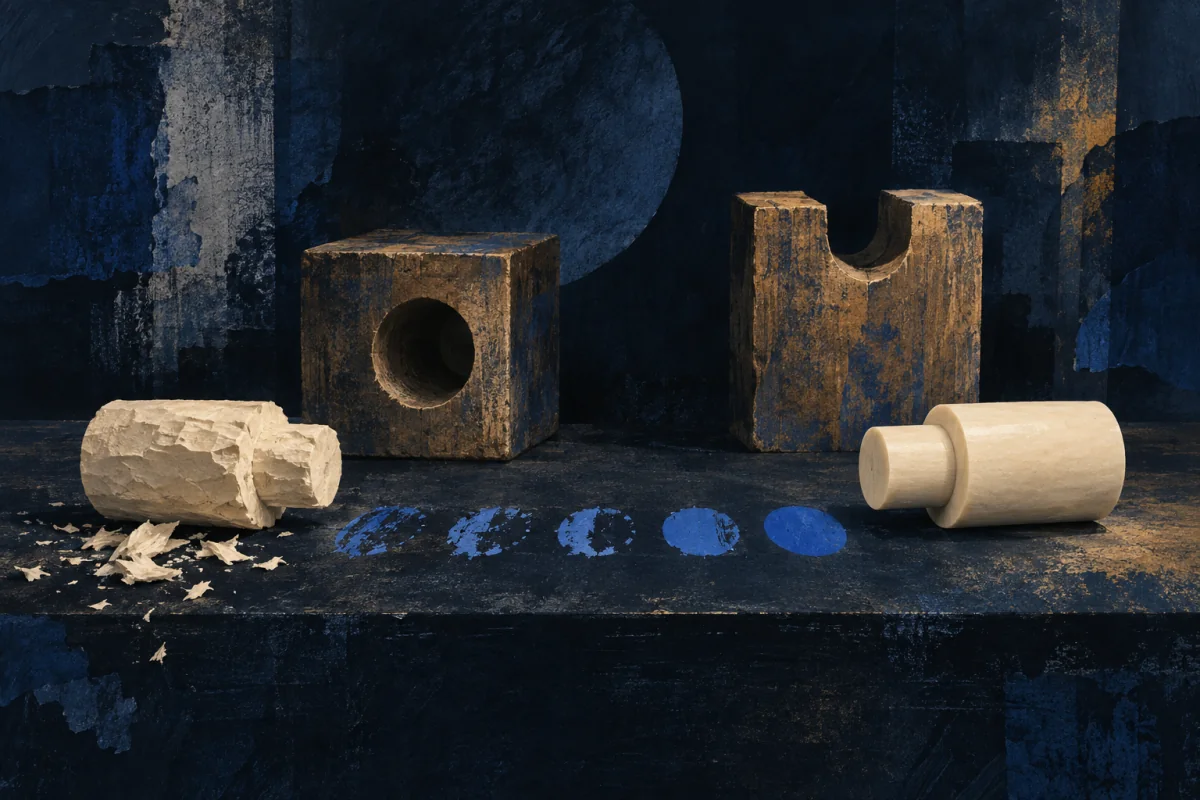
The last turn.
The tempting thing is to do the difficult part and let somebody watch. The useful thing is the reverse: do the part that needs judgment, and hand over the turn where the thing either holds or does not.
It is a small transfer and it feels like nothing. It is the only part of the afternoon that ends up in somebody else's hands.
Where It Stops
Being good at something is not this, and neither is enjoying an audience. A demonstration is a performance, and the reliable sign is whether the other person's hands moved at all.
It goes wrong as never letting the difficulty land. A learner protected from every consequence acquires confidence and no skill, and finds out which they have at the worst possible moment.
It goes wrong the other way as decomposing what should be left whole. Some things are learned by doing the entire thing badly a hundred times, and breaking those into drills produces somebody excellent at drills.
It also fails where nobody wants to learn. This pattern will start teaching a person who only asked for the chair to be fixed, and that is tiring for one of them and faintly insulting to the other.
Take the plainer explanation first. Any trained instructor does all of this because the training is this. The test is whether it appears with no class, no fee, and a job that would be quicker done alone.
Where It Pays
Inside a job. Trades and apprenticeships, clinical and surgical training, aviation and marine instruction, laboratory technique, machine operation, and every workplace where one person holds a skill and the rota assumes they always will. The contribution is not that people learn faster, though they do. It is that a capability stops living in one pair of hands, which changes what an organisation can survive — illness, resignation, retirement — and is invisible until one of those happens.
It pays badly wherever the measure is this week's output, and badly again where the skill is genuinely simple and a demonstration would have done. Any trade with a shortage of people usually turns out to have a shortage of this instead, since the skill existed and nobody was handing it over.
Outside one. Driving, cooking, instruments, languages, DIY, swimming, and the long business of teaching a child something a parent can do without thinking. The cost worth naming is time, and it is not a small multiple: a thing done properly with a learner takes four or five times as long and looks worse at the end. The second is subtler. Watching somebody be shown rather than taught becomes physically uncomfortable, and most of what passes for teaching in ordinary life is showing.
Try This
The next time you are about to do something in front of somebody who would benefit from being able to do it, stop before the last step.
Pick the smallest part that has a consequence attached — the turn, the cut, the knot — and hand it over. Say nothing while they do it. Let it be slightly wrong before you speak.
Then ask them what it felt like, not whether they understood. If the answer is about a sensation rather than a rule, the thing has landed.
The last turn is a tool, not a self. Pick it up where somebody will need the skill again. Put it down when they only wanted the chair fixed, which is most of the time and is a perfectly reasonable thing to want.
If This Isn't You
A great many people are excellent at things and simply do them, and the world runs on that far more than it runs on anybody's teaching. Feeling no urge to hand over the clamp is an answer, not a gap.
Where To Go Next
Its near-twin — Route-Changer. Both find where somebody has stopped being able to follow. The Route-Changer works on understanding and rebuilds the road to it. This one works on a skill that lives in the hands, where explaining is often the least useful thing available.
Its shadow — Audience-Singer. The Audience-Singer's skill exists to be watched, and a room that could do it too would be beside the point. This one's skill exists to be copied, and counts the evening a failure if nobody else's hands moved.
Most often confused with — Row-by-Row Builder. Both work slowly with their hands and will not be hurried. The Row-by-Row Builder is making the thing. This one is making somebody who can make the thing, and will accept a worse chair to get it.