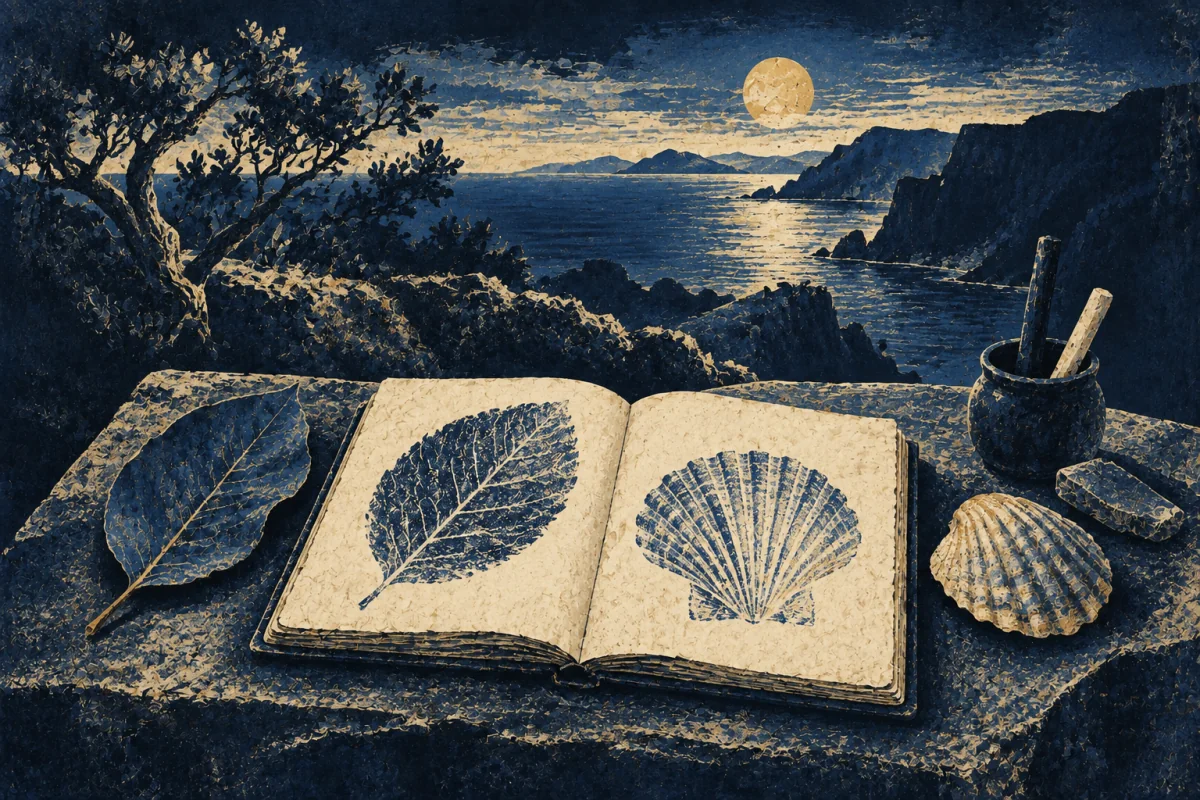
In Plain Sight
Some people look at a thing until it can be set down on paper. A specimen, a body, a coastline, held in view while the hand records what the eye has actually verified. It is patient, exact, and unhurried by any wish to interpret. You'd notice this in the one whose field notebooks outlive the field they were made in.
The Pattern at Work
The looking comes long before the drawing. A specimen is turned, held to the light, compared with the one beside it, and only then does anything go on paper. What is being established first is what is actually there as against what is expected to be there, and the two differ constantly. Most people draw the leaf they remember. The whole discipline is drawing the leaf in front of them, including the part that is wrong, damaged or not like the description in the book.
The hand works slowly and does not improvise. Vein by vein, and where something cannot be seen clearly it is left out rather than guessed, because a guess on a plate becomes a fact in somebody else's paper a decade later. That restraint is the difference between a record and an illustration, and it is why this work is trusted.
Accumulation is part of the method. The same species drawn forty times from forty individuals produces something no single image does: a sense of the range, of what varies and what never does. Somebody at this for years has notebooks that constitute a survey, usually without having set out to make one.
And the notebooks outlast almost everything else. Conditions change, specimens are lost, coastlines move, and a dated drawing made by somebody careful becomes the only evidence of what was there. Plenty of nineteenth century plates are now cited in papers about decline, by authors who have nothing else to compare against, and none of them were drawn with that in mind.
What the Examples Show
It reads as being good at drawing, or as a scientific hobby, or as patience with small things.
The first element is that drawing is used as a way of looking rather than as a way of making pictures. The output matters, and the mechanism is that the hand forces the eye to check everything.
The second is restraint about interpretation. What is uncertain is left uncertain, and nothing is tidied, which is what distinguishes a record from an illustration and is the hardest habit to acquire.
The third is that the value accrues across a series. One plate is a picture; four hundred dated plates of the same subject are a body of evidence, and the person making them is usually the last to describe it that way.
Going Deeper
Drawing as record built most of the natural sciences and is now largely unfunded.
Maria Sibylla Merian went to Suriname and drew insects through their whole life cycles, which is where the evidence was. Botanical and zoological illustrators produced the plates that describe most named species, and type descriptions still rest on them. Medical illustration did the same for anatomy, and surgical teaching depended on it for centuries, long after cameras existed. Survey and expedition artists recorded coastlines and landforms before photography, and those drawings are now the baseline against which change is measured. In every one of those fields the drawing was not an illustration of the finding. It was how the finding was arrived at, and the plate was the evidence rather than a picture of it.
What has happened to the practice, and what it costs its practitioners, is consistent. Photography was assumed to replace it and did not: a camera records everything including the irrelevant, while a drawing shows what matters and omits what does not, which is a judgement no lens makes. Despite that, funding moved to imaging, and illustration posts have been cut almost everywhere. The work is slow and paid by the plate, which makes the effective hourly rate poor. Credit is thin, since the illustrator is usually a line in an acknowledgement while the describing author takes the species. And it requires access to material and to specialists, so somebody working outside an institution has very little to draw and nobody to check it with.
The Image
The part left blank.
A section of the drawing where the structure could not be seen clearly, left unfinished rather than completed from memory.
Every instinct is to close it up, and closing it up is what turns a record into a decoration. The blank is the honest part, and it is what makes everything around it usable by somebody who was not there.
Where It Stops
Being able to draw is not this, and neither is liking nature. The work is verification through the hand, and it is defined by what is refused rather than by skill.
It goes wrong as pedantry without a subject. Accuracy for its own sake can produce four hundred beautiful plates of something nobody needed recorded, while the thing that was disappearing went undrawn.
It also fails where speed matters. Some situations need a photograph and a note, and a person committed to the slow method can spend an afternoon on one specimen while the tide comes in.
Take the plainer explanation first. Anybody employed as an illustrator draws accurately, because that is the commission. The test is whether it happens with no purpose attached — a dead bird on a path, a rock, a plant in somebody else's garden.
Where It Pays
Inside a job. Scientific and natural history illustration, medical and surgical illustration, archaeological and forensic drawing, museum and conservation recording, cartographic and geological illustration, and technical drawing for publication. Also fieldwork in taxonomy and ecology, where the recording and the science are done by the same person.
What is being bought is a record that shows what matters. Photographs are cheap and full of noise; a drawing is a considered statement about which features are diagnostic, and in taxonomy, surgery and archaeology that judgement is the entire value. It also produces something a photograph cannot: an image that can be reproduced cleanly at any size, in print, in the field, on a page somebody is holding in the rain.
Where it pays badly is almost everywhere now, since budgets moved to imaging and the remaining posts are few. It pays badly on per-plate rates that ignore the hours of looking, and in any project that treats illustration as decoration added after the findings rather than as part of producing them.
Outside one. Notebooks, natural history societies, amateur recording schemes, and the long tradition of careful private observation that has produced a surprising share of the record. The cost worth naming is that this work is slow enough to require a life arranged around it, which usually means another income, and a tolerance for spending an afternoon on one shell.
Try This
Take one small thing — a leaf, a shell, a bone, a screw — and draw it for forty minutes.
Do not stylise and do not improve. Where you cannot see something clearly, leave it blank rather than filling it in.
Then put the drawing away and go back to the object. You will see three things you missed, which is the whole point of the exercise.
Date it. In ten years it will be the only evidence of what that thing looked like.
Recording by hand is a tool, not a self. Pick it up where a thing has to be understood rather than merely captured. Put it down when speed matters more than judgement, because there a photograph is the honest answer.
If This Isn't You
Most people photograph the thing, look at it later or not at all, and get on with the day, which is a reasonable use of a phone. Not drawing it is an answer, not an inattention.
Where To Go Next
Its near-twin — Field-Naturalist. Both look closely at living things and keep records. Field-Naturalist is after what is happening and will record it in any form. This one is specifically recording what a thing looks like, and the drawing is how the looking is done.
Its shadow — Image-Maker. Image-Maker is making a picture and will change what is there to make it better. This one would rather leave a gap, and each finds the other's priorities slightly incomprehensible.
Most often confused with — Sound-Witness. Both capture things before they are gone and attach dates to them. Sound-Witness takes what happens without altering it. This one has to decide what matters and leave the rest out, which is a judgement a recording never makes.