In Plain Sight
Some people hold a wood in their head as a running account. They count stems, mark which trees come out this winter, and watch how much light reaches the ground once a gap opens. What is taken is always weighed against what grows back in its place. You'd notice this in the one who can say what the same hillside looked like before the last cut.
The Pattern at Work
A wood is not a crop that comes in. It is a crop that comes in across a lifetime, and whoever keeps it has to hold the whole arc in mind at once.
Walking a compartment in winter, the work looks like very little: a slow pass with a can of paint, a mark on this stem and not on that one. What is actually happening is a calculation about light. Take out the wrong three trees and the gap closes over in four years with nothing worth having in it. Take out the right three and the neighbours put on width for two decades. The person marking is reading crown shape, lean, the ground under each tree and the age of the whole stand, and the mark goes on in about six seconds, because the reading was done on the way up the ride.
The count matters as much as the cut. Stems per hectare, roughly, arrived at by pacing and by eye rather than by survey, along with a sense of how that number has moved since the last thinning. It is held loosely and it is held accurately, and it is the thing that stops a wood being emptied one reasonable decision at a time. Somebody who keeps woodland this way can usually say what a compartment will yield in fifteen years and be roughly right, which nobody working from a spreadsheet and no boots can do. The number is never exact and it does not need to be, because the decisions it feeds are decisions about direction rather than about volume, and being roughly right every winter for thirty winters beats being precisely right once.
What the Examples Show
It reads as being good with trees, or as patience, or as country instinct.
Three things are running. The first is arithmetic held in the body: a stem count arrived at by walking and looking, accurate enough to make real decisions on and never written down until somebody asks for it.
The second is that the unit of attention is the stand, not the tree. Any single tree is a line in a larger account, and the question asked about it is always what its removal does to everything around it.
The third is the timescale. A decision made this winter pays out in the 2050s, which means the feedback loop is longer than a working life. The only way to learn it is to inherit somebody else's woodland along with their notes, which is why the knowledge travels in families and institutions rather than in courses.
Going Deeper
Managed woodland is one of the oldest running accounts there is, and almost none of it was ever kept on paper.
Coppice woods in England were cut on seven to fifteen year cycles for six hundred years, each compartment a different age so that every single year something came out. The satoyama woodlands of Japan ran the same logic beside villages, supplying fuel, fodder and leaf mould on a rotation nobody had to be told about. German forestry turned the idea into a written science in the eighteenth century, and the standard term for sustained yield is still a German word. Swedish family forests are still held on the plain assumption that whoever plants will not be there for the harvest. In every one of these places the record that mattered lived in somebody's legs and eyes, not in the archive.
What every version of it has in common is an account nobody can audit inside their own lifetime, and that has always cost something. The person holding the knowledge cannot prove it, because the proof takes forty years and arrives after they have gone, which makes them easy to overrule by anybody with a five-year plan and a chainsaw. The rotation only works if it is never interrupted, so one bad decade wipes out six good ones with no way to catch up. And the work pays worst exactly where it is done best: a wood kept properly gives a steady modest return forever, while a wood cleared gives a large return once, and the second is the offer most owners actually receive.
The Image
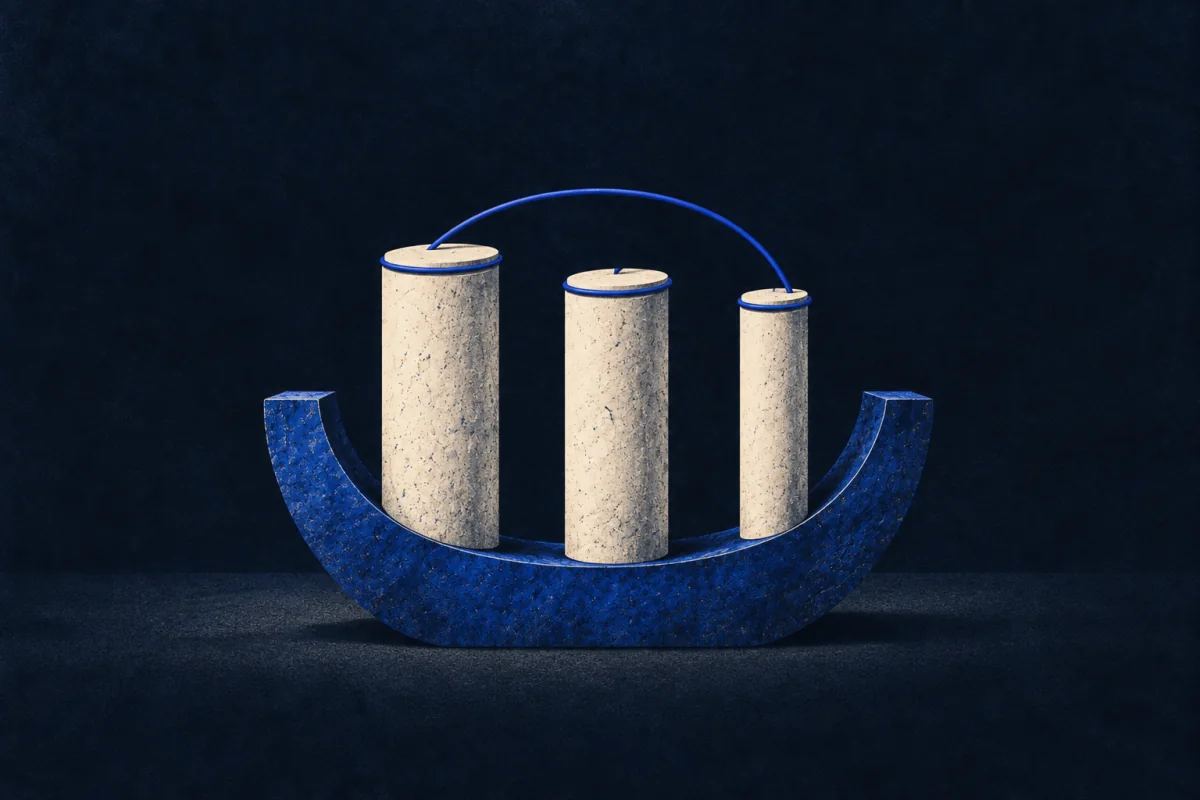
The rotation.
A wood divided into compartments, each one a different age, one of them cut every year. Nothing is ever emptied and something is always coming out.
Anybody can take the whole wood today. Keeping it so that it can be taken from every year forever is a different act, and it asks somebody to hold a number that will not be checked while they are alive to see it.
Where It Stops
Liking trees is not this, and neither is planting them. Planting is the easy half. The arithmetic is in deciding what comes out.
It goes wrong as rigidity. A rotation is a model of a wood, and a wood hit by disease, drought or a new deer population is no longer the wood the rotation assumed. Somebody holding the number tightly will keep thinning to a plan the ground has already left behind.
It also fails at scale. The reading works because one person has walked the same ground for years, and it does not survive being handed a map of forty thousand hectares and a quarterly target.
Take the plainer explanation first. Anybody managing a wood counts stems, because the job requires it. The test is whether the counting carries on where there is no yield in it at all — a hedgerow, a city park, somebody else's garden.
Where It Pays
Inside a job. Forestry and woodland management, arboriculture, estate and land agency, timber buying and grading, conservation bodies holding long-term sites, agroforestry, and the supply side of firewood, charcoal and coppice products. Also carbon and biodiversity schemes, which have created paid demand for exactly this reading and have mostly staffed it with people who learned it on the ground.
Where it pays badly inside a job is in any operation working to a harvest contract, where the number that matters is this season's volume and the forty-year account is somebody else's problem entirely.
What is being bought is a decision made now whose consequence lands after everybody in the room has retired, and the only defensible way to make one is to have watched the last one land. Nobody has invented an instrument that shortens that, and the schemes now paying for long-horizon land decisions keep discovering it the expensive way.
Outside one. Smallholdings, community woodland, hedgerow and orchard keeping, anywhere a family holds ground for longer than a generation. The cost worth naming is that this attention cannot be switched off in a place being mismanaged: standing in a fresh clear-fell is genuinely painful to somebody who can still see what was there.
Try This
Find any group of trees you can get back to — a copse, a line along a road, a park corner.
Count the trunks. Not carefully; pace it out and estimate, then write the number down somewhere you will find it again.
Pick the three you would take out if you had to take three, and write down why each one. Crown shape, lean, what it is shading, what would grow if it were gone.
Go back in a year and see whether you still agree with yourself.
The count is a tool, not a self. Pick it up where a thing is meant to keep yielding for decades. Put it down where the answer is needed this quarter, because there it is only a way of being right too late.
If This Isn't You
Plenty of people love a wood without ever wanting to know how many trees are standing in it, and that is most of what woods are for. Seeing a wood rather than a ledger is an answer, not a shallowness.
Where To Go Next
Its near-twin — Land-Reckoner. Both hold ground as a number. Land-Reckoner works out what a piece of land holds now, and can do it on ground seen once. This one needs the same ground across decades, because the number it carries is a rate of change.
Its shadow — From-Nothing Starter. From-Nothing Starter builds where there is nothing and moves on. This one inherits what somebody else started and measures its own work by whether the next holder can carry on.
Most often confused with — Greenery Tender. Both keep plants alive for years. Greenery Tender is after the health of the thing in front of them. This one is after the balance of an account in which any single tree is one line.