In Plain Sight
Some people want to know why two notes clash. They are not satisfied by playing well. Intervals get charted, scales named and tunings reasoned out until the rule underneath is written down. You'd notice this in the one who has spent decades refining one treatise that almost nobody will read.
The Pattern at Work
The question starts as a practical irritation: the piano is in tune and the chord is still slightly wrong. Most players accept this, and the ones who ask why discover something that is not a defect in the instrument but a fact about arithmetic — that twelve perfect fifths do not arrive back at the octave, that the gap is real and small and has to be put somewhere, and that every tuning system ever devised is a different decision about where to hide it.
From there the work is ordering. Which intervals are being protected, at the cost of which others, and what that does to a piece that moves through several keys. The answer is not a preference. It is a set of relationships that can be written down, argued about, and tested by ear against an instrument.
Somebody spends four decades on a treatise about mode. The subject is not obscure to them: it is the question of why a melody in one mode feels settled and the same melody moved up a tone does not, and whether that is a property of the intervals, of habit, or of the instruments a culture happens to have built. The manuscript is revised continuously for most of a working life. Perhaps two hundred people will ever read it, and about twenty will understand what it is arguing against.
Both of those are the same act. A thing that is heard immediately and universally is being taken apart until the rule underneath it can be stated.
What the Examples Show
It gets read as theory in the dismissive sense, or as a person who has mistaken the map for the music.
The charge is worth taking seriously and it is usually wrong in an interesting way. The ear comes first here: the work begins with something heard, and the theorising is an attempt to account for a perception rather than to replace it. Somebody who cannot hear the clash has nothing to explain.
What is unusual is the refusal to stop at the perception. Almost everybody who notices the chord is wrong adjusts and carries on, which is the correct response for a working musician. This pattern treats the anomaly as the interesting thing and follows it into arithmetic, history and the physical behaviour of strings and pipes.
And the output is a rule that somebody else could use. Not a performance, not a piece: a statement about relationships, written down, that will outlast the instrument it was worked out on.
Going Deeper
Music theory is one of the oldest formal disciplines and has always been carried out by a small number of people at some distance from performance.
Pythagorean ratios tied intervals to simple arithmetic and produced a system that does not quite close, which is the problem everybody since has been managing. Al-Farabi and Ibn Sina both wrote treatises cataloguing intervals and instruments in enormous detail, and both were read for centuries afterwards. Chinese theorists worked on the lu pitch standard for centuries and the court took it seriously as a matter of state. Zarlino, Rameau and Helmholtz each tried to ground harmony in something — proportion, a fundamental bass, the physics of the ear. Indian theory built an elaborate architecture of modes and microtones which performers use fluently and almost never cite, having absorbed it as practice rather than as doctrine.
The bill is the same in all of them.
The work is slow, solitary and mostly unread, and its usefulness to any working musician is close to nil in any given year, which makes the practitioner easy to dismiss and occasionally ridiculous. It is also vulnerable to a particular failure: a system that is internally beautiful and does not describe what anybody actually hears, which has happened repeatedly and is hard to detect from inside. And the audience is tiny. A treatise is addressed to perhaps a few hundred people alive at the time, and the satisfaction has to come from the thing being right rather than from anybody agreeing.
The Image
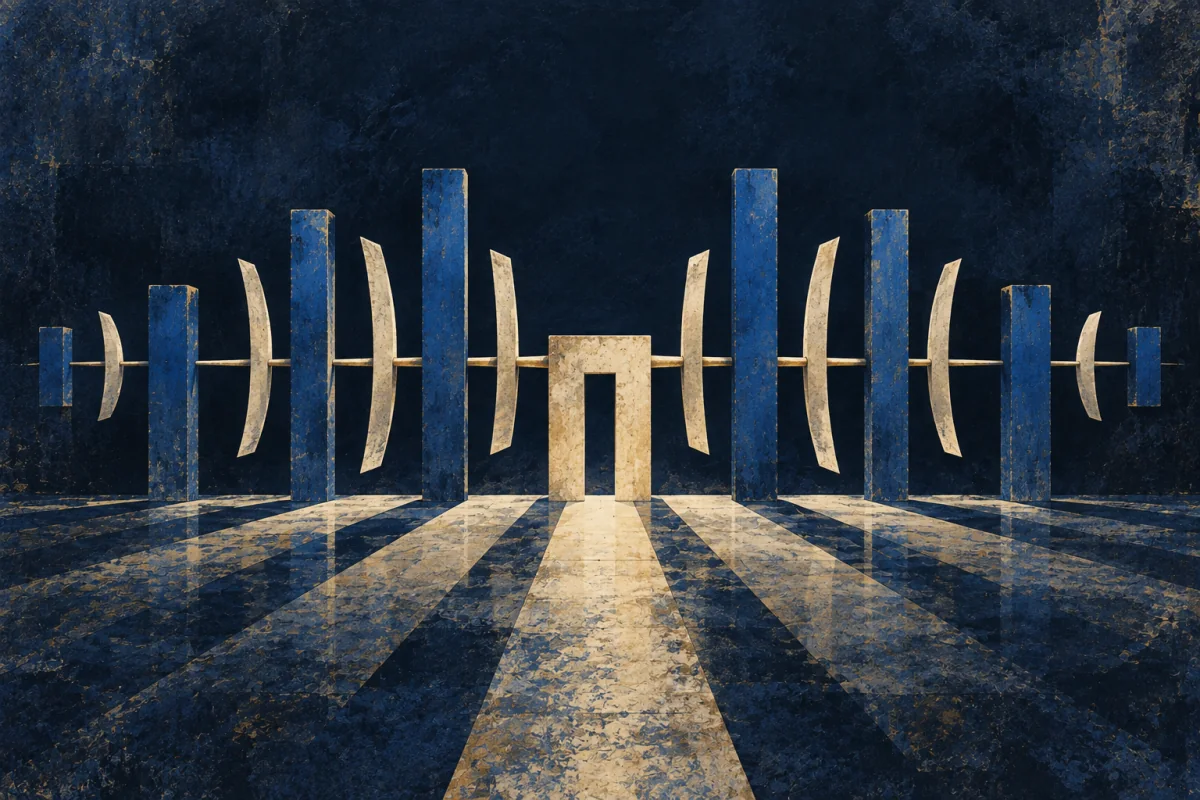
Twelve fifths that do not close.
Go up by perfect fifths and you do not land back where you started. The gap is small, real, and cannot be removed — only moved somewhere less noticeable.
Every tuning system in the world is a decision about where to put it. Most practical systems anywhere have a comma like that in them, and most people using them have no idea it is there.
Where It Stops
Being musical is not this, and being a theorist is not the same as understanding music. Some superb theorists are indifferent performers and some extraordinary musicians find the whole enterprise beside the point, and both are entitled.
It goes wrong as the system outrunning the ear. A framework can be elegant, consistent and describe something nobody hears, and this pattern is particularly prone to it because internal consistency is so satisfying.
It also fails where the music is not systematic. Traditions carried orally are frequently doing something coherent that does not decompose into intervals and rules, and an outsider's analysis can flatten them while appearing to honour them.
Take the plainer explanation first. Anybody who studies music formally learns theory because it is the syllabus. The test is whether somebody keeps going past what any examination needs, on a question nobody asked, for years.
Where It Pays
Inside a job. Music theory and musicology, ethnomusicology, instrument design and tuning, acoustics, music software and synthesis, composition teaching, and the analytical end of music education. Also anywhere a perceptual system has to be formalised before it can be built on: audio engineering, psychoacoustics, speech technology, hearing research.
What is being supplied is a language that makes something transmissible. Perception cannot be handed over; a rule can. Every scale anybody is taught, every tuning any instrument is built to, and every piece of software that generates a chord rests on somebody having written down a relationship that was previously only heard, and that work compounds for centuries.
Where it pays badly is anywhere the output must be a performance, anywhere the timescale is a single season, and in any institution that measures scholarship by readership or by impact, since the readership for this is measured in hundreds and the impact arrives, if at all, in the century after next. Outside one. Teaching, tuning, arguing amiably in a pub about why a chord does that. The cost worth naming is that almost nobody wants the answer, and the people who most need it are the ones least interested in hearing it.
Try This
Find two notes that sound wrong together — on a piano, a guitar, anything.
Do not adjust them. Instead, work out what the interval is, then find the same interval somewhere else on the instrument and check whether it sounds equally wrong. Usually it does not, which is the interesting part.
Then find out why. The answer is short, arithmetic, and about four hundred years old, and almost nobody who plays an instrument daily has ever been told it.
Twelve fifths that do not close is a tool, not a self. Pick it up where something everybody perceives has a rule underneath that nobody has stated. Put it down where the music is working and somebody is enjoying it.
If This Isn't You
Most people hear the chord, like it or not, and play the next one, which is what music is for and what almost all of it consists of. Feeling no urge to find out why is an answer, not an incuriosity.
Where To Go Next
Its near-twin — Music Mark Designer. Both formalise music into something that can be handed over. Music Mark Designer is solving how a page behaves for a player at speed. This one is after the relationship underneath the sound and does not much care how it is written.
Its shadow — Sound-Mind. Sound-Mind decides by ear in the moment of playing and would find explanation an interference. This one cannot let the thing alone until it is explained, and is often a modest player.
Most often confused with — Idea-Shaper. Both take apart something that seems whole and look for where a term is doing two jobs. Idea-Shaper works on arguments and language. This one works on sound, and the test is whether an ear agrees.