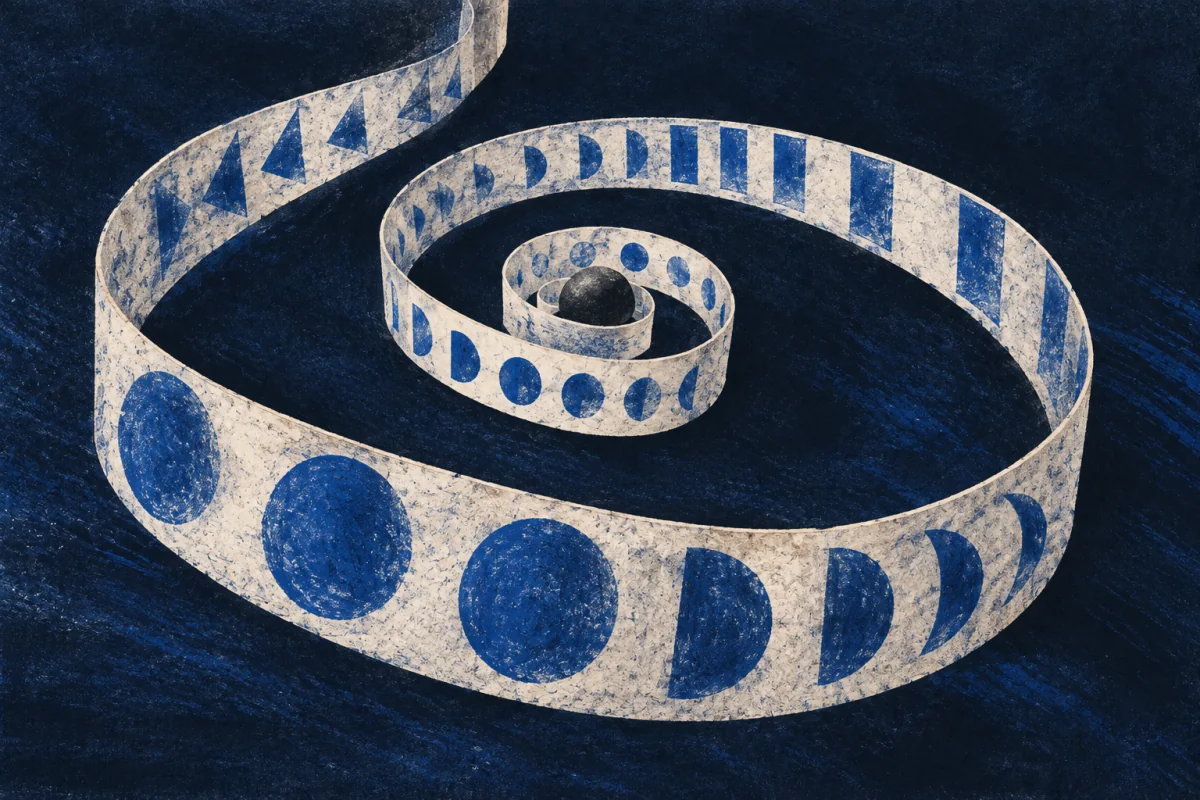
In Plain Sight
Some teachers wrap the lesson in a story. They are not avoiding the point. The tale is paced so the listener arrives at the meaning themselves, and nothing is announced at the end. You'd recognize this in the one the family still quotes forty years later, usually getting the story slightly wrong.
The Pattern at Work
A nine-year-old has been unkind to somebody at school and is defending it vigorously, which is what a direct conversation would produce for the next half hour. Her grandfather does not raise it. Later, peeling potatoes, he tells her about a man in his regiment who was left out by everybody for reasons nobody could afterwards remember, and about what the man did on one particular night, and then he stops and asks her to pass the colander. There is no moral. The story is about somebody else, it costs her nothing to listen to, and it does not require her to be wrong. She thinks about it on and off for eleven years.
A trainee is told about a previous case, in detail, with the wrong turnings left in. What this transmits that a procedure could not is the feel of uncertainty: at what point it was still reasonable to think the other thing, and how it looked from inside before anybody knew. The trainee remembers it in a corridor two years later, in a situation that is not the same and rhymes.
A teacher explains a physical principle by way of an account of two people arguing about a cart in 1650. Everybody in the room can still describe the cart at the end of term. About half can do the algebra, which is a better proportion than the year before, when the same teacher did it properly and in order. The cart is not an aid to the principle.
It is the hook the principle is hanging on, and the principle would have slid off anything smaller.
What the Examples Show
It gets read as being a good storyteller, or as a roundabout way of making a point that could have been made in a sentence.
The sentence is the alternative and it is the weaker one. A direct statement asks the listener to agree or disagree, and anything that touches their own conduct will be met with defence before it is met with thought. A story about somebody else asks nothing. It can be listened to without any position being taken, which is what lets it be considered later, when the listener is alone and not defending anything.
The pacing matters more than the plot. Where the detail slows, where it stops, what is left out: all of that decides whether the listener arrives at the meaning or is handed it. Announcing the moral converts the thing back into a statement and wastes everything that came before.
And it survives distortion. A story misremembered still works. A well-phrased principle misremembered is just wrong.
Going Deeper
Teaching through narrative is older than writing and has been the main method almost everywhere until very recently.
Parables and koans are both built for the delay — designed to be unsatisfying on delivery and to open later. Aesop and the Panchatantra both put moral instruction into the mouths of animals, so that nobody in the room had to be accused of anything. West African griot traditions carry law, lineage and conduct in narrative. Rabbinic teaching works largely through cases and stories rather than propositions, and Jataka tales do the same across a different continent. Every one of those traditions had the direct statement available to it, used it elsewhere, and chose narrative for exactly the material that touches how a person behaves.
The costs have been constant, and two of them are serious.
The first is slowness and unverifiability: nothing can be assessed at the end of the lesson, and a teacher working this way has no way of demonstrating that anything happened, which makes the method almost unusable inside a system that measures. The second is that the same technique is the finest instrument of propaganda ever devised, since a story installs a frame without ever stating a claim that could be examined. The honest practitioner and the manipulator are doing the identical thing, and the difference lives entirely in whether the story is true to what it is about. There is also a quieter cost: the teacher usually never learns whether it landed, because it lands eleven years later in a room they are not in.
The Image
No moral at the end.
The story stops, and the silence afterwards is where the work happens. Everything gained by not asking the listener to agree is thrown away by one sentence explaining what it meant.
Almost everybody adds that sentence, usually out of a fear that the point has been missed. It is the hardest part of the method and it is most of the method, and the ones who can hold the silence are the ones still being quoted decades on.
Where It Stops
Being entertaining is not this. A room that enjoyed the anecdote and took nothing from it is a common outcome, and the teller frequently cannot tell the difference.
It goes wrong as never being plain. Some things need saying directly: a safety instruction, a fact, a diagnosis, the plain truth to somebody who has asked for it. A story offered there is an evasion dressed as wisdom, and it wastes somebody's time.
It also fails where the listener wants the answer now. Somebody with a decision to make this afternoon is not served by a narrative that will open in a decade.
Take the plainer explanation first. Anyone who teaches will use examples, because examples work. The test is whether the meaning is deliberately withheld — whether the person can stop without explaining.
Where It Pays
Inside a job. Teaching of every kind, clinical and professional training where judgement matters more than procedure, law, ministry, mentoring, safety culture work, and organisational learning after an incident, where a case told properly does what a report never does. Also journalism, documentary and anything trying to change how people understand a situation rather than what they know about it.
Organisations in particular lose enormous amounts to this gap: every incident produces a report that is filed and a story that circulates, and only one of the two ever changes anybody's behaviour.
The contribution is durability under disagreement. Instruction works on people who already accept the instructor; a story works on people who do not, and survives being resisted. That makes it the only tool available in the situations that matter most, which are exactly the ones in which the listener has a stake in not being told, and has already decided what they think.
Where it pays badly is in anything assessed on the day, in technical instruction where the answer is simply the answer, and in organisations that require a learning objective to be stated before the session, since stating it is the one move that empties the method.
Try This
Think of something you want somebody to understand and have already tried telling them.
Instead, find a true account of somebody else in a similar position — from your own life, from work, from anywhere — and tell it once, with the detail in and the uncertainty left in.
Then stop. Change the subject. Do not connect it to them in any way.
The test is not whether they respond. It is whether they raise it themselves, weeks or months later, which is the only evidence this method ever produces and is why almost nobody sticks with it.
No moral at the end is a tool, not a self. Pick it up where the truth would be defended against. Put it down where somebody has asked a plain question and deserves a plain answer.
If This Isn't You
Most people say what they mean and are understood, which is faster and works perfectly well for most of what needs saying. Feeling no pull to tell it sideways is an answer, not a bluntness.
Where To Go Next
Its near-twin — Story Keeper. Both carry narrative and both refuse to summarise. Story Keeper is preserving a particular telling and would resist changing a word. This one will alter anything to make the thing land on this listener, and does not care whether the story survives.
Its shadow — Showmaster-Teacher. Showmaster-Teacher produces a question in thirty people and answers it in the next ten minutes. This one produces nothing visible at all and is content to wait a decade.
Most often confused with — Wisdom-Passer. Both answer with an account rather than advice. Wisdom-Passer's account is a real precedent with a cost attached, aimed at a decision being made this week. This one's is a story, and whether it happened is not the point.