In Plain Sight
Some teachers build the lesson as a show. They are not performing for the sake of it. The demonstration, the pause and the reveal are timed so the idea arrives with a shock that makes it stick. You'd recognize this in the one who draws a crowd at the board and whose class still remembers the trick years later.
The Pattern at Work
The lesson is about air pressure and there is an empty oil drum, a kettle and a cold bucket. The teacher does not explain first. He boils a little water in the drum, caps it, and then says nothing at all while thirty adolescents watch a steel drum crush itself with a noise that makes two of them jump. Only then does he ask what they think happened, and the answers come fast and wrong and get worked through in eleven minutes. What was bought with the bang was attention and a question they now own. Nine years later most of that class can still describe what happened to the drum, and about a third can still explain why, which is a retention rate no worksheet in the building comes close to.
A history lesson on rationing starts with the teacher handing out the week's actual butter allowance on a saucer to each table, in silence, and then walking away for two minutes. Nobody has said a word about the war yet. The argument that starts at the tables is the lesson, and it arrives with a force no reading could deliver.
The chemistry demonstration at the open evening is arranged so that the reveal comes ninety seconds later than the audience expects. The person running it worked that out over several years: too quick and the room has not committed to watching, too slow and it loses them, and ninety seconds is where a crowd of parents stops talking and starts leaning in.
None of that is decoration. The timing is the teaching.
What the Examples Show
It gets read as showmanship, or as a teacher who is popular, or as the sort of thing that entertains but does not educate.
The last charge is the serious one and it is where the difference lies. A performance that only entertains produces a class who remember the drum and nothing else. This pattern uses the theatre to buy something specific: a question that the room now wants the answer to, and a memory hook that the explanation can be hung on later.
The order is the whole of it. Shock first, explanation second, and never the other way round — because an explanation given before the surprise is an answer to a question nobody has asked, and that is most teaching.
The second thing running is live reading. Pace, voice and gesture are being adjusted mid-explanation against what the room is doing, which is why the same lesson lasts eleven minutes with one class and nineteen with another.
Going Deeper
The lecture-demonstration is an old form and it has always been suspected of being frivolous by people who are worse at it.
Michael Faraday's Christmas Lectures were built on exactly this: the demonstration in front of the audience, the delay, the question. The Royal Institution kept them going for two centuries. Anatomy theatres were theatres by name and by design, with tiered seating built so that several hundred people could watch one body at one moment. Itinerant lecturers in the eighteenth century made a living from electrical demonstrations and were sneered at by universities that were teaching the same material to nobody's memory. Travelling showmen and revivalist preachers worked the identical timing from the other end, for different purposes, which is part of why respectable institutions have always been uneasy about the form.
The suspicion is not entirely unfounded, and that is the difficulty.
The form is easy to counterfeit: the bang without the question underneath produces a memorable lesson that teaches nothing, and from the back of the room the two are indistinguishable. So this pattern is judged by its worst practitioners and has to keep proving that the theatre is instrumental. It is also expensive in preparation — the drum, the butter, the timing — for a result that looks spontaneous, and the preparation is invisible by design. And it does not scale or transfer: the same demonstration in somebody else's hands, delivered at the wrong pace, is a dud, which makes it almost impossible to write down as a resource.
The Image
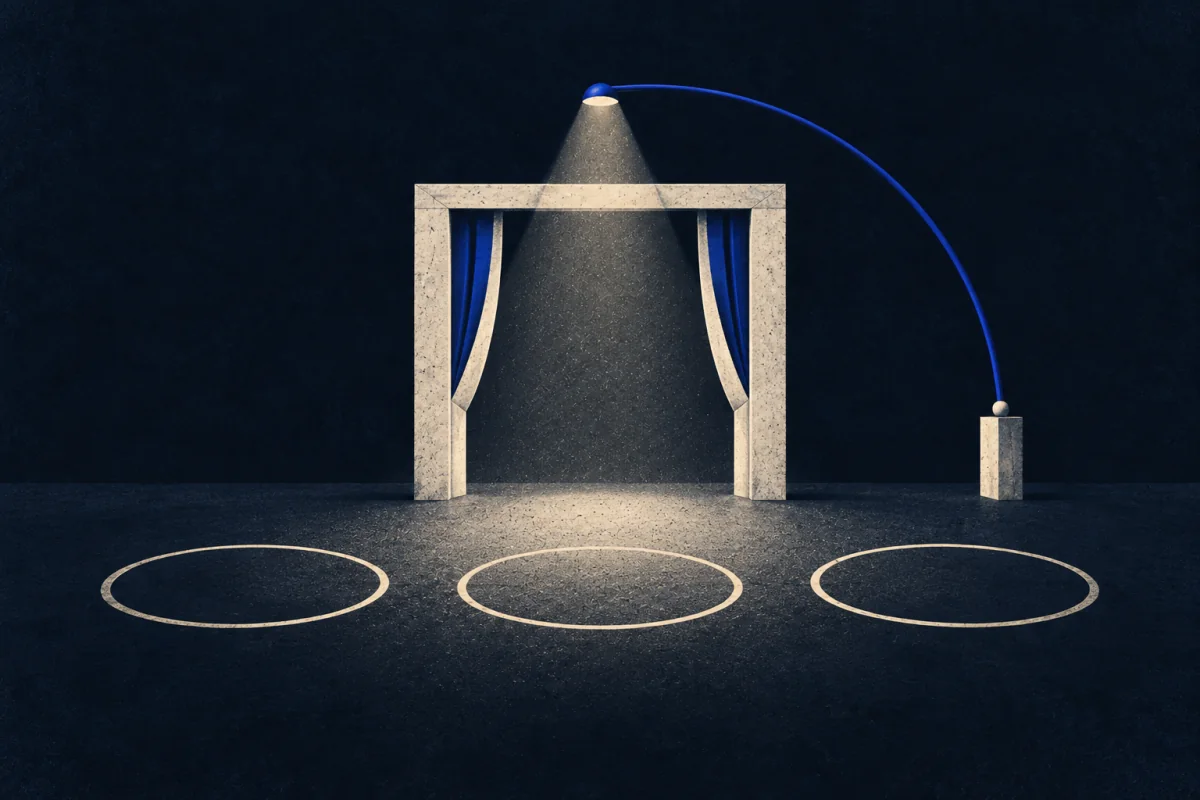
The bang before the explanation.
Not to entertain, and not to soften what is coming. To produce a question in thirty people simultaneously, so that the next eleven minutes are spent answering something they actually want to know.
Almost all teaching runs the other way round, delivering the answer first to a room that has no question, which is why almost all of it is gone by Friday and why the lesson with the drum in it is still there nine years later.
Where It Stops
Being entertaining is not this. A well-liked teacher whose classes are enjoyable and whose results are poor is doing something else, and knows it.
It goes wrong as needing the bang. Not every idea has a demonstration, and a mind organised around the reveal will either force one where it does not belong or quietly neglect the material that cannot be staged, which tends to be the difficult half of any subject.
It also fails one to one. This is built for a room, and the same technique used on a single learner is overwhelming and slightly absurd.
Take the plainer explanation first. Any science teacher does demonstrations because the syllabus contains them. The test is whether the timing is deliberate — whether the person can say why the reveal is delayed by ninety seconds.
Where It Pays
Inside a job. Teaching large groups in any subject with something to show, science and museum communication, public lectures, training and induction, conference speaking, sales demonstration, and broadcast or online teaching where attention has to be won rather than assumed. Also safety training, where the entire problem is that everybody in the room has heard it before, believes it does not apply to them, and is not listening.
What is being bought is retention per minute. Most instruction is delivered to people who are physically present and mentally elsewhere, and the material is therefore not competing with forgetting but with never having landed. One person who can produce a genuine question in thirty people at once changes what the following ten minutes are worth, and the effect is measurable years later in what people can still explain.
Where it pays badly is in small-group and individual teaching, in material with nothing demonstrable in it, and in any culture that reads visible technique as a lack of seriousness, which includes a good deal of higher education and most professional training. The preparation is also unfunded: the drum, the butter and the timing all cost an evening that appears on no timetable.
Try This
Take something you know well and will have to explain to more than five people soon.
Find the fact in it that is genuinely surprising — the one that made you stop when you first met it. There is almost always one, and it is usually not the one at the start of the chapter.
Build the first two minutes around that, with no explanation attached at all, and let the room sit in it for longer than is comfortable.
Then explain, and keep it short, because you are now answering a question rather than delivering material.
The bang before the explanation is a tool, not a self. Pick it up where a room has no particular reason to listen. Put it down with one person who is already asking.
If This Isn't You
Most people explain things clearly, in order, and a great deal gets learned that way by anybody who came wanting to learn it. Feeling no urge to crush an oil drum in front of thirty people is an answer, not a dullness.
Where To Go Next
Its near-twin — Route-Changer. Both get an idea into somebody who was not getting it. Route-Changer works on one mind and finds where it stopped following. This one works on thirty at once and starts by making them want the answer.
Its shadow — Practice Teacher. Practice Teacher's method is silence and withholding, on the grounds that attention on the teacher is attention off the work. This one puts the attention on the teacher deliberately, and buys something with it.
Most often confused with — Part-Wearer. Both hold a room physically. Part-Wearer is making something that exists only while it is performed. This one is using performance as a delivery mechanism and would drop it entirely if a worksheet worked better.