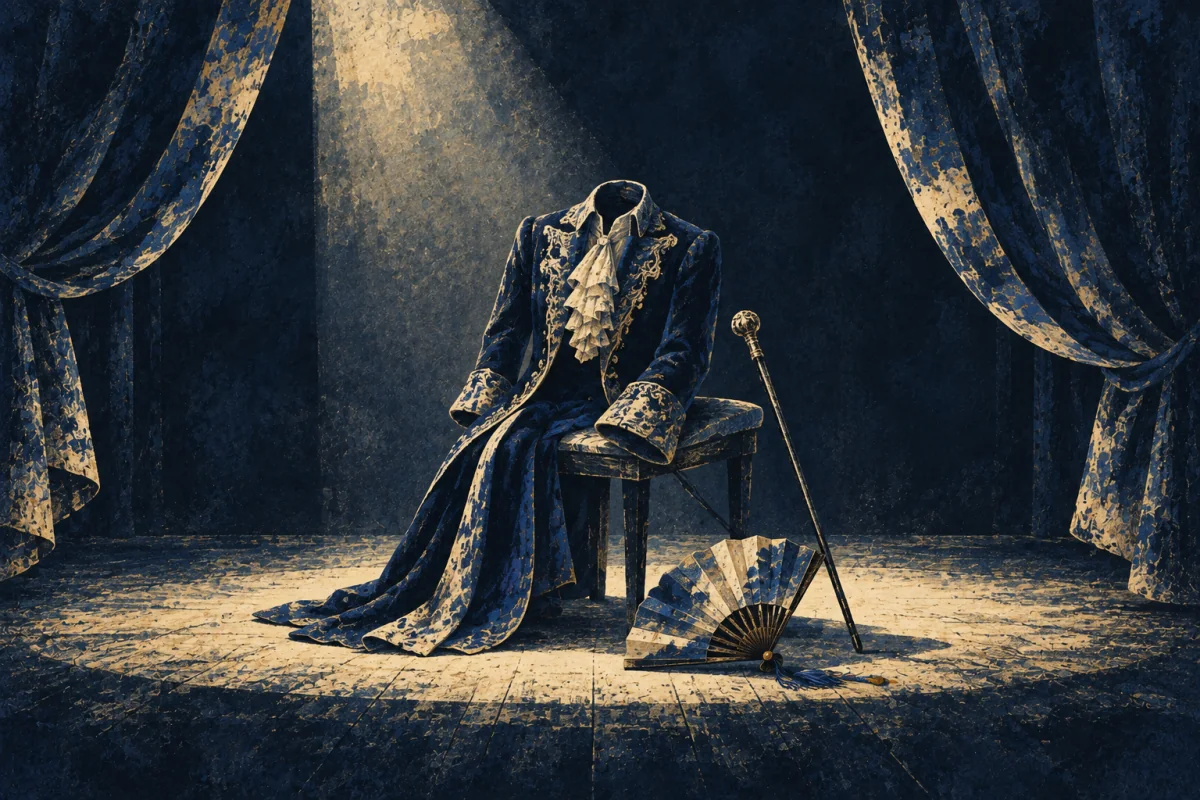
In Plain Sight
Some performers work through the whole body rather than the lines. They are not pretending to be someone else. Posture, walk and the tilt of a head do the telling, and they watch the room from half a step outside the part. You'd notice this in the one who quiets a hall by changing how they stand.
The Pattern at Work
Four scenes, one method: the body is carrying the meaning, and the person inside it is watching from slightly outside.
The village hall production has an actor who is not the best at the lines and who is nevertheless the one people talk about afterwards. What he has done is decide how the character stands before he has decided anything else, and then built the rest on top of it: a man whose weight is always slightly on the back foot, who gets up from a chair in two movements rather than one. None of that is discussed and none of it is in the script. By the second act the audience knows something about the man that nobody has told them.
A teacher takes a room of thirty at half past two on a Friday and changes the temperature without raising her voice. What she actually does is stop, put her weight evenly on both feet, drop her hands, and wait. It takes four seconds. Thirty adolescents adjust to it without any of them noticing that anything has been done to them.
A storyteller in a marquee holds two hundred people, half of them children, for forty minutes with no set and no props. The wolf is a shoulder. The old woman is a hand on a hip. The distance covered is in the feet.
And all of it is done while watching. Mid-performance, the pace changes because the room has changed — a laugh that came late, a stillness that has gone flat — and the adjustment happens inside the part without anybody stepping out of it.
What the Examples Show
It gets called presence, or charisma, or having something. Those words are descriptions of the effect rather than of what produces it.
Two things are producing it. The first is that the body, not the voice, is doing the work: posture, weight, rhythm, the size and speed of gesture, all chosen rather than felt. That is why it carries to the back of a hall and why it works on people who are not listening to the words at all, including children and anybody at the end of a long week.
The second is the half-step. The performer is inside the part and simultaneously watching it land, adjusting in real time. That double position is the unusual part. Complete absorption produces something that is powerful and deaf to the room; pure technique produces something accurate and dead. This runs both at once, which is also why it is tiring in a way that looks like it should not be.
Going Deeper
Performing through the body is the oldest form of the craft and for most of history it was the only one that worked, because rooms were large, lit badly and full of noise.
Greek actors wore masks, which removes the face entirely and leaves posture and movement to carry everything. Commedia dell'arte built stock characters as physical shapes first: the way Pantalone stands is the character. Noh formalised movement so tightly that a turn of the head is a plot event. Kathakali trains the body for years before a word is spoken, on the understanding that a trained body can be given a script and an untrained one cannot be given a presence. Chaplin and Keaton worked in silence and are still legible a century later, which is the test.
What the tradition costs is consistent across all of it.
The instrument is a body, so it keeps an account: knees, back, voice, and the particular damage of doing the same physical thing eight times a week. The work is also unrepeatable and unstorable — a performance exists for two hours and then does not exist, and what survives is somebody's memory of it. It requires a room, which means it cannot be done alone and cannot be practised the way a musician practises: the thing being worked on only exists when other people are present, so most of the learning happens in public and in front of witnesses. And the half-step out is not something that switches off at the stage door, so an ordinary conversation is carried on by somebody who is also, slightly, watching how it is going, which the other person occasionally notices and does not like.
The Image
The shoulder from forty yards.
Whatever is happening in the face is not available to most of the room. The shoulder is. So is the weight, the walk, and how long somebody takes to sit down.
Anything that has to reach a hall, a class, a crowd or a child has to be built out of things that are visible at that distance, and almost nobody builds it that way on purpose.
Where It Stops
Wanting to be looked at is not this, and neither is confidence. Some very self-assured people are inert on a stage, and some of the best at this are unremarkable in a small room.
It goes wrong as never stopping. The half-step position, held permanently, turns ordinary life into a performance with an audience of one, and the people closest are the ones who feel it: every conversation slightly shaped, every difficulty played rather than had.
It also fails where the room does not want a performance. A meeting, a difficult diagnosis, a friend in trouble — those want somebody fully present and unwatched, and the shoulder is exactly the wrong instrument.
Take the plainer explanation first. Any trained actor or dancer works physically because the training is physical. The test is whether it appears untrained and off duty: a story told to children, a room quieted without a word, a queue managed by somebody who simply stood differently.
Where It Pays
Inside a job. Acting and physical theatre, storytelling, puppetry, clowning and circus, dance, presenting, and any performance that has to reach the back of a room. Beyond the stage: teaching large groups, courtroom and public advocacy, auctioneering, tour guiding, and front-of-house work in places where four hundred people have to be moved gently in one direction.
What is actually transferable is control of a room without volume. Most people faced with a group that is not with them get louder, which works briefly and costs more each time. This pattern changes what the room is looking at instead, and can hold attention for forty minutes with nothing but a body and a voice, in conditions where no equipment would help.
It pays badly in work done mostly in writing or at a desk, badly at any distance, and badly in any setting where visible technique is read as insincerity rather than as craft.
Outside one. Village halls, school plays, children, weddings, eulogies, after-dinner speaking. The cost worth naming is that the skill is recognised socially as a personality, so it gets asked for constantly, unpaid, and at short notice, and declining is heard as a refusal to be oneself.
Try This
Next time you have to hold a room — a meeting, a class, a table of eight — change nothing about what you say and one thing about how you stand.
Put your weight evenly on both feet, let your hands drop, and wait three seconds before starting. Three seconds is much longer than it feels.
Then watch what the room does in the first ten seconds, rather than listening to yourself.
Do it four times. The interesting discovery for most people is how much of what they thought was nerves was actually posture, and how quickly it changes when the posture does.
The shoulder from forty yards is a tool, not a self. Pick it up where something has to reach people who are not already paying attention. Put it down with anybody who needs you present rather than effective.
If This Isn't You
Most people say the thing and let their body do what it was doing anyway, which is honest and serviceable in almost every room. Feeling no pull to build a character out of a walk is an answer, not a flatness.
Where To Go Next
Its near-twin — Image-Maker. Both compose something for an audience to read at a glance. Image-Maker makes an object that persists and can be looked at again. This one makes something that exists for two hours and then does not exist at all.
Its shadow — Arena-Player. Arena-Player performs in front of a crowd for an outcome that is won or lost. This one performs for an effect in the room, and the only score is whether two hundred people were still with it at minute forty.
Most often confused with — Ground-Shaker. Both use the body in public. Ground-Shaker's body is doing the thing itself, at maximum, once. This one's body is describing something else, at whatever size the room needs, and could do it again tomorrow.