In Plain Sight
Some builders can see the finished thing before the first peg goes in. They are not simply reading a drawing. The whole shape is held in their head while the work is ordered around it, and it gets adjusted as the walls come up. You'd notice this on site, in the one pointing at a corner that does not exist yet.
The Pattern at Work
The site is a field with pegs in it and the client cannot picture anything. The one who can is standing on what will be the landing, describing where the light will come from in February, and she is not imagining it — she is reading it off something she is holding. That volume in her head is what lets her answer, in about four seconds, a question that would take a draughtsman a morning: if the kitchen goes a metre that way, what stops working. The answer is the drains and the neighbour's view, and she knew both without looking, because they are part of the same held object.
Halfway up, the steelwork arrives a week late and the roof trusses arrive early, which reverses the order of two trades and puts the scaffold in the wrong arrangement for eleven days. Nothing about the finished building has changed. Everything about the route to it has. She re-sequences on the spot: the first-floor joists go in before the internal blockwork rather than after, the crane comes twice instead of once, and the plasterer is moved back a fortnight and told why, because a plasterer who is moved without a reason does not come back at all.
A village hall extension is built by volunteers over three summers under one person who never drew anything and who was on site every Saturday. It fits the old building at the join, to the brick, and the only record of how that was achieved is in the head of somebody who could not explain it if asked.
What the Examples Show
It reads as visual imagination, or as experience, or as reading a drawing well. The last is closest and still wrong.
A drawing is a set of views. What is running here is a single object held in three dimensions, with the sequence of its construction attached — not just what the thing is, but the order in which it can come into existence, which is a separate and harder problem. Walls cannot go up before the slab. The crane cannot come after the roof. Most of the expensive mistakes in building are ordering mistakes rather than design mistakes.
Holding both at once is what allows the fast answer. Move the kitchen and the drains change, the sequence changes, and two trades have to swap: all of that falls out of one object rather than being worked through.
And it stays live. The thing in the head is edited as conditions change, which is why this pattern can absorb a late delivery without losing the building, and why a plan on paper cannot.
Going Deeper
For most of history, buildings were put up by somebody holding them whole, because there was no other way to do it.
Master masons ran cathedrals with templates, string and a lodge, and there was no complete drawing anywhere — the building existed in the master's head and in a set of local rules. Vernacular building across the world worked from remembered form rather than plan. Japanese carpentry traditions transmitted a whole building through joint types and proportion, held in a lineage. Brunelleschi built the Florence dome while refusing to explain in advance how it would stand up, which infuriated the committee paying for it. The explanation existed as an object in his possession rather than as an argument, and he was not being difficult so much as accurate about what he had.
What that position costs, then and now, is that it cannot be shared.
The held object is not transferable, so the person holding it becomes a bottleneck: every decision comes back to them, they cannot be away, and the project slows to whatever pace their attention can manage. It cannot be checked either, which makes clients and institutions uneasy and is a large part of why the profession split into designers who draw and builders who follow. It is also carried alone, through the middle period when nothing on site resembles the thing and everybody else has lost confidence. And when a building goes up well the credit attaches to the drawing, because the drawing is the only artefact anybody can look at afterwards.
The Image
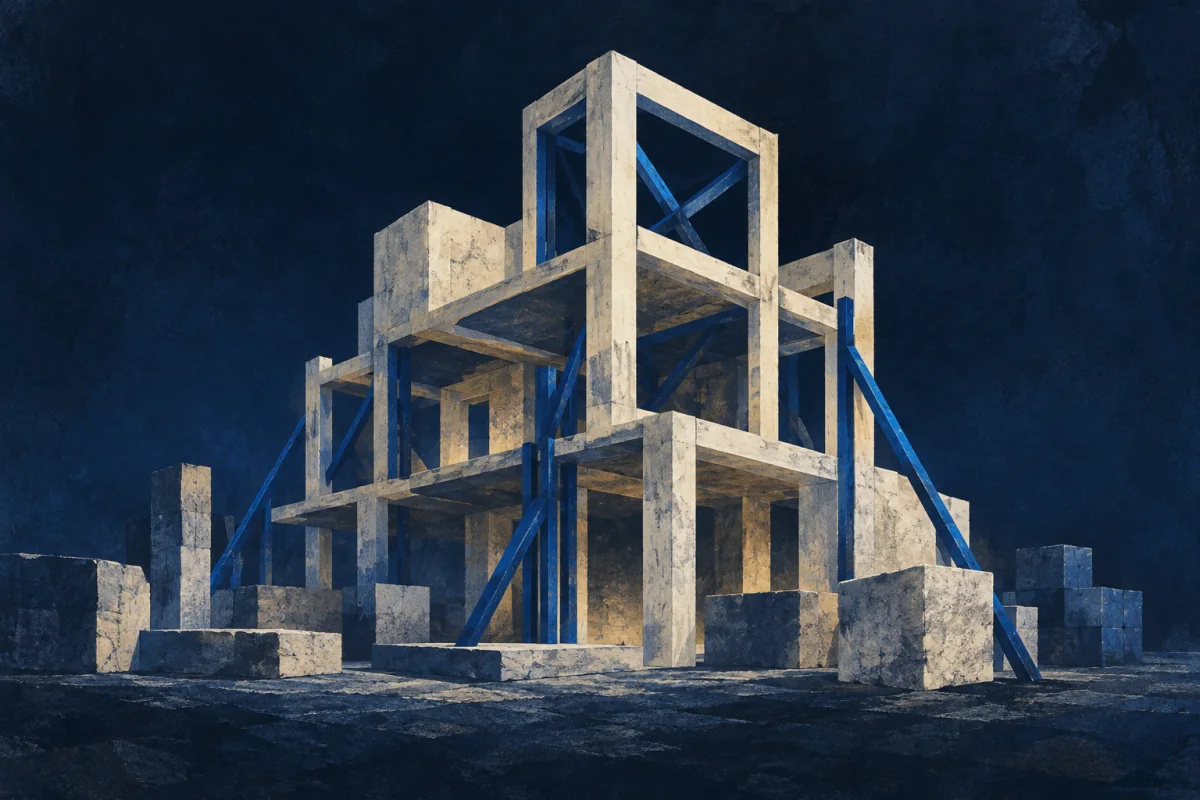
The corner that is not there yet.
Somebody standing in a muddy field, pointing at a place in the air, describing what will be visible from it.
They are not imagining. They are reading off something they are already holding, and the test of whether it is real is that they can answer questions about it — what the light does, what is behind it, what breaks if it moves a metre.
Where It Stops
Drawing well is not this. Plenty of people picture a finished thing beautifully and have no idea what has to happen in which order for it to exist.
It goes wrong as never writing it down. A held object is fast and it dies with the holder's attention: the person is ill for a fortnight, or leaves, and the project discovers that nothing above the foundations was ever recorded.
It also fails at scale. One head can hold a house, a hall, a small development. Beyond that the object has to become documents and meetings, and this pattern in that setting is frustrated, slow, and usually convinced that everybody else is being obtuse.
Take the plainer explanation first. Any site manager or architect holds a building in mind because the job requires it. The test is whether it appears without a project — rearranging a garden, planning a loft, looking at somebody else's half-built extension and saying what will go wrong in March.
Where It Pays
Inside a job. Building and construction management, self-build, timber framing, landscape and garden design, exhibition and set construction, boat fitting-out, and anywhere a physical thing has to be brought into existence in a sequence on a site. Also event build, shop fit and anything that has to be made, used and taken down again on a schedule.
What is being bought is the speed of the answer and the avoidance of ordering faults. On any site the questions arrive faster than a drawing office can answer them, and the difference between a job that flows and one that stops twice a week is somebody who can say, straight away and without leaving the site, whether a change is cheap.
It pays badly on very large projects with distributed decisions, badly where every change must be documented before it can be made, and badly in organisations that treat an undocumented decision as no decision at all.
Outside one. Extensions, sheds, gardens, village halls, anything built by volunteers. The cost worth naming is that the whole thing sits in one head for the duration, so the person cannot rest until it is finished and everybody near them lives for a year with somebody partly elsewhere.
Try This
Take a space you are about to change in some small way.
Before measuring anything, stand in it and describe out loud what it will look like finished, including what you cannot see: where the light comes from, what is behind you, what you will trip over.
Then ask the ordering question, which most people skip: what has to happen before what, and what becomes impossible in the wrong order.
Write the sequence down, do the job, and see which step you had wrong. There is nearly always one.
The corner that is not there yet is a tool, not a self. Pick it up where something physical has to be brought into being. Put it down where the thing already exists and somebody is simply asking your opinion of it.
If This Isn't You
Most people work from the drawing, do what the builder says, and end up with a perfectly good building, which is what drawings and builders are for. Not being able to stand in a field and see the landing is an answer, not a limitation.
Where To Go Next
Its near-twin — Settlement-Planner. Both arrange things on ground before they exist. Settlement-Planner works at the scale of how people will live among the buildings. This one works at the scale of one structure and how it gets built.
Its shadow — Under-Load Builder. Under-Load Builder thinks in where the weight goes and will accept any form that holds. This one thinks in the finished form and treats the structure as what has to be solved to get it.
Most often confused with — Kitchen Leader. Both re-sequence work under pressure so that other people know what to do next. Kitchen Leader holds a sequence inside one fast hour and nothing survives the evening. This one holds a sequence across eleven months toward an object that will still be there in a century.