In Plain Sight
Pressure sharpens this person when other people are watching. They are not chasing attention. The open test helps them focus because the result is clear and shared. You'd notice this in the player who gets quieter before the final point, asks for the ball, and uses the simple move they saved.
The Pattern at Work
Fourth set, and the match has been drifting for twenty minutes. What changes is not effort. She stops trying the shot she has been trying and goes back to the one she can hit blind, over and over, into the same corner, and she slows her own service routine down by about two seconds per point. It looks like less. It is a deliberate reduction: in front of two hundred people with a result attached, the number of things she is willing to attempt has fallen to three, and all three work.
A debating final, and the boy who has been quick and funny all year is suddenly neither. He makes four points, in order, and sits down. His coach knows exactly what has happened, because they rehearsed it: under this much attention he loses the improvisation and keeps the structure, so the structure was built to be enough on its own. He wins, and the funny version of him does not reappear until the coach buys the team chips on the way home.
A kitchen on a Saturday, two hundred covers, and a section goes down. The chef de partie who takes it over does not speed up. He cuts the menu in his head to what can be plated in four minutes, says so once, and works at a rhythm that anybody watching would call unhurried. Everything goes out. Two days later, alone and unwatched at a quiet lunch service, he burns a sauce and swears at himself for ten minutes.
What the Examples Show
The reading that gets offered is confidence, and the last line of the third scene is the argument against it. The same person is worse without the crowd, which confidence does not explain.
What is running is narrowing under load. Attention does something to everybody — the standard finding is that it degrades whatever is complicated and sharpens whatever is well learned. Most people experience only the first half. This pattern has, deliberately or otherwise, arranged a life in which the second half is what matters: fewer options, all of them drilled, chosen in advance.
The other half is that the result is public and unambiguous. A point is won or not. That is unusual. Most work offers no such thing, and a person who needs a clear shared outcome to switch on will not find one in an ordinary week, which is why this pattern so often looks flat between events and unrecognisable during them.
Going Deeper
Norman Triplett noticed in 1898 that cyclists rode faster with others on the track than alone against a clock, which is usually credited as the first experiment in social psychology. The effect turned out to be conditional rather than general: Robert Zajonc resolved decades of contradictory results in 1965 by pointing out that an audience improves performance of a well-practised task and damages performance of an unfamiliar one. Everybody is affected. What differs is what has been made automatic beforehand.
The traditions that take this seriously all arrange the same thing. A boxer's trainer cuts the repertoire down before a fight rather than adding to it. Musicians distinguish practice from performance absolutely, and the whole purpose of the first is to reduce what the second requires. Aviation and surgery formalised it into checklists, which are not aides-memoire for the ignorant but structures for people whose judgment will narrow under pressure and who decided in advance what should remain.
The bill comes in a particular form. A life organised around clear public tests has very few of them in it, and the gaps between are long, unstructured and badly served by this temperament. The identity attaches to the result, which is binary and mostly out of anybody's control, so the same performance is a triumph or a failure depending on a line judge. And it ends early. Most people who live this way have the arena taken away from them at an age when everybody else is still building, and the ordinary world afterwards offers nothing with that shape in it.
The Image
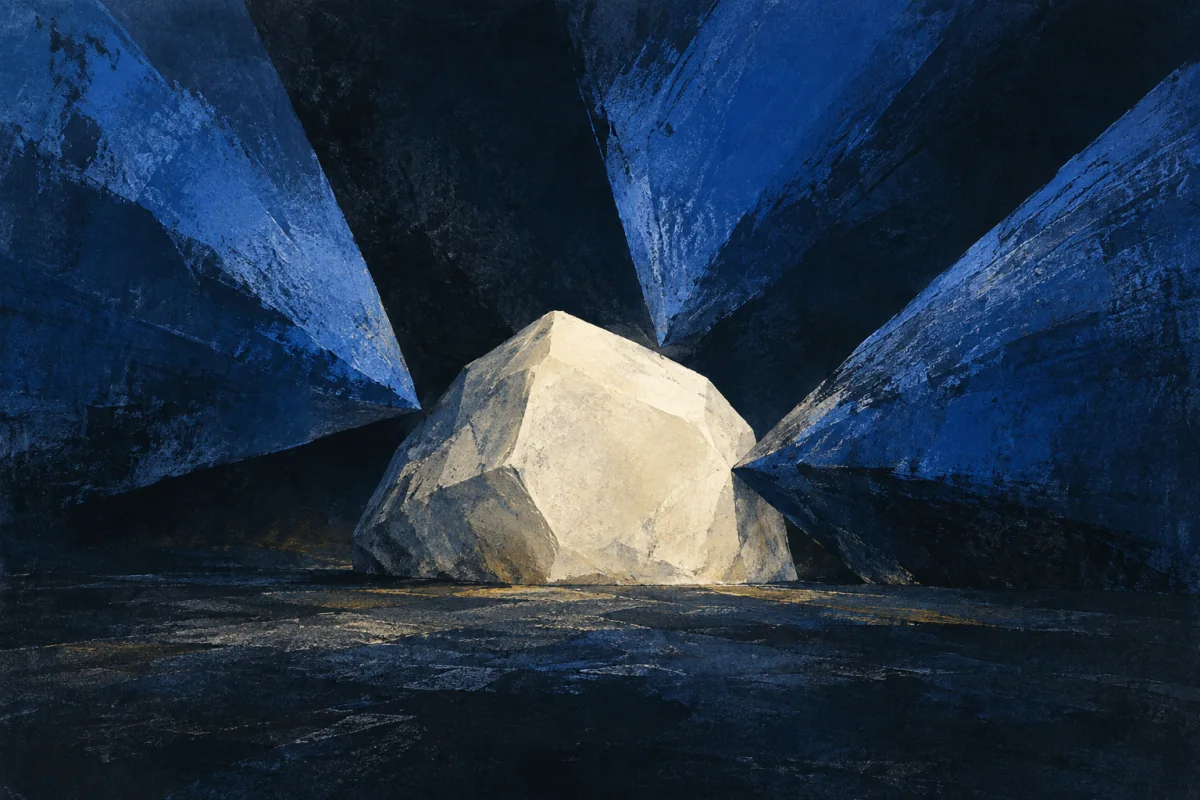
The shot you can hit blind.
Under attention, the list of things you can actually do gets shorter without asking your permission. The only decision available is which things are on the short list, and that decision is made months earlier, in an empty room, by repetition.
Ask it of anything you will have to do while being watched. What is on my list of three, and have I earned them?
Where It Stops
Wanting attention is not this. A person who needs to be watched will attempt more under pressure, not less, and the tell is a repertoire that grows in front of a crowd.
It goes wrong as needing the arena to function. The talent that narrows beautifully at match point is often useless on a wet Tuesday, and a career, a marriage and a health problem are all wet Tuesdays.
It goes wrong again as taking the scoreboard for a verdict. A result that turns on a line judge is not a measure of a person, and treating it as one is how this pattern produces its characteristic damage.
It also fails wherever the test is not clear or not shared. Most important things are decided slowly, privately, with no result announced, and this pattern will keep waiting for a whistle that never comes.
Take the plainer explanation first. Any professional competitor has been trained into all of this. The test is whether it shows up in a pub quiz final, or a driving test, with nothing at all at stake.
Where It Pays
Inside a job. Competitive sport most obviously, but the same shape earns in live performance, trial advocacy, surgery, emergency medicine, trading floors, auctioneering, sales presentations that decide a year, and any role where the whole thing comes down to a short window with people watching. The contribution is reliability at exactly the moment everybody else's competence is dropping, which is worth more than raw ability and is much rarer. Examiners and selectors spend their whole careers trying to detect it in advance. It pays badly across long unobserved stretches, where there is nothing to narrow against and this pattern drifts, and badly again in cultures that treat visible calm as evidence somebody is not trying, which is a persistent misreading of the third scene above.
Outside one. Amateur sport, music, examinations, driving tests, speaking at a wedding, and every occasion where a person has to be good once at a fixed time. The cost worth naming is the gap between events, which is where this pattern is least at home and most likely to be restless. The second is the ending. Whatever the arena was, it usually closes, and the thing that has to be found afterwards is not another arena but a reason to be good at something with nobody counting.
Try This
Take something you will have to do in front of people in the next month — a presentation, a match, a difficult conversation with an audience.
Write your list of three. Three things you can do without thinking, that you would still be able to do if your hands were shaking. If you cannot fill the list, that is the finding: you have been relying on improvisation that will not be there.
Then spend the preparation time on those three rather than on anything new. It will feel like an unambitious fortnight, and that feeling is the mistake this exercise exists to correct.
The list of three is a tool, not a self. Pick it up where the moment is fixed and public. Put it down on the long ordinary stretches, which are not a test and cannot be won.
If This Isn't You
Most people are worse when watched, know it, and arrange their lives to do the important things quietly, which is sensible and costs almost nothing. Feeling no lift when a room turns to look at you is an answer, not a gap.
Where To Go Next
Its near-twin — Audience-Singer. Both come alive with people watching. The Audience-Singer needs the room itself — the attention is the medium and the exchange with it is the event. This one needs the test, and would play the same match to an empty court if the score still counted.
Its shadow — Lone Composer. The Lone Composer's work is ruined by being watched and requires a room with nobody in it. This one is at its best in the exact conditions the other cannot work in, which makes them useful measuring sticks for each other.
Most often confused with — Crowd-Mover. Both are in front of crowds and both are affected by them. The Crowd-Mover is working the crowd, reading it and moving it. This one has genuinely stopped noticing it is there, and would tell you afterwards that the second set was quiet.