In Plain Sight
Some people stitch distant places into one working line. Port to port, oasis to oasis, warehouse to warehouse, held together by knowing the right person at every stop. The whole route sits in mind while the next handshake is being made, and the travel, weather and risk are simply part of it. You'd notice this in the one who can name every dockmaster between here and the coast.
The Pattern at Work
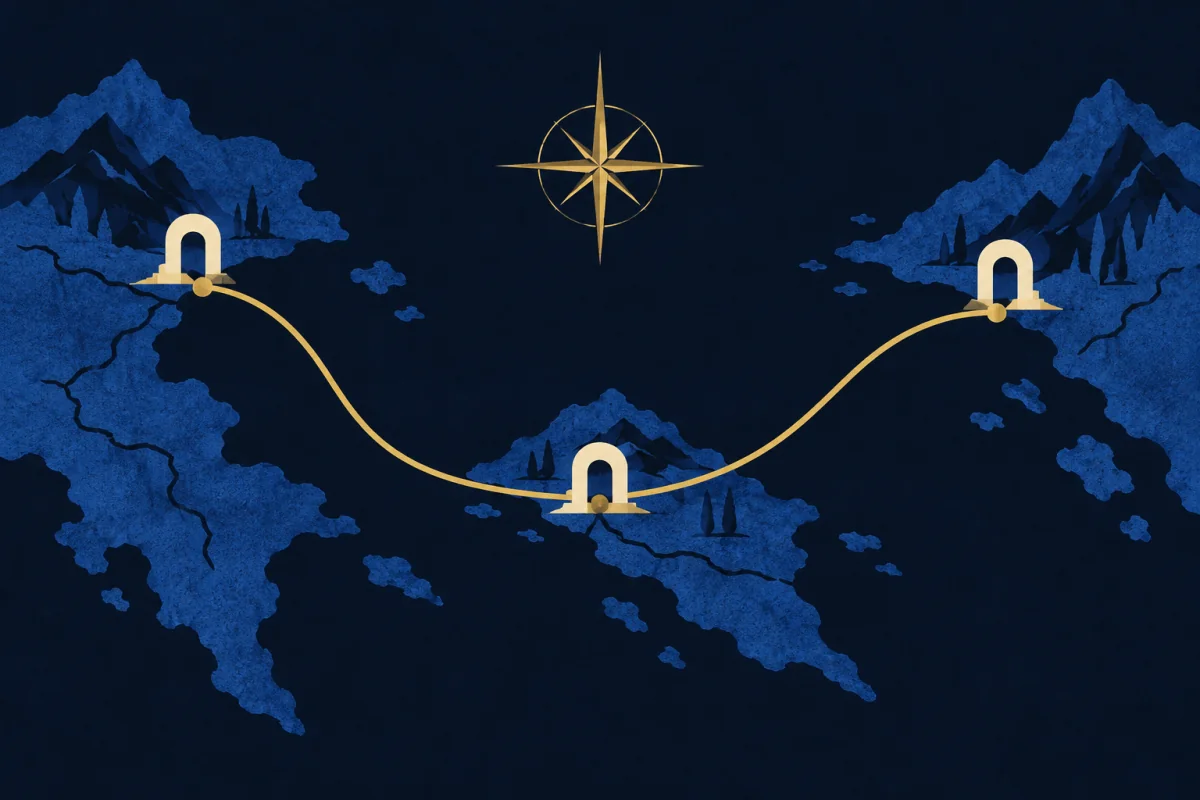
A route is a chain of relationships rather than a line on a map. Each stop needs somebody who will hold goods, advance credit, warn of trouble ahead and not steal, and the whole line runs at the reliability of its weakest link. Building one takes years and consists mostly of small transactions done correctly with people who had no reason to trust anybody.
The route is held whole while being worked in pieces. Standing in one warehouse negotiating one consignment, the person is also holding what is in transit three stops back, what is waiting at the far end, what the weather will do to the middle section, and what a delay here costs everywhere else. That simultaneous picture is what allows a decision made in one place to be right for the whole line.
Redundancy is built deliberately because chains break. Two hauliers rather than one, a second buyer at the far end, an alternative crossing, a relationship kept warm with somebody not currently needed. It looks like inefficiency and it is the entire reason some routes survive a bad year.
And the travelling is the cost that never goes away. Relationships at a distance decay unless somebody turns up, so the work requires being away for long stretches, permanently, and that has shaped the lives of everybody who has ever done it. A route neglected for two years is not a route any more. The people at each stop have made other arrangements, and rebuilding takes nearly as long as building did.
What the Examples Show
It reads as import and export, or as having good contacts, or as somebody who travels a great deal for work.
The first element is that the asset is a chain of people. The goods, the vehicles and the paperwork can all be replaced; what takes years and cannot be bought is somebody dependable at each point.
The second is holding the whole line while acting on one part of it. Every local decision is made against the state of the entire route, which is what separates this from simply doing deals in several places.
The third is deliberate redundancy. Second options are maintained at cost, against failures that have not happened yet, because a single broken link stops everything.
Going Deeper
Long-distance trade routes have been built by individuals holding relationships, and almost never by the states that later taxed them.
Silk Road commerce ran on merchant communities with kin and co-religionists settled at intervals along the route, which is how credit and trust travelled further than any law did. Trans-Saharan caravan trade operated the same way across the desert. Hanseatic merchants kept their own factors and warehouses in foreign ports. Armenian, Gujarati and Hokkien trading networks each built lines across continents on family and community obligation rather than on contract, because nothing enforceable crossed those distances. The arrangement was always the same: a network of people who could ruin each other socially if anybody cheated, which held where legal systems did not reach and travelled considerably further than any of them.
The costs have been constant. The work requires long absence, so households are run by somebody else for months or years at a time, and the family structures around this trade have always reflected that. The risk is real: goods, capital and occasionally the trader are lost, and there is rarely recourse. The whole position depends on trust that cannot be secured legally, so a single betrayal at one stop can close a route built over a decade. And the people who hold these lines are habitually distrusted by the societies at either end, which has a long and ugly history attached to it, with expulsions and worse arriving at exactly the moments the routes mattered most.
The Image
The relationship kept warm.
A visit, a letter, a small piece of business with somebody who is not currently needed for anything.
It costs time and money and produces nothing this year. It is why, when the usual crossing closes or the usual buyer fails, there is an alternative that can be used immediately rather than one that has to be built from nothing in the middle of a crisis.
Where It Stops
Being well travelled is not this, and neither is having contacts. The work is a chain of dependable people, maintained deliberately, across distance.
It goes wrong as dependence on the chain rather than the goods. A route is only worth holding if something profitable moves along it, and there is a version of this that becomes an elaborate network moving very little.
It also fails where trust has been replaced by systems. Containerisation, tracking and enforceable contracts have removed much of what this reading supplied, and on well-served routes the personal chain is a cost rather than an advantage.
Take the plainer explanation first. Anybody in international trade maintains relationships along a supply chain, because the business requires it. The test is whether the same instinct appears where no trade is involved — a chain of people kept in touch with for no reason anybody can name.
Where It Pays
Inside a job. Import and export, freight forwarding and logistics, commodity trading, supply chain management, shipping agency, and the procurement of anything from places without reliable institutions. Also humanitarian and development logistics, where goods must move through territory that no system covers, and the relationship chain is the only thing that works.
What is being bought is a line that keeps working when something goes wrong. Anybody can arrange a shipment on a good day; the value is entirely in what happens when a border closes, a supplier fails or a port strikes, and that depends on whether somebody has a person to call at every point.
Where it pays badly is on well-served routes, where the systems have caught up and a trader's relationships add nothing to a price comparison. It pays badly wherever a large buyer uses a route until it is proven and then goes direct, which is the standard way this work is repaid.
Outside one. Diaspora networks, family businesses, informal trade and the movement of goods to places no company will serve. The cost worth naming is the absence: this is a life spent away, and the people who build these lines are frequently strangers in their own households.
Try This
Map one chain you already depend on. Anything that reaches you from a distance: a supplier, a service, a piece of your work that passes through several hands.
Write down every point in it and the name of the person at that point. Most people find they can name one or two and no more.
Then pick the weakest link and do one small thing to make it a relationship rather than a transaction.
Six months later, see whether that link behaved differently when something went wrong.
Building a line is a tool, not a self. Pick it up where distance and unreliability stand between two places that would both benefit. Put it down where the systems already work, because there the chain is an expense that buys nothing.
If This Isn't You
Most people order the thing, it arrives, and they have no idea how many hands it passed through, which is exactly what a working system is for. Not building the line is an answer, not a narrowness.
Where To Go Next
Its near-twin — Crossroads-Trader. Both work between places. Crossroads-Trader stands at one seam where two worlds meet and profits from the difference. This one builds and holds the whole line between many stops, and the margin is in the route rather than in any single exchange.
Its shadow — Lamp-Hand. Lamp-Hand gives a lifetime to one unvarying duty in one place. This one is never in the same place twice and maintains dozens of relationships badly rather than one perfectly.
Most often confused with — Supply-Line Holder. Both keep things moving over distance. Supply-Line Holder runs an existing line and is judged on flow and stock. This one builds the line in the first place, in territory where none existed, which is a different problem entirely.