In Plain Sight
Some people come back from a hard trip with a book of drawings rather than photographs. The hands were cold, the light was going, and what got put down was chosen: this rock because of how it lies, that bird because of the wing. The record is thin and it is useful. You'd notice this in the walker who stops in sleet to sketch a ridge line.
The Pattern at Work
The drawing is not a picture of the place. It is a decision about which parts of the place will matter to somebody who was not there.
A photograph takes everything at once and lets nobody choose. A field drawing does the opposite: the artist decides in the moment what the important feature is, draws it larger than it looks, drops what would clutter it, and writes a note beside it about colour or smell or how the ground felt. That selection is the value, because the person reading the record later needs the diagnostic detail and not the view.
The conditions do most of the deciding about method. Wet paper, numb fingers, an animal that will not stay, light failing in minutes, a boat that will not hold still. So the working habit is to get down the thing that cannot be recovered first and fill the rest in from memory afterwards, with the notes written at the time to hold the memory honest. Anybody who tries to make a finished picture on the spot comes back with fewer of them and no better.
And the accuracy is of a particular kind. It is not photographic likeness but structural correctness: the number of tail feathers, the join where a limb meets a body, the way one rock bed sits on another. A drawing can be beautiful and useless if it gets that wrong, and plain and valuable if it gets it right. Somebody doing this well knows which details are load-bearing and will spend the last of the light on those.
What the Examples Show
It gets read as a talent for drawing, or as a romantic way of travelling, or as a hobby brought along on a trip.
The first element is that the record is selective on purpose. What goes in is chosen for what a later reader will need, and leaving things out is most of the skill.
The second is that the conditions shape the method. Cold, wet, moving subjects and failing light force a way of working: the irreversible detail first, the rest reconstructed from notes made at the time.
The third is that the accuracy required is structural rather than pictorial. Joins, counts and proportions have to be right, and a drawing that looks handsome while getting them wrong is worth nothing at all.
Going Deeper
Every voyage of exploration carried an artist before it carried a camera, and many carried one long afterwards.
The role was formal. Naval and survey expeditions appointed draughtsmen to record coastlines for navigation, and naturalists drew specimens because a dried skin loses its colour within days. The coastal profiles in old sailing directions were drawn from the deck so that a ship arriving later would recognise the headland. Botanical and zoological illustration developed conventions that photography still cannot match: the plant shown with flower, fruit and root together, the insect drawn with the diagnostic parts separated out. A photograph shows one specimen in one light; a plate shows the species. The great botanical and Arctic expeditions produced their evidence this way, and much of it is still consulted.
The costs have shifted rather than gone. Photography took the documentary contract away and left the work looking decorative, so the people still doing it are often paid as illustrators rather than as recorders, and the field element is the first thing a budget cuts. Expedition places are scarce, unpaid as often as not, and go to people who can also do something else. Very little of it now pays a living on its own. The work itself is physically miserable for long stretches and produces nothing anybody sees for months. And there is a quieter loss: the conventions take years to learn, they are taught in very few places, and each time a survey decides a camera will do, the knowledge thins a little further.
The Image
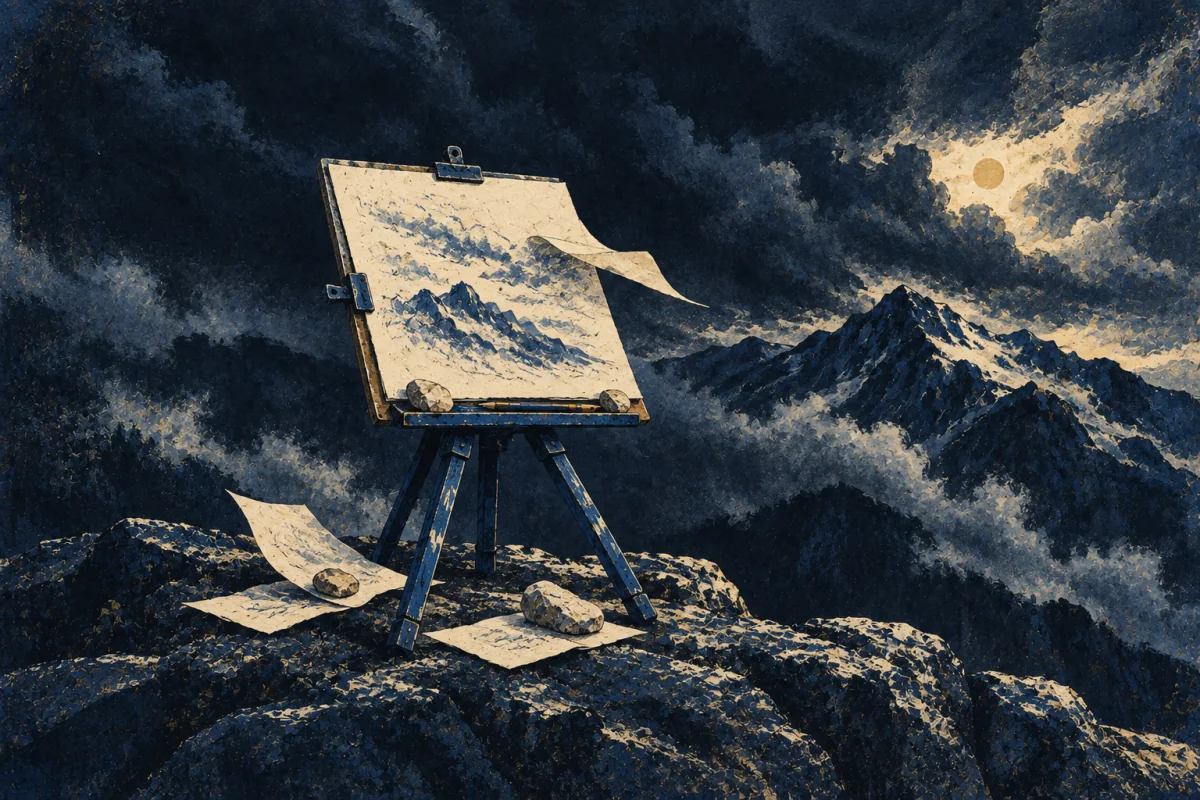
Drawing with the gloves off.
Bare hands in cold that hurts, because a pencil cannot be held through a glove, and the light will not last.
Everything about the moment argues for taking a photograph instead. The reason not to is that the photograph would be of everything, and in a week nobody will be able to say which part of it was the point. The drawing already knows.
Where It Stops
Being good at drawing is not this. Plenty of accomplished artists produce nothing useful in the field, because the skill is in deciding what to leave out under pressure rather than in rendering.
It goes wrong as a preference for the drawing over the fact. A record that has been improved, tidied or composed is no longer evidence, and somebody who cannot resist making it handsome will quietly change the thing they came to document.
It also fails where a photograph is simply better. Colour under known light, a crowd, a moment too fast to see: insisting on the pencil there wastes the trip.
Take the plainer explanation first. Anybody who travels with a sketchbook fills it. The test is whether the drawings carry notes and whether anything was deliberately left out.
Where It Pays
Inside a job. Natural history and scientific illustration, archaeological and forensic drawing, medical and surgical illustration, and reconstruction work for museums and heritage sites. Also courtroom artists, expedition and field reporting, and the concept end of film and game design, where somebody has to draw a place that cannot be photographed because it does not exist.
What is being bought is a picture that answers a question. A museum reconstruction, an excavation drawing or a species plate has to show the thing as understood rather than as seen, which no camera can do, and institutions pay for that because their whole account depends on it being right.
Where it pays badly is the field part. Expedition work is scarce and often unfunded, illustration rates have been flattened by stock imagery, and most practitioners hold the work together with teaching or commissions that have nothing to do with the outdoors. A day in the field costs more than a day at a desk and earns the same.
Outside one. Travel sketchbooks, nature journals, recording a landscape that is about to change. The cost worth naming is that a trip stops being a trip, because every view becomes a decision about what to put down.
Try This
Go somewhere ordinary and pick one thing you could photograph in a second: a plant, a tool, a corner of a building.
Do not photograph it. Draw it badly for about ten minutes, and while you draw, write three notes beside the drawing about things the drawing cannot hold. Colour. Smell. How heavy it looked.
Then ask what you left out, and whether you left it out because it did not matter or because it was hard.
Come back a week later and see which of the two records you still understand.
Drawing to record is a tool, not a self. Pick it up where somebody will need to know what was there. Put it down when a photograph would answer the question better.
If This Isn't You
Plenty of people take a photograph, get on with the walk and remember it perfectly well. Wanting the view rather than the record is not a shallower way to travel.
Where To Go Next
Its near-twin — Wilderness-Writer. Both go out into hard country and bring back a record made by hand. Wilderness-Writer turns it into language, at a desk, later. This one puts it down on the spot, in line, and the value is in what was decided while cold.
Its shadow — Map-Painter. Map-Painter draws a place so somebody can move through it, dropping everything that is not the route. This one draws so somebody can identify what was there, and would keep the detail a map would happily throw away.
Most often confused with — Field-Naturalist. Both read a place closely and carefully. Field-Naturalist works out what happened from the signs. This one records what is present so somebody else can work it out later, and may never form a view at all.