In Plain Sight
Some people watch the young or the vulnerable before trouble gets anywhere near them. It is not fearfulness. It is care that runs ahead, because a small risk grows very fast around somebody who cannot protect themselves. You'd notice this in the neighbour who moves the hot mug back from the table edge before anyone else has seen a problem.
The Pattern at Work
The reading runs forward from where somebody is to what they will do next. Not the child at the table, but the child who is about to stand on the chair. Not the elderly relative on the step, but the step in the dark on the way back. What registers is the situation forming rather than the situation present, and that is why the interventions look premature to everybody else and never look like anything afterwards.
The corrections are tiny and made in passing. A mug moved four inches. A cable tucked behind a leg. A gate that would have been fine pushed properly shut. A chair moved out of a route somebody will take later. None of it is discussed, and the person doing it is frequently unaware of having done it until somebody points it out.
Attention is weighted by who is exposed. A room with a toddler in it is read completely differently from the same room without one, and the reading follows the most vulnerable person present rather than covering the space evenly. When that person leaves, the attention drops, which is how somebody can be exhausting on a family holiday and entirely relaxed at work.
And the whole thing is nearly silent. Warnings are rarely issued because warnings are ignored and adjusting the environment is not, and a person doing this well does almost nothing that anybody could disagree with. The exception is when somebody notices and takes it as a comment on their parenting, which is the one place this attention regularly causes offence.
What the Examples Show
It reads as being anxious, or as a maternal instinct, or as somebody who fusses.
The first element is that the reading is predictive rather than reactive. What is being seen is the situation two steps from now, which is why the action comes before there is anything visible to act on.
The second is that the environment is adjusted rather than the person warned. Moving the hazard works and telling somebody to be careful does not, and the preference for the first is the distinguishing feature.
The third is that the attention is weighted towards whoever cannot manage the risk themselves. It is not general vigilance; it follows a specific vulnerable person around a room and stands down when they are not there.
Going Deeper
Looking ahead on behalf of people who cannot has always been distributed across households rather than assigned to anybody.
Extended families everywhere have relied on several adults watching children loosely, which is a far more robust arrangement than one parent watching closely and is what most of human history looked like. Alloparenting is the term anthropology uses, and the pattern of a grandmother or an older relative holding this role appears in most societies that have been studied. Public health in the twentieth century did the same thing structurally, by changing environments rather than telling people to be careful, and the fall in childhood injury came from guards, gates, packaging and speed limits rather than from vigilance. That is the same move this reading makes in a kitchen, several decades earlier and without any evidence base, and it is worth noticing that the formal version arrived at the identical conclusion: change the room, do not lecture the people.
The costs are real and unevenly distributed. The work is constant and invisible, and nothing bad happening is the output, which nobody can see. It falls disproportionately on whoever is assumed to do it, usually the same person every time. It does not switch off easily, so people who carry it are genuinely more tired after a family gathering than anybody understands. And the line between this and anxiety is not always clear from inside: the same attention that prevents accidents can become a permanent low-level fear that does the person carrying it real harm.
The Image
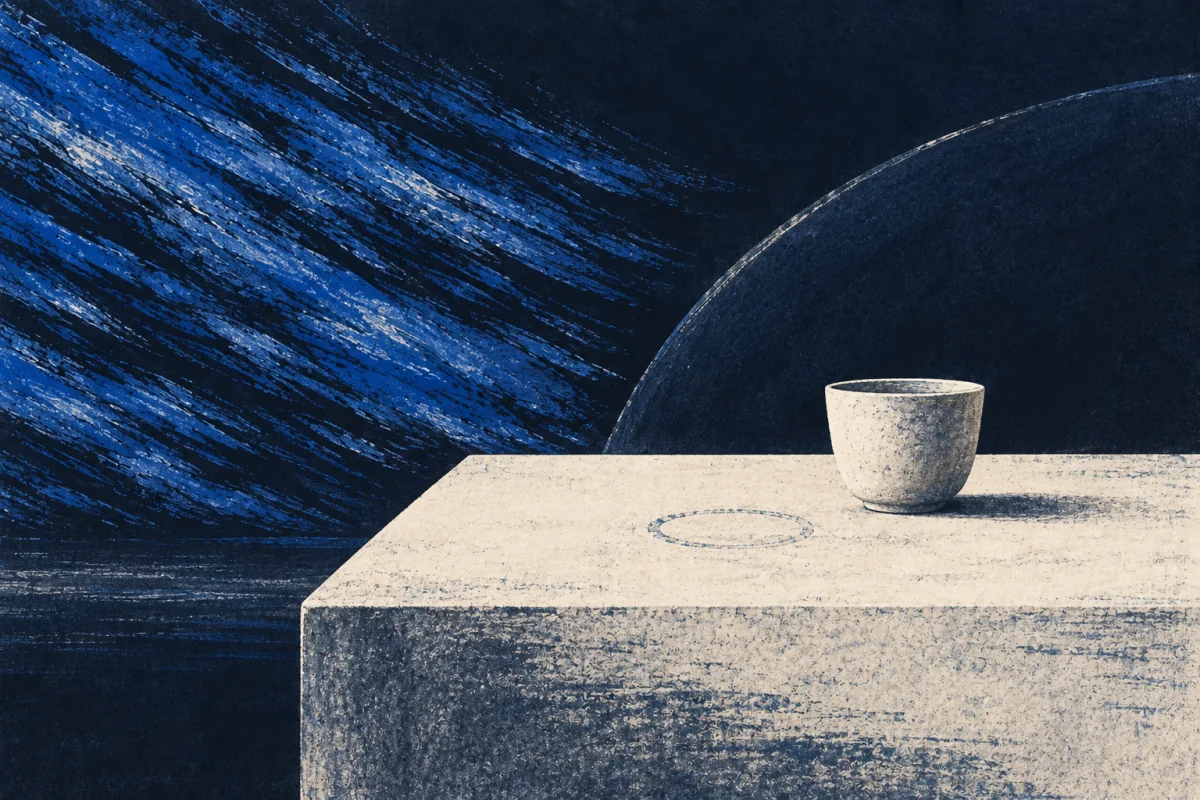
Four inches.
The mug moved back from the edge, by somebody walking past, without breaking their stride.
Nothing happens next, which is the point and also the problem: there is no way to demonstrate that it mattered. A household where this is being done looks identical to a lucky one, and the difference only becomes visible on the day somebody is not there.
Where It Stops
Being cautious is not this, and neither is being fond of children. The reading is predictive and specific to a person who cannot manage a risk themselves.
It goes wrong as anxiety with a justification attached. The same forward reading can start generating hazards that are not there, and the difference between somebody moving a mug and somebody unable to let a child out of sight is one of degree and is genuinely hard to see from inside.
It also fails as taking over. A child who is never allowed near an edge does not learn about edges, and there is a real cost to a childhood in which every risk was removed by somebody else before it arrived.
Take the plainer explanation first. Anybody caring for small children removes hazards, because the job requires it. The test is whether it runs for people who are nothing to do with them — somebody else's toddler, a stranger's elderly parent, a colleague on crutches.
Where It Pays
Inside a job. Childcare and early years work, nursing and care work, teaching and supervision, occupational health and safety, health visiting, social work, and disability support. Also design and facilities roles, where the whole discipline is removing hazards from environments rather than warning the people in them.
What is being bought is incidents that did not happen. Every safety-critical setting eventually learns that engineering the environment beats instructing the people in it, and somebody who does that instinctively and continuously is worth considerably more than a policy and is a great deal cheaper than an investigation.
Where it pays badly is almost everywhere it is informal, which is most places. It pays badly in care and childcare, which are near the floor of every pay scale, and in any organisation that funds safety only after an incident, which is the common pattern. In the meantime the work gets done quietly and for nothing by whoever noticed.
Outside one. Households, extended families, congregations and every gathering with small children or frail people in it. The cost worth naming is that this person does not get an evening off at a family occasion, and everybody else's relaxation is partly a function of one person not relaxing at all.
Try This
Walk through a room you know well and look at it from two feet off the floor.
Not metaphorically. Crouch down and look. Cables, edges, handles, hot things, the gap under the stairs.
Then fix three of them, physically, without telling anybody.
Then do the same thing for whoever in your life is least able to manage a risk, whatever their age, and notice how differently the same room reads.
Most people find the hazards were always visible and that they had stopped seeing them, which is the whole of what this attention is doing.
Looking ahead is a tool, not a self. Pick it up where somebody cannot yet look after themselves. Put it down when they can, because removing every edge from a person's life teaches them that edges are somebody else's problem.
If This Isn't You
Plenty of people notice the hazard when somebody trips over it, deal with it then, and have a much more restful time. Not seeing it coming is an answer, not a negligence.
Where To Go Next
Its near-twin — Hearth-Defender. Both make small unannounced adjustments to a room for somebody else's benefit. Hearth-Defender is reducing strain so that people can stay and rest. This one is preventing a specific harm, and the adjustment is about danger rather than comfort.
Its shadow — Field-Initiator. Field-Initiator deliberately puts people into calibrated danger because that is how they learn. This one removes it before it arrives, and the two are arguing about the same child.
Most often confused with — Protective Watcher. Both watch in order to keep people safe. Protective Watcher is reading people for intent, and the danger is usually somebody. This one is reading environments for hazards, and the danger is usually a table.