In Plain Sight
Some people read a body that has stopped speaking. Bruise, bone and stain, taken as the record of what happened. It takes patience with detail, no flinching at decay, and a willingness to sit with the dead long enough for a sequence of events to come clear. You'd notice this in the one a family calls when something about a death does not add up.
The Pattern at Work
The reading is a reconstruction from physical evidence, and the order matters more than any single finding. Bruising of different ages means injuries happened at different times. A fracture pattern says which direction a force came from. Staining says what position a body was in and for how long. Each observation is small and means little alone, and what is being built is a sequence: this happened, then this, then this, and the times between them can be estimated.
Almost all of the discipline is restraint. There is enormous pressure — from families, from police, from the obvious story — to say what happened, and the correct answer is very often that the findings are consistent with several things. Somebody good at this separates what was observed from what is inferred, every time, in writing, and refuses to let the second contaminate the first. The strongest practitioners are the ones most willing to say they cannot tell.
Tolerance for decay is a real and uncommon prerequisite. Much of this work involves conditions that most people cannot be in the room for, and the attention has to remain fine and systematic under those conditions rather than becoming hurried, because the instinct to get it over with is exactly what loses evidence.
And the work is done for people who will read it later. A report is written for a court, a family, a pathologist in ten years, and the discipline of recording what was seen rather than what was concluded is what makes it usable.
What the Examples Show
It gets read as forensics, or as a strong stomach, or as a morbid interest in death.
The first element is that a sequence is being reconstructed from physical traces. The individual findings are almost meaningless; the ordering and the timing are the work.
The second is the separation of observation from inference. What was seen and what it might mean are kept apart deliberately, because the pressure to collapse them is constant and collapsing them is how wrong conclusions become permanent.
The third is that the material conditions are part of the competence. Working carefully, at length, in circumstances most people cannot tolerate is not a side issue; it is a requirement, and it excludes most people who are intellectually suited.
Going Deeper
Reading the dead for what happened to them is old, and it became reliable only recently.
The Song dynasty manual on washing away wrongs set out systematic examination of bodies in the thirteenth century, including distinctions that still hold. European medico-legal practice developed through the eighteenth and nineteenth centuries as courts began demanding physical evidence. Forensic anthropology grew out of archaeology and anatomy, and now does a great deal of the work of identification after mass casualties. Modern forensic pathology added toxicology and imaging, and in doing so exposed how much earlier confident testimony had been wrong. That last point is the most important thing about the history of this work. Every generation of examiners has believed its methods sound, and every generation has had some of them overturned by the next, which is why the good practitioners now write their reports to be checkable rather than to be believed.
The costs and the dangers are both real. Over-confident forensic evidence has sent people to prison, and several whole subfields have been discredited, which is a history anybody in this work carries. The psychological load is heavy and was denied for a long time, particularly for those working with children and with mass fatalities. It is isolating socially: people do not want to hear about it, so the working life is discussed with almost nobody. And the pressure is structural — investigators want a finding, families want an answer, and the honest report is frequently the one that satisfies neither.
The Image
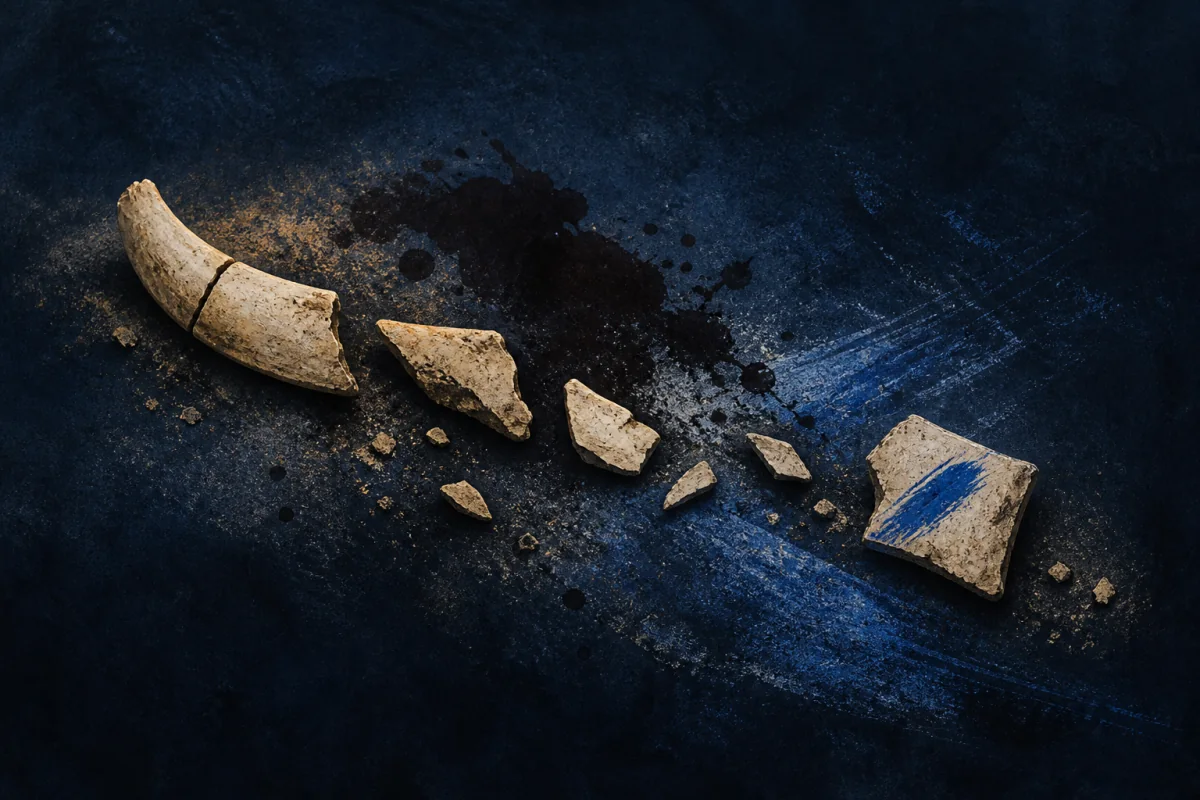
Two ages of bruising.
Marks on one body that did not happen at the same time.
Nothing else about the finding is dramatic. It says that whatever happened happened more than once, and it converts a single event into a sequence, which is often the entire difference between an accident and something else. It is found by looking carefully at something most people would rather not look at.
Where It Stops
Being unsqueamish is not this, and neither is an interest in crime. The work is systematic reconstruction and careful separation of what is known from what is guessed.
It goes wrong as certainty. The single greatest failure mode in this field is a confident expert opinion that outruns the evidence, delivered to people with no way to evaluate it, and the damage from that has been severe and repeated.
It also fails where the reading is asked to do too much. Physical evidence constrains what can have happened; it rarely determines intent, and the distance between those two is where most miscarriages live.
Take the plainer explanation first. Anybody in forensic work examines systematically, because the protocol requires it. The test is whether the attention appears elsewhere — a dead bird, an old injury on a living person, a photograph that does not quite fit the account given of it.
Where It Pays
Inside a job. Forensic pathology and anthropology, coronial and medical examiner work, mortuary and autopsy technical roles, crime scene investigation, disaster victim identification, veterinary pathology, and archaeological human remains work. Also insurance and safety investigation, where establishing a sequence from physical traces is the whole question.
What is being bought is a defensible account of what happened. Courts, coroners and families all need something that will hold up under challenge, and the difference between an expert who states the limits of the evidence and one who does not is the difference between a finding that survives and one that is overturned a decade later.
Where it pays badly is in the technical grades, where the conditions are hardest and the pay is lowest. It pays badly wherever services are under-resourced enough that backlogs build, which happens in most countries, and in any system that pressures examiners towards the conclusion an investigation would prefer.
Outside one. Almost nowhere, and that is worth saying plainly: this is one of the few readings with essentially no informal version, because access to bodies is rightly controlled. The cost worth naming is that the work cannot be talked about, so the people who do it carry it privately and are frequently alone with it.
Try This
Do the reasoning without the material. Take any object that has broken or worn out — a tool, a shoe, a piece of furniture, a bicycle part.
Look at it and write down only what you can see. Where the wear is, which direction the crack ran, what is missing, what is discoloured.
Then, separately, write what you think happened, in sequence.
Then check which parts of the second list are actually supported by the first. Most people find half of it was assumption, and that gap is the entire discipline this work is built on.
Reading what is left is a tool, not a self. Pick it up where something cannot account for itself. Put it down at the edge of the evidence, because past that line a confident answer does more harm than no answer at all.
If This Isn't You
Most people would find an hour of this unbearable and are glad somebody else is willing, which is an entirely reasonable division of labour. Not wanting to look is an answer, not a weakness.
Where To Go Next
Its near-twin — Evidence Mapper. Both reconstruct events from physical traces. Evidence Mapper works the scene — position, spread, what was disturbed — and reasons across a space. This one works the body itself, where the evidence is in tissue and bone.
Its shadow — Body-Eye. Body-Eye reads the living surface for what is happening now and is trying to prevent something. This one reads after the fact, and nothing can be changed by what is found.
Most often confused with — Truth-Seeker. Both want to know what actually happened. Truth-Seeker will follow any line of evidence and is after the whole account. This one stays strictly within what the physical traces support, and considers the rest somebody else's job.