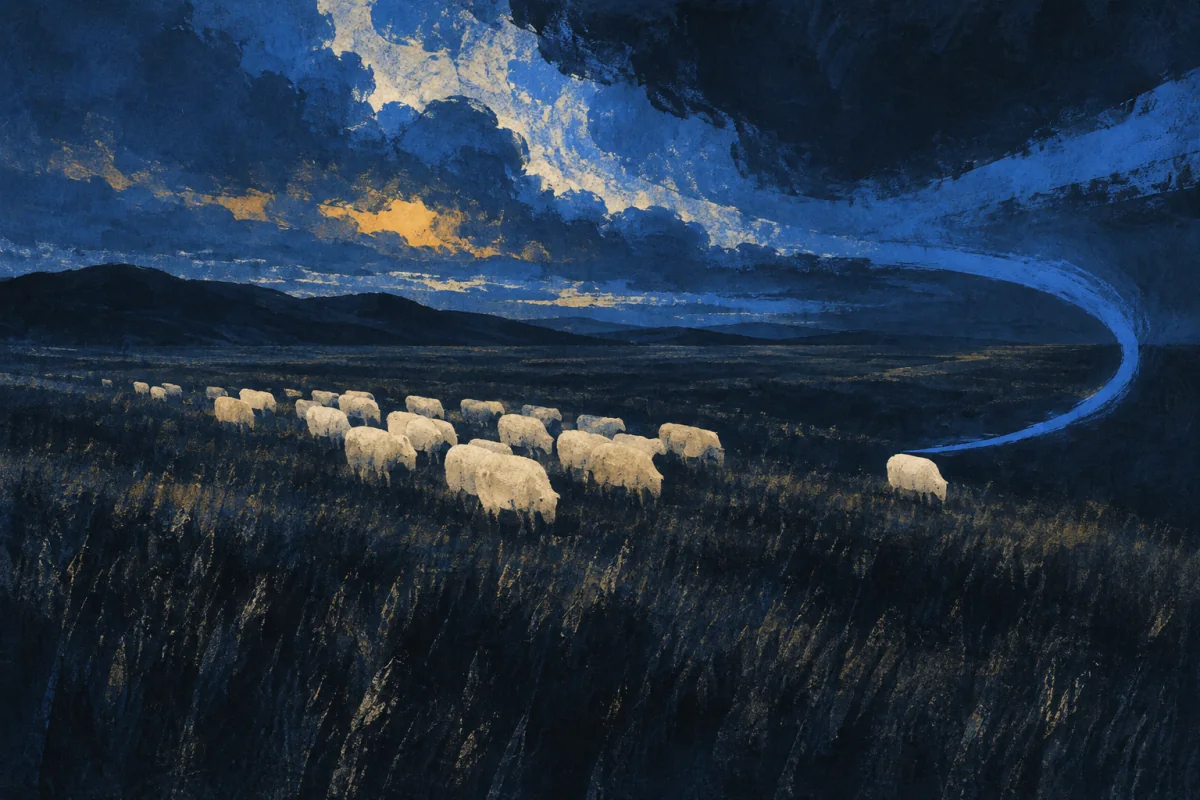
In Plain Sight
Some people move large animals across grass, snow and weather, and read the herd's mood, the state of its feet and the shape of the land in one look. They stay out for long stretches, count heads without thinking about it, and know which animal is wrong before anything shows. You'd notice this in the one still waking before light to go and look.
The Pattern at Work
Moving a herd is done by arranging where the pressure comes from rather than by pushing anything. A hundred animals have a collective behaviour, and somebody who understands it changes position by a few yards and the whole group drifts through a gate. Done badly the same job is an hour of shouting, a stressed herd, and two animals through a fence. Position, angle and pace are the entire instrument, and the quietest stockperson in the yard is almost always the most effective one.
Reading the individual within the group is the other half. Health shows in a herd in a sequence that is legible days before anything obvious: an animal standing slightly apart, one that is last through a gate when it is usually third, a difference in how the weight sits on a foot. Somebody with this reading picks it out while walking past, and the count is happening at the same time, in the background, without any deliberate counting. That early notice is most of the difference between a treatable case and a dead animal.
The land is read alongside the animals, and the two are the same problem. Which paddock is coming on, which is being punished, where the stock will shelter when the wind turns, where the ground will hold up through a wet week. A grazing plan for a season is mostly this, held in the head and adjusted by what the grass is actually doing rather than by the calendar.
And the hours are the condition. Before light, in weather, alone, and every day of the year including the ones everybody else has off.
What the Examples Show
It gets read as farming, or as being good with animals, or as a way of life people are born into.
The first element is reading a group as a single body with behaviour of its own. Movement is achieved by adjusting pressure rather than by force, and the skill is invisible until somebody without it tries.
The second is picking the individual out of the group early. The signs are small and relational — where an animal is in the order, how it stands — and they are read continuously rather than at inspection.
The third is that stock and ground are one system. Decisions about animals are decisions about grass, and somebody who reads only one half will be right for a season and wrong for a decade.
Going Deeper
Keeping large animals is among the oldest occupations, and it has always organised whole societies around it.
Cattle cultures across East Africa built wealth, marriage and status on herds, with a vocabulary for coat patterns and conditions far richer than any European equivalent. Transhumance in the Alps, the Pyrenees and Central Asia moved animals between altitudes on a calendar that everything else fitted around. Ranching in the Americas and Australia produced a working culture built on covering enormous ground with very few people. Highland and Irish cattle keeping sustained communities on land that would grow almost nothing else. In all of them the knowledge passed by working alongside somebody, from childhood, and none of it was ever written down in a form that would survive the working lives that carried it.
The pressures now are mostly economic, and they fall hardest on the people doing the work. Margins in livestock are thin to the point of absurdity, and a skilled stockperson frequently earns less than the machinery costs to run. The work does not stop, so holidays, illness and family events are all negotiated against animals that must be checked, which is an unusual constraint to carry for forty years. It is dangerous in a way the figures make plain: livestock handling injures and kills more farm workers than almost anything else. And the whole sector is under a scrutiny that lands personally, so people doing careful work with animals they know individually are addressed as though they were an industry.
The Image
Two yards left.
The stockperson moves a short distance, says nothing, and a hundred animals turn towards the gate.
Nothing was driven. The herd responded to where the pressure came from, and the person who knows exactly where to stand looks, to anybody watching, as though the cattle simply decided to go. Every alternative involves shouting and a worse outcome.
Where It Stops
Liking animals is not this, and neither is owning some. The reading is of a group and of ground, built over years, and it is what separates competent stockmanship from the alternative.
It goes wrong as fatalism. Long experience of losses can turn into an acceptance that some things cannot be helped, applied to situations where they could, and a herd can slowly become less well kept without anybody noticing the drift.
It also fails at scale. The reading depends on knowing animals individually and on walking the ground, and systems that put thousands of animals under one person remove exactly what makes the skill work.
Take the plainer explanation first. Anybody keeping stock checks them and moves them, because the job requires it. The test is whether the same reading runs on animals that are nothing to do with them — somebody else's field, a market, a group of sheep seen from a road.
Where It Pays
Inside a job. Livestock farming and ranch work, stockmanship and herd management, dairy, veterinary and technical support roles, livestock transport and market work, abattoir welfare roles, and grazing management for conservation. Also breeding and genetics work, where somebody has to judge animals by eye before any figures are involved.
What is being bought is early detection and low-stress handling, both of which show up directly in money. Animals caught early are treatable, herds handled quietly produce more and injure fewer people, and the difference between a good stockperson and an adequate one is measurable across a year in a way almost nothing else on a farm is. It is also one of the few farm skills that cannot be bought in as a service, since it depends on the same person seeing the same animals repeatedly.
Where it pays badly is throughout livestock agriculture, where the value is real and the margins do not allow it to be paid. It pays badly in systems that measure throughput, and in any operation where the person who knows the animals has no say over stocking rates.
Outside one. Smallholdings, commons grazing, family farms and the people who keep a few animals well. The cost worth naming is that the animals do not observe Christmas, illness or bereavement, and somebody has to go out regardless.
Try This
Find any group of animals you can watch without disturbing. Cattle, sheep, horses, even a flock of birds on a field.
Watch for twenty minutes and find the order. There is one: who moves first, who follows, who is at the edge, who is last.
Then come back another day and see whether the order is the same, and who has changed position.
The one who has moved down the order is the one a stockperson would look at. That is the whole reading, and it works on any social animal.
Reading a herd is a tool, not a self. Pick it up where animals have to be moved and kept well. Set it down where pressure is being applied to something that cannot move away, because the same instrument used badly is just force.
If This Isn't You
Most people see a field of cattle as a field of cattle, and are perfectly right to. Not seeing the order in it is an answer, not a blindness.
Where To Go Next
Its near-twin — Animal Whisperer. Both read animals closely. Animal Whisperer works with the individual and its state of mind, often one creature at a time. This one reads a group as a body and moves a hundred at once.
Its shadow — Bench-Improviser. Bench-Improviser fixes what has already broken, at a bench, with time to think. This one works to make sure nothing breaks, outdoors, on a schedule set by weather and by animals.
Most often confused with — Ground Yield Maker. Both make land produce. Ground Yield Maker is thinking in outputs, inputs and what the ground can be made to return. This one is thinking in animals, and the grass is read through what it does to them.