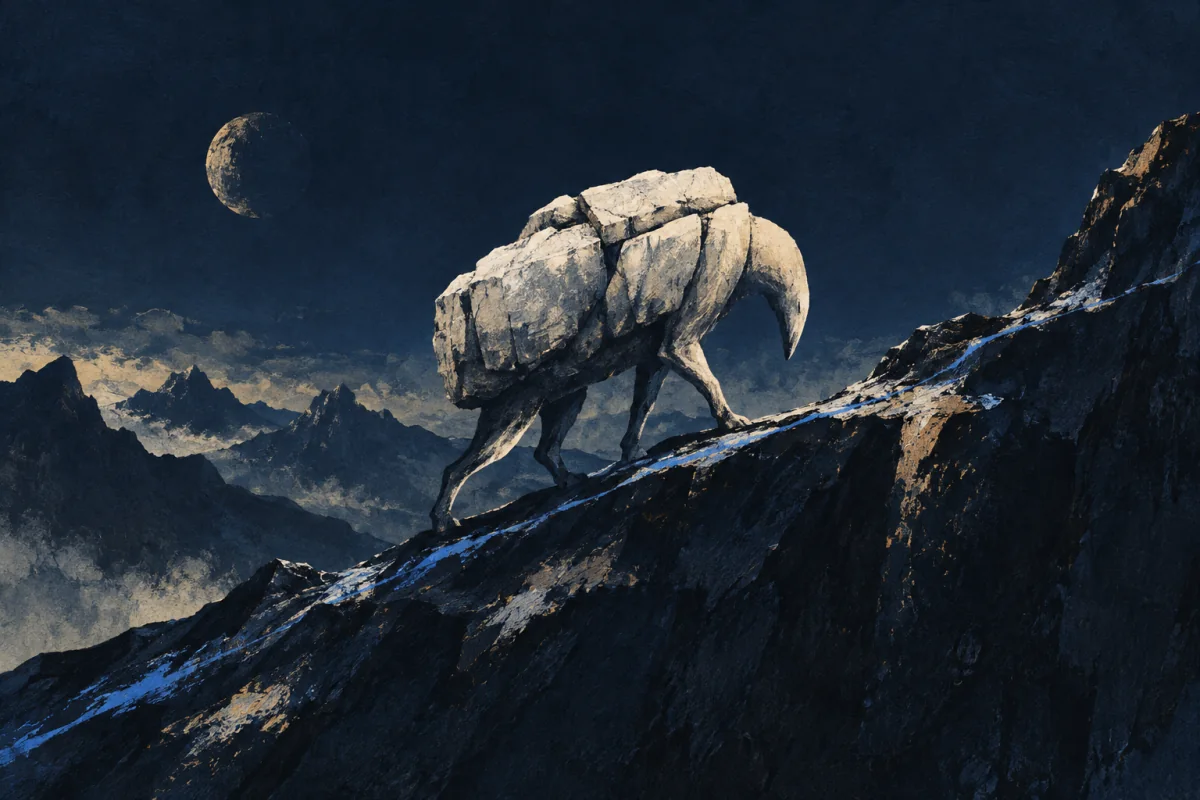
In Plain Sight
Some people take on physical hardship alone and on purpose. They are not proving anything to anybody. Long walks, long fasts and mountains entered without company are how the thing gets found out, and there is very little talk about it afterwards. You'd notice this in the one who went away for a month and said almost nothing on returning.
The Pattern at Work
Four scenes, one shape: difficulty chosen, taken alone, and not reported.
He walks for three weeks with no fixed route and tells two people where he is going in only the vaguest terms. There is no photograph and no account of it afterwards. Asked how it was, he says it was good and changes the subject, and this is not modesty or evasiveness — the thing that happened is not in a form that survives being described, and attempting to describe it would replace it with an anecdote.
A woman fasts for four days twice a year and has done for two decades. She is not religious about it in any doctrinal sense and is not doing it for health. What she is after is the state that arrives somewhere in the second day, which she cannot get to any other way and which reorganises something.
A climber goes alone on ground he could comfortably do with a partner, and it is a different activity entirely rather than a harder version of the same one. The same route, roped, is a physical problem to be solved. Unroped it is an attention problem, sustained for hours, with no possibility of letting go of it, and only one of those two things holds any interest for him.
Somebody walks all night rather than sleep, in bad weather, for no reason anybody could put into a sentence, and comes back at seven in the morning settled in a way that a fortnight's holiday has never produced. The next person who asks about the weekend is told it was quiet.
What the Examples Show
It gets read as endurance, or as risk-seeking, or as running away from something.
The last is worth taking seriously because it is sometimes true. But the pattern is more specific than escape: what is being sought is a state that only appears when the body is under sustained strain and there is nobody else present, and both conditions are necessary. Company changes it. Being watched changes it. Talking about it afterwards reliably destroys it.
The strain is functional rather than punitive. Hunger, distance, cold and sleeplessness all quiet something that ordinary life keeps loud, and the quieting is the object. That is why the same person is frequently indifferent to sport, to competition, and to any version of this with a number attached.
And the silence afterwards is part of it rather than a personality trait. Making it into a story converts an experience into a performance, and this pattern knows that and declines.
Going Deeper
Solitary physical austerity turns up in almost every culture, usually inside a religious frame and usually practised by people at the edge of the institution.
The desert fathers went out alone and the accounts of them are mostly by other people. Hindu and Jain ascetic traditions formalised fasting and wandering. Japanese mountain practitioners walked entire ranges for months at a time, within a tradition that had a name for it and still expected them to go alone. Vision quests across several North American traditions put a young person alone without food for days. Long pilgrimage routes everywhere, from Kumano to Santiago to Kailash, are recognisably the same practice with a destination attached, and the destination does a good deal of social work in making it explicable to everybody who stayed at home.
The frames differ enormously and the practice is remarkably constant, which suggests the frames were fitted to something people were already doing.
What it costs is mostly borne by other people. The risk is real and solitary, which means that when something goes wrong it goes badly wrong, and the people at home carry an anxiety the person themselves does not feel. It is also socially illegible: there is no achievement to report, no cause attached, and in a culture that understands hardship only as training or as charity, doing it for its own sake reads as either self-indulgence or pathology. And it is genuinely hard to distinguish from self-harm from outside, and occasionally from inside.
The Image
No photograph.
Three weeks, alone, and nothing brought back: no account, no picture, no achievement to name.
Anything done for its own sake has this test available to it. If the thing has to be reported before it counts as having happened, then something other than the thing was the point. Most of what people describe as solitude does not survive that test, and almost nobody applies it.
Where It Stops
Being fit is not this, and neither is liking the outdoors alone. The specific thing is deliberate strain, taken solitary, pursued for a state rather than for an outcome.
It goes wrong as escalation. There is no external limit, no coach and no competitor, so the dose creeps, and a practice that was restorative at three days becomes damaging at seven with nobody in a position to notice.
It also fails where other people depend on the person. A family, a business or a crew cannot absorb somebody disappearing for a month, and the pattern is notably poor at recognising that the cost has been transferred rather than avoided.
Take the plainer explanation first. Plenty of people walk, fast or climb alone because it is convenient or because nobody else was free. The test is whether solitude is being chosen when company was available and would have been easier.
Where It Pays
Inside a job. Not many jobs, honestly. Remote field and survey work, solo-handed sailing and delivery, long-distance guiding and route proving, some expedition and research roles, and anything requiring somebody to be self-sufficient and unsupported for weeks. Also the training end of endurance sport and of military selection, where the capability matters and the appetite is what sustains it.
What is being supplied is a very high tolerance for unsupported effort, which is rarer than physical strength and is what actually decides who can do this work. Plenty of people are physically strong enough for a fortnight alone in difficult country. Almost nobody finds it restorative rather than depleting, and the difference between those two shows up sharply in the second week, which is where selection for this kind of work actually happens.
Where it pays badly is in teams, in anything requiring continuous availability, and in any role where the person is a single point of failure. Outside one. Walking, climbing, sea kayaking, long solitary anything. The cost worth naming is not to the person. It is the standing anxiety carried by whoever is at home, which cannot be argued away and is rarely acknowledged as a real cost by the one causing it.
Try This
Do something ordinary and physical for considerably longer than is comfortable, alone, and tell nobody you are doing it.
Walk for five hours with no destination. Skip a day of food if that is safe for you. Stay out all night somewhere legal.
Take no photographs. Post nothing. Make no plan to describe it to anybody.
Afterwards, notice the pull to tell somebody. That pull is worth examining more than the experience is, because it is the difference between doing a thing and collecting it.
No photograph is a tool, not a self. Pick it up where something can only be found out by going alone. Put it down where people are relying on you, because there the strain is being paid for by somebody who did not choose it.
If This Isn't You
Most people take their hardship as it comes, which is plenty, and see no reason to add any, which is entirely sane. Feeling no pull toward a fast or a night on a hill is an answer, not a softness.
Where To Go Next
Its near-twin — Map-Edge Walker. Both go alone into hard country and are comfortable there. Map-Edge Walker is after the place beyond the information and comes back with knowledge of it. This one is indifferent to where, and comes back with nothing at all.
Its shadow — Ground-Shaker. Ground-Shaker trains alone for years so that a crowd can watch one maximum effort. This one does the same volume of solitary effort precisely so that nobody watches, and the public moment would spoil it.
Most often confused with — Inner-Walker. Both go inward alone and neither reports back. Inner-Walker works on the mind directly and can do it sitting in a chair. This one needs the body under strain, and finds the chair useless.