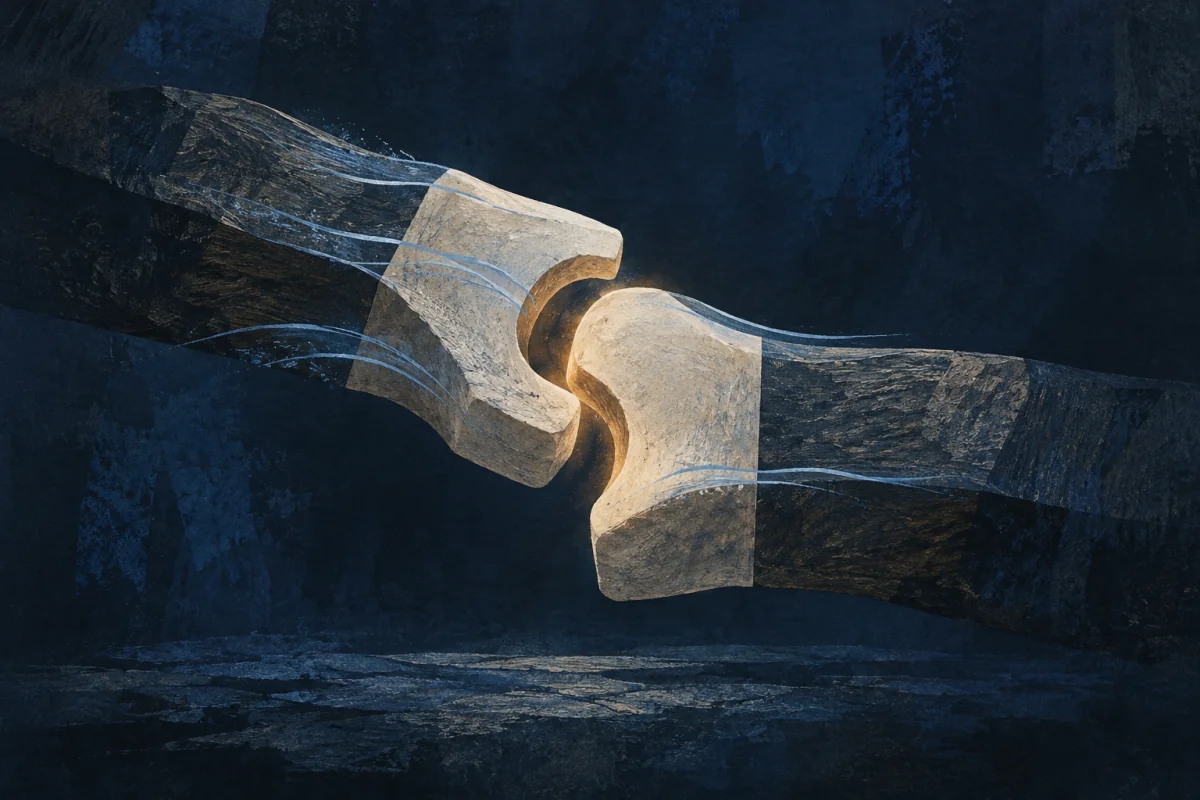
In Plain Sight
Some people find the moment a joint goes back where it belongs. They are not guessing at it. The hands read tension and the give of tissue against a picture of the body held in the head, and then one small movement does it. You'd notice this in the one whose neighbours arrive sore and walk out straight.
The Pattern at Work
The man has had a locked neck for three days and cannot turn his head to the left. The practitioner spends about eleven of the fifteen minutes doing nothing that looks like treatment: moving the arm through a small range, pressing along the spine and waiting for a response, asking him to turn until it stops and then letting go of the arm to see what happens. What is being built is a picture of which segment is not moving and which ones are moving too much to compensate, because the painful place is usually the compensator. The actual technique takes under two seconds and is the least interesting part of the appointment. He turns his head in the car park.
A farmhand has put a finger out and the nearest hospital is fifty minutes away. The neighbour who reduces it does not pull. She feels where the joint surfaces are sitting, takes the slack out, and lets the tissue itself draw it back, which is why it goes in easily and why the same manoeuvre performed with force would not.
A woman's hip has been painful for a year and every scan has come back normal, which she has been told is good news and does not feel like it. The work does not go near the hip at all. It goes to the opposite ankle, which was broken a long time ago, healed with a few degrees less movement than it should have, and has been quietly altering how she stands for two decades. The hip has been paying for it. Three sessions on the ankle and some walking does more than a year of attention to the place that hurt.
What the Examples Show
It reads as a knack, or a gift in the hands, or something slightly suspect, depending on who is describing it.
What is running is a three-dimensional picture of a body assembled by touch and held without diagrams: where things are sitting, what is moving, what has stopped, and what is compensating. That picture is the work. The technique itself is mechanical and can be taught in an afternoon, which is why teaching it in an afternoon produces people who hurt patients.
The second element is a very specific physical judgement about slack. A joint goes back when the surrounding tissue permits it, and the skill is in finding the position where almost nothing is required, rather than in supplying force. The hands are looking for the direction of least resistance, which is usually not the direction the pain suggests.
And the painful site is treated as evidence rather than as the target. The hip, the neck, the shoulder: all of those are usually where the body is paying for something happening elsewhere.
Going Deeper
Putting joints back is as old as medicine and has spent most of its history outside it.
Hippocratic writings describe reductions and traction boards in considerable detail, with illustrations of frames that would be recognisable today. Bonesetters were a recognised trade across Europe and Asia for centuries, usually within families, passed from parent to child, and were consulted long before any physician was. The Chinese tradition of tui na and the Japanese practices around sekkotsu carry the same knowledge under their own names. Osteopathy and chiropractic were founded in the nineteenth century as attempts to systematise it, and modern manipulative physiotherapy has since absorbed a great deal of the technique while carefully distancing itself from the theories that came with it, which is probably the right settlement and leaves the practical knowledge intact.
The position has never been comfortable, and the reasons have not changed.
The effect can be immediate and dramatic, which attracts exactly the kind of claim that discredits the field, and the practitioners who overclaim are indistinguishable, to somebody in pain, from the ones who do not. The assessment cannot be shown to anybody: a picture built by hand convinces only the hand that built it. There is real risk attached, so the important half of the skill is knowing when not to touch, and that half is invisible and unrewarded. And the dramatic result creates dependence — the patient who gets instant relief wants it again next month, and a practitioner with a full diary is not always the one whose patients are getting better.
The Image
The direction of least resistance.
Not where it hurts, and not the way that looks obvious. The position in which the thing will go back almost on its own, which has to be found rather than forced, and which is usually somewhere nobody would have guessed.
Look for it in anything stuck. The question is rarely how much force is needed. It is which way requires almost none.
Where It Stops
Being strong is not this, and enthusiasm for it is a warning sign. The technique is nearly effortless when it is right and a person reaching for force has not found the position.
It goes wrong as treating everything mechanically. Pain that is inflammatory, systemic or serious does not respond to this and can be masked by it, and a practitioner who believes every problem is mechanical will delay a diagnosis that matters.
It also fails where the body is fragile. Bone disease, certain medications, older patients, anything vascular near the neck: all of those turn a routine technique into a serious event, and knowing that list matters more than any amount of skill.
Take the plainer explanation first. Any manual therapist manipulates because the training contains it. The test is the assessment rather than the technique — whether somebody goes to the ankle when the complaint is the hip.
Where It Pays
Inside a job. Osteopathy, chiropractic, manipulative physiotherapy, sports therapy, veterinary manipulation, and emergency or remote medicine where reductions have to be done on the spot. Also traditional practice where it persists, and any setting with poor access to imaging.
What is being bought is speed and reach. A great deal of musculoskeletal pain resolves in one or two sessions with somebody who can find the segment, and the alternative route is months of waiting, scans that show nothing, and medication for a mechanical problem. One person doing this well takes a large volume of low-grade suffering out of a system that is not designed for it. Where it pays badly is anywhere every intervention must be evidenced against a protocol, anywhere the clinical picture is complex and medical rather than mechanical, and in any practice model that rewards repeat visits, since this work is at its best precisely when it makes itself unnecessary within a fortnight.
Outside one. Farms, stables, sports clubs, families. The cost worth naming is that a reputation for this arrives fast and arrives unfiltered. The requests come from people who have not been assessed by anybody, at parties and over gates, and saying no is both the right answer and the one that gets remembered as unhelpfulness.
Try This
Find something in your house that is stuck — a stiff drawer, a jammed window, a bolt.
Do not pull harder. Instead, move it in every direction it will go, a millimetre at a time, feeling for where the resistance drops away.
There is nearly always a direction in which almost no force is needed, and it is nearly always not the direction of the intended movement.
Do it three times on three stuck things. That is the entire principle, and almost everybody's instinct is the opposite of it.
The direction of least resistance is a tool, not a self. Pick it up where something mechanical has stopped moving. Put it down where a person's pain has not been looked at properly, and send them to have it looked at.
If This Isn't You
Most people take a sore back to a doctor, wait, and get better anyway, which is what usually happens. Feeling no urge to find the segment that is not moving is an answer, not a squeamishness.
Where To Go Next
Its near-twin — Body-Mapper. Both hold a picture of the whole body and treat away from the pain. Body-Mapper works across a session toward a general resettling. This one is after a specific mechanical event, and knows within two seconds whether it happened.
Its shadow — Body Signal Reader. Body Signal Reader assembles a diagnosis by hand and is content to hand the treatment to somebody else. This one is after the treatment, and the assessment exists only to locate it.
Most often confused with — Touch-Healer. Both relieve pain by hand and both work quietly. Touch-Healer's effect builds through the session and is felt rather than seen. This one is looking for a single discrete moment that either occurs or does not.