In Plain Sight
Columns settle this person. They keep the record straight because a straight record is satisfying in itself, not because anyone asked. The social channel goes quiet at the desk and the symbols get loud. You'd see this in the one who recounts the cash twice before anyone questions it, and keeps the book by hand long after the software arrived.
The Pattern at Work
A stocktake runs late in an empty shop. Everyone else has gone. One person is still there because the count came out eleven short, and eleven is not a number anyone shrugs at. Not forty, which would be theft, and not one, which would be a slip of the hand. Eleven is the size of something that happened exactly once — a delivery booked twice, a box logged and never opened, a returned order that went back on the shelf without going back on the system. The record will say which, if it is read properly, and it will take about forty minutes.
In a hospital pharmacy a technician logs a controlled drug and notices the running total disagrees with the shelf by a single ampoule. There is a form for this and the form takes an hour. The hour gets spent. Nobody thanks anyone for a reconciled register; the entire value of it is that nothing ever comes of it.
A volunteer treasurer for a small football club keeps accounts nobody audits, for sums nobody would query, to a standard nobody requires. The subs are logged the week they arrive. The kit invoices match the bank line and the bank line matches the statement. When the club applies for a grant eight years later the accounts are the reason it succeeds, and by then the treasurer has long stopped explaining why the books are kept like that. Three settings, three different reasons offered, one insistence underneath all of them: the written thing and the real thing have to agree.
What the Examples Show
Everyone files this under good with numbers. The filing is wrong, and it costs this pattern most of its recognition, because plenty of people who carry it are indifferent mathematicians.
What is actually running is a low tolerance for a record that has come loose from the thing it describes. Numbers are just the place that happens most visibly. The pleasure is correspondence — the moment two independent routes to the same figure arrive together and agree.
And the quiet is not a side effect of the work. It is a requirement of it. Reading a room costs this pattern the same attention the symbols need, which is why the real work happens after everyone has left, and why open-plan offices are quietly ruinous for it.
Going Deeper
Writing was invented for this.
The oldest written documents anyone has recovered are not poems, laws or prayers. They are receipts: how much grain, whose grain, into which store, on what day. Temple scribes in Mesopotamia, tally-keepers at the granary door, monastic copyists ruling their lines. Before literature there was accounting, and someone sat with a stylus doing exactly what the treasurer does now.
That figure is why any of it held together. A settlement can only grow past the number of people who can personally know each other if there is a written record everyone agrees to trust — and a record is only trustworthy because somebody was willing to bore themselves keeping it straight, every day, for years. Every institution that has outlived its founders rests on somebody doing this unwatched, and it has always cost that somebody the same two things.
The work is invisible when it is right and catastrophic when it is wrong, so the only attention it attracts is bad attention. Nobody notices the ten thousand reconciled entries; everybody notices the one that was not.
And it removes the person from the room. The scribe is not at the feast. The treasurer is in the back office during the match. The withdrawal is not sad, and reading it as sadness is the common error — it is the condition the work requires. But it does mean a life built largely out of time spent with symbols rather than people, and the people are often genuinely unsure what this person is like.
The Image
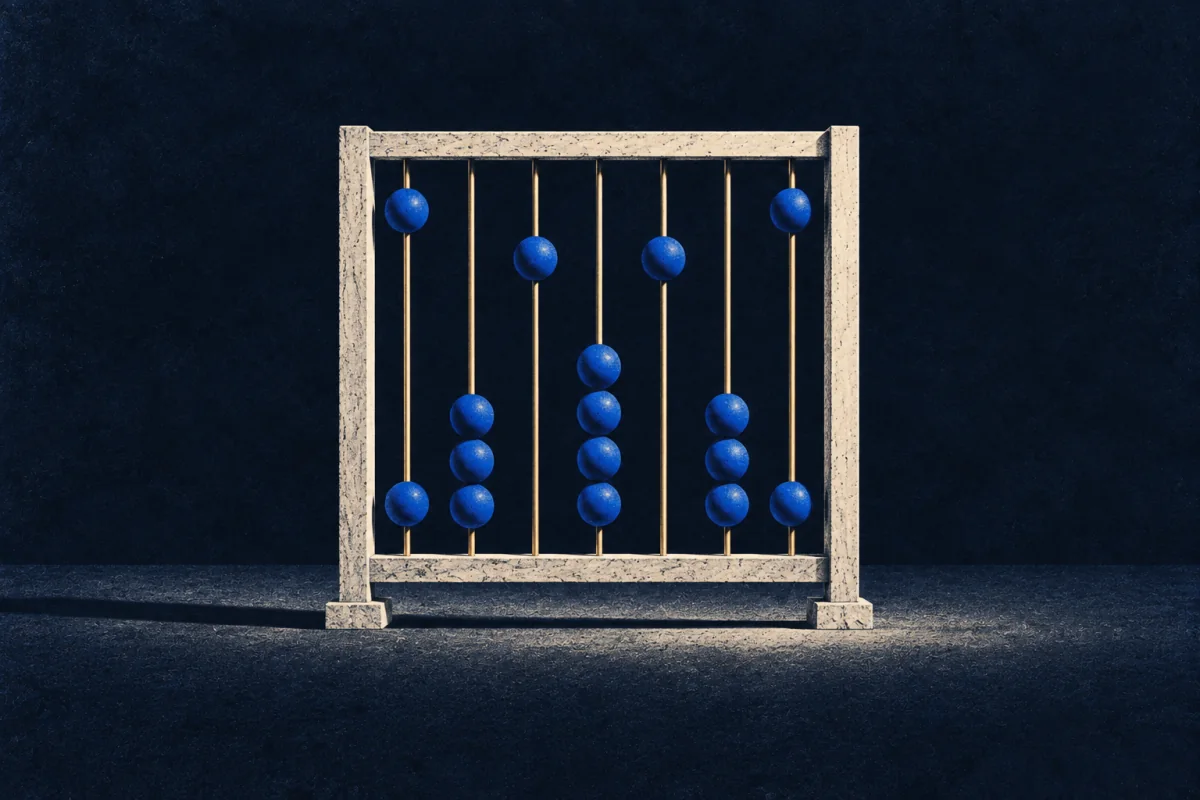
The column that comes out even.
Double-entry works because everything is written twice, by two different routes, and the two totals have to meet. Not because the bookkeeper is trustworthy — because the structure catches it if they are not.
Take that one with you. In any claim, any budget, any confident sentence: is there a second road to this number, and does it arrive at the same place?
Where It Stops
Arithmetic ability has surprisingly little to do with it. Some people who carry this pattern are slow at mental maths and perfectly content to let a machine do the sum; what they will not accept is a total that nobody can trace.
It has little to work with where nothing is recorded. Fast negotiation, live crisis, a room deciding by feel — these offer no written thing to check a real thing against, and this pattern can look slow or irrelevant in them.
It misfires as false precision. The same insistence that catches a real eleven-unit gap will chase a rounding difference for an afternoon, or present a forecast to two decimal places when the underlying guess was nearest hundred. Exactness in the record starts passing itself off as certainty about the world.
And the plainer explanation first: a trained bookkeeper does all of this because it is the job. The test is whether it happens where no one is paying for it.
Where It Pays
Inside a job. Anywhere a record has to be trusted by people who cannot check it themselves. Reconciliation, audit, inventory, data integrity, compliance, the month-end close. Also, less obviously, any young organisation at the point where informal memory stops working and nobody has yet noticed.
The real contribution is not accuracy. It is that other people get to build on the record without re-verifying it — which is the difference between a team that can move fast and a team that only thinks it can. You are the reason nobody has to go back and check.
It pays badly where the work is continuous negotiation, where the numbers are placeholders in a story being told, or where being right matters less than being quick. Those roles read this as friction, and they are not entirely wrong.
Outside one. Household accounts, a club's books, an estate, a collection, a family archive — anywhere something would quietly rot if no one kept it straight and no one else is going to. The cost worth naming is that it can read as cold or pedantic, particularly to people who experience a correction as an accusation. It is usually neither. Knowing which rooms want the discrepancy raised, and which would rather you let it go, is a separate skill, and this pattern does not supply it.
Try This
Take one number you have been repeating lately — a cost, a headcount, a metric in a deck — and trace it to its source by two different routes. Not the route you were given. A second, independent one.
Most of the time they will agree and the exercise will feel wasted. Occasionally they will not, and you will find out something nobody in the building knew.
Then notice what you do with the gap, because that is the part worth learning about yourself.
The even column is a tool, not a self. Pick it up where a record has to hold, and put it down in the rooms that need a decision more than they need a reconciliation.
If This Isn't You
Feeling nothing much here is an answer in itself, not a failure to understand. Nothing needs resolving before leaving the page.
Where To Go Next
Its near-twin — Order-Keeper. Both want things to line up. The Order-Keeper straightens the world — processes, rotas, the actual shelf. This one straightens the record of the world and will tolerate a messy shelf if the book is right.
Its shadow — Room Turner. Everything here works because the social channel is quiet. Room Turner runs entirely on that channel and needs a live audience to function. Almost nobody holds both strongly, and reading one card after the other is the fastest way to feel which end of that you sit at.
Most often confused with — Track-Counter. Both count carefully. Track-Counter counts things in the world, out where they are. This one counts the entries, at a desk, and trusts the written record over the memory of anyone who was there.