In Plain Sight
At every family gathering, there is one person who knows the names, the stories, and the connections that nobody wrote down. They carry that thread because someone has to, and they have decided it will be them. You'd find this in the cousin everyone calls before a reunion to get the story straight about who is related to whom and how.
The Pattern at Work
The funeral is on Thursday and the list of who must be told has been made by one cousin in an afternoon. It is not the address book. It includes the neighbour from the old house who is not family and would be hurt, the friend from the army whose surname nobody else can remember, the estranged brother-in-law who should be told even though he will not come, and the two people who must not be seated together. She also knows which of the three sisters should make the call to which person, because two of those pairings have history and one of them nearly ended in a solicitor's letter in 1994. None of that exists anywhere except in her. If she had been away that week, four of those calls would not have been made, and two of them would have been made by the wrong person.
The club is a hundred years old and applying for a grant that requires proof of continuous operation. There are no minutes for eleven of those years. One member can account for the gap: the hall was requisitioned, the fixtures moved to the recreation ground, and a man called Wilf kept the subscriptions in a biscuit tin and handed them over in 1947. He can name three people still alive who were there. The grant goes through on the strength of a memory nobody had thought to ask for until a form demanded it, and the committee that celebrates the money has already forgotten where the eleven years came from.
What the Examples Show
It reads as a good memory, or as being the nosy one, or as simply having taken an interest.
Memory is the material rather than the work. What is actually running is a decision, usually made young and rarely discussed, that this is going to be somebody's job and it may as well be theirs. From that point the noticing is deliberate: names get asked for, dates get checked, a photograph gets turned over and written on the back.
The second half is the indexing. The value is not in holding the facts but in being able to produce the right one at the moment it is needed — who must be told, who cannot sit together, why the two branches stopped speaking. A pile of facts helps nobody. A fact retrieved on Thursday afternoon changes what happens at a funeral.
And it is almost entirely oral. This material is not written down, because the parts that matter most are the parts nobody would put in writing.
Going Deeper
Every group that persists longer than the people in it has the same problem: the things that hold it together are precisely the things nobody records. Ownership, grievance, obligation, who is owed an apology and who was quietly forgiven. Written records capture the formal half and lose all of that.
So the role keeps being invented. The Icelandic genealogies were kept because land and kinship depended on them. West African griots held lineage as a profession, and a ruler's legitimacy could rest on what they could recite. Clan seanchaidh in the Highlands did the same work in a smaller compass. Polynesian navigators memorised genealogy and route together, as one body of knowledge. Church parish registers exist because somebody realised the oral version was failing, and they still record only what was official.
The bill is always the same and it comes due late.
Carrying an unwritten record is unpaid and unrecognised until the day it is needed, at which point everybody needs it at once and is faintly impatient that it is not already written down. It cannot be shared out, because it is not a list but an index inside one head, and the holder is generally the only person who knows how much of it there is. The material is also heavy: this is the person who knows what was done to whom, and who therefore has to decide, repeatedly, what not to say. And it has an end date. Most of these records are lost inside a fortnight of a single funeral, and the family only discovers what it had when it goes to look for something.
The Image
The list of who must be told.
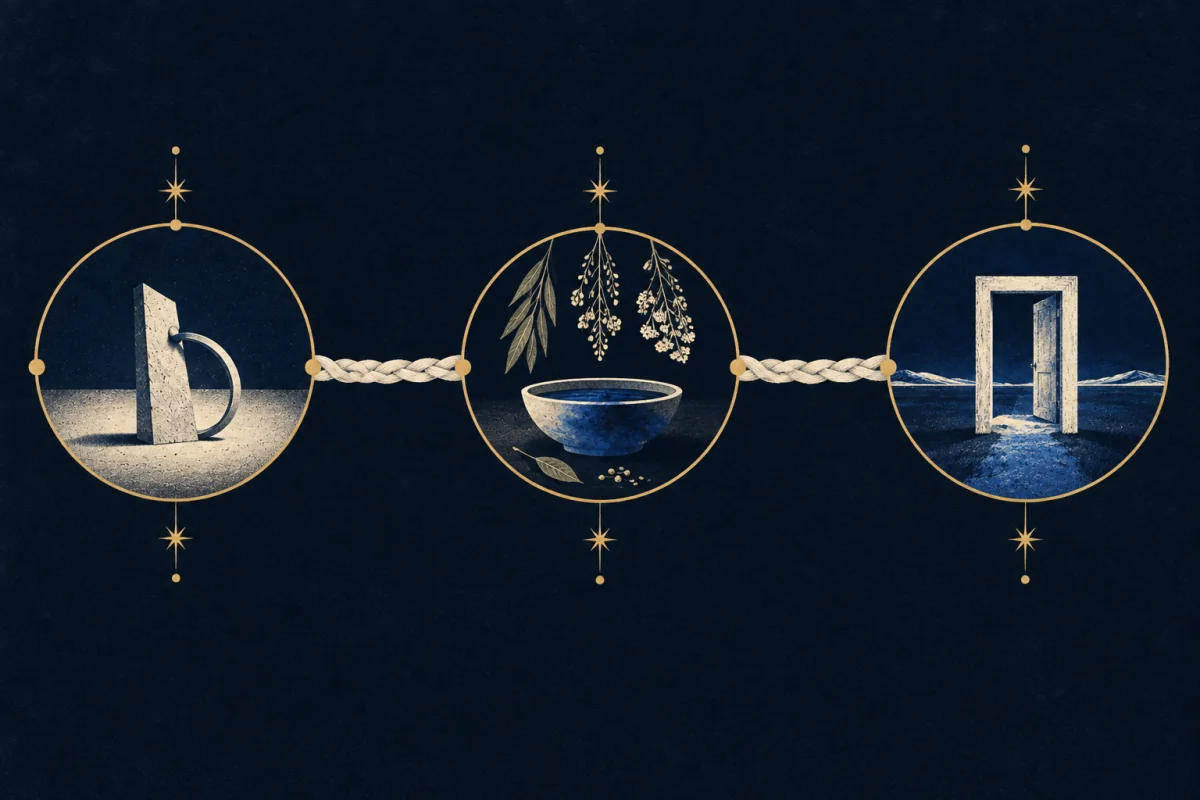
Not the address book, which anybody can open. The other list — the one that knows the neighbour counts as family, that one name has to come off, and that two of these calls must be made in a particular order by particular people.
Every family and every long-lived group has one. It is rarely written down, and there is usually exactly one person who could write it.
Where It Stops
Being interested in the past is not this. A genealogist working from records is doing something else entirely, and often knows less about the living arrangements than the cousin who has never opened an archive.
It goes wrong as owning the record. A memory held by one person can be used, and the difference between keeping the story straight and deciding what the story is can disappear slowly and without anybody noticing, including the keeper.
It also fails where the group wants to move on. Some things are not being forgotten by accident, and the person who can produce the 1994 letter at a Christmas table is not always helping.
Take the plainer explanation first. In most families the oldest surviving member knows the most, by default and not by pattern. The test is whether somebody is doing this well before their turn, and about a group they married into or joined.
Where It Pays
Inside a job. Institutional memory is the job title nobody has: long-serving administrators, clerks to committees, archivists of the working sort, company secretaries, union officers, parish and club officials. Also succession and handover work, where the point is to get out of one head what has never been in a document.
The contribution is continuity. Organisations lose the same knowledge repeatedly, and what they lose is never the procedure — it is why the procedure exists, who was hurt last time, and which supplier will not deal with them any more and for what reason. A single person who holds that turns a three-month reconstruction into a two-minute answer, and their departure is usually the most expensive thing that happens all year.
It pays badly wherever turnover is fast and deliberate, and badly again in organisations that believe a documented process is the same thing as a memory, which is most of them until the person leaves.
Outside one. Families, clubs, congregations, villages, long friendship groups. The cost worth naming is that the role is permanent once accepted: every question comes to the same person for forty years, and most of them arrive at inconvenient moments and are treated as trivial by whoever is asking.
Try This
Pick an older person in your family and ask one question you do not know the answer to. Not a general one: how the two sides stopped speaking, who paid for the house, why nobody goes to that town.
Write down what they say the same day, in their words, with the date and their name at the top.
Then ask one follow-up you would normally be too polite to ask.
Do that four times in a year with four people, and keep the notes together. Four conversations is usually more than a family has on paper.
The list of who must be told is a tool, not a self. Pick it up where a group has to hold together over time. Put it down where somebody is trying to leave the past behind on purpose.
If This Isn't You
Most people enjoy the stories at the gathering, forget the details on the way home, and are entirely good company at the next one. Feeling no obligation to carry the thread is an answer, not a carelessness.
Where To Go Next
Its near-twin — Story Keeper. Both hold what would otherwise be lost. Story Keeper keeps a telling intact and cares that it is passed on whole. This one keeps an index of relations and obligations, and would happily lose the telling if the facts survived.
Its shadow — Knowledge-Gatherer. Knowledge-Gatherer collects and organises what can be written down and consulted. This one holds precisely the material that is never written down, and would be the first to say the archive is missing the important half.
Most often confused with — Wisdom-Passer. Both bring the past into the present. Wisdom-Passer produces a previous case to change a decision. This one produces a fact to keep a group intact, and has no interest in what anybody decides.