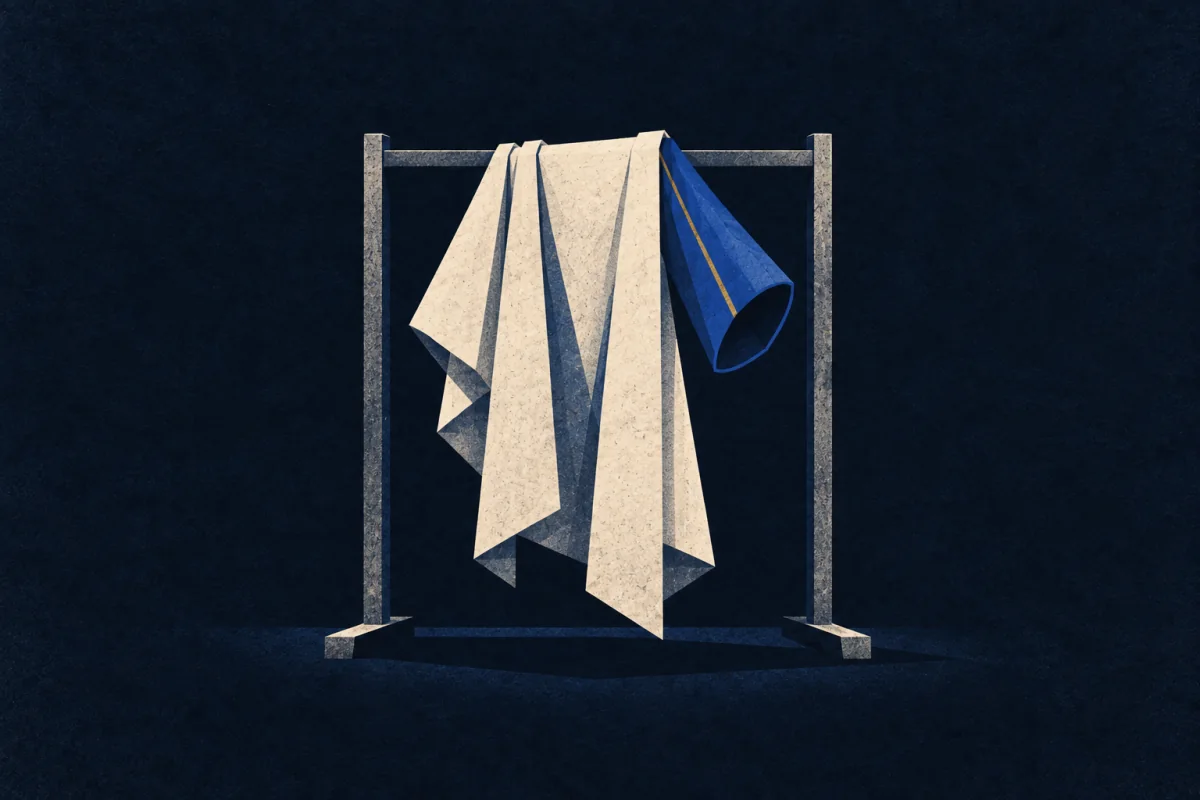
In Plain Sight
Some people make clothes that tell a room who somebody is meant to be. The cut, the weight and the colour are chosen for what they say across a crowded room, not for how they look up close. One changed sleeve and the person in it is read differently. You'd notice this in whoever fixes the school play costume and suddenly the shy king can command the room.
The Pattern at Work
The first question is what the audience has to know and how fast. A character read as poor, or as military, or as somebody's mother, has to arrive that way before a word is spoken, and in most settings the whole budget for establishing it is a couple of seconds. So the work starts from the back row rather than from the drawing: what survives distance, bad light and a moving body, and what disappears entirely.
That leads to choices that look wrong in the hand. Detail gets exaggerated or dropped altogether, a texture that reads as rich at a distance may be cheap material, colours get pushed past what anybody would wear, and a line gets simplified because complexity turns to mud beyond the third row. Somebody with this pattern is designing for the eye at a distance, which is a different craft from tailoring even though the hands do the same things.
The third element is what the clothes do to the wearer. A costume that works changes how the person inside it moves, and this is used deliberately rather than hoped for. A heavier coat slows somebody down, a stiff collar lifts a chin, shoes decide a walk entirely. A nervous performer given the right weight to carry stands differently before they have thought about it, and the maker will be watching the walk rather than the fit at the first fitting.
And it has to survive the run. Forty performances, quick changes, sweat and somebody kneeling in it nightly.
What the Examples Show
It gets read as sewing, or as dressing up, or as an eye for period detail.
The first element is that the reader is the audience, at distance. Every decision is made against what survives forty feet and two seconds, which is why the garment can look crude close up and still be exactly right.
The second is that accuracy is negotiable. A historically correct coat that reads as nothing from the back row loses to an incorrect one that reads instantly, and somebody good at this knows which battle they are in.
The third is that the garment acts on the wearer. Weight, stiffness and footwear change how a person moves before they decide anything, and that change is designed in rather than discovered.
Going Deeper
Clothing that announces a role in advance of speech is older than theatre and mostly had nothing to do with performance.
Sumptuary laws across medieval and early modern Europe governed who could wear which cloth and colour, and existed precisely because clothes were understood to establish rank faster than any introduction. Court dress, judicial robes, military insignia, clerical vestments and academic gowns all survive as fossils of that system, and all of them are still doing the two- second job. Theatre borrowed the vocabulary wholesale: Greek masks made the role legible from the top of a hillside, the stock costumes of commedia dell'arte told an audience who had walked on before the actor moved, and Beijing opera encoded rank, temperament and fate in colour and embroidery that a regular audience read fluently.
The costs are the usual costs of work that has to be finished before anybody else's work begins. The schedule is brutal and lands at the end of a production, so every delay upstream is absorbed here, and the hours before an opening are legendary in the trade for good reason. The craft is invisible when it succeeds, because a costume that works is experienced as a character rather than as a garment, and the notice will praise the performance. It is poorly paid relative to its skill, sits low in the credits, and is overwhelmingly done by women. And it is destroyed by use: the thing gets worn out, altered for a different body, or broken up for stock, so the maker keeps nothing.
The Image
The sleeve, changed once.
The child playing the king looks like a child in a sheet. You take in one sleeve and add weight to the shoulder.
He has not done anything differently. He is standing straighter because the coat is heavier, his arms are further from his sides because the sleeve says so, and the room has decided he is a king. The whole transformation is four minutes of work and it happened to the audience, not to him.
Where It Stops
Being able to sew is not this, and neither is loving clothes. A beautifully made garment that tells an audience nothing has failed at the only job it had, and the reverse is regularly true as well.
It goes wrong as swamping the performer. A costume can be so complete that the person inside it has nothing left to do, and the audience watches the coat. The garment is supposed to open a door, not walk through it.
It also fails where the audience is close. Screen work, small rooms and anything filmed in detail punish the exaggeration that makes stage costume work, and a stage instinct applied to a camera looks absurd.
Take the plainer explanation first. Plenty of people can put together a convincing outfit. The test is whether the choices change when they are told where the audience will be sitting.
Where It Pays
Inside a job. Theatre, opera, dance and film wardrobe, television and commercial costume, pageant and carnival work, historical interpretation and living museums, cosplay and fan production at the professional end, and the costume side of theme parks and immersive venues. Also uniform design, liturgical vestments, and ceremonial dress for institutions that need to be recognisable.
What is being bought is time. Every second an audience spends working out who somebody is comes off the front of the story, and a production where the costumes do their work can begin two minutes earlier than one where they do not. In immersive and themed settings the effect is more direct still, since visitors behave differently around staff whose clothes have placed them, and the whole experience rests on it.
Where it pays badly is in almost every part of the trade. The hours are worst at the point of least leverage, freelance rates are low, the work is physically hard on hands and eyes, and the credit goes elsewhere.
Outside one. Schools, amateur companies, carnivals, weddings and any occasion where somebody has to look like something. The cost worth naming is that the person who once saved a school play becomes the permanent costume department for an entire community.
Try This
Next time somebody near you has to look like something, work backwards from the room.
Stand at the far end of it and look at them. Ask what a stranger arriving now would guess, in two seconds, with no information.
Then change one large thing rather than three small ones. Weight, colour or silhouette. Detail below the shoulder will not reach the back wall.
Watch how they move afterwards. If the garment did not change their walk, it has not done its second job yet.
Building the role into the cloth is a tool, not a self. Pick it up where an audience has to know before anybody speaks. Put it down when the person inside has been left nothing to play, because there the clothes have taken the part.
If This Isn't You
Plenty of people put a crown on a child in a sheet and everybody has a lovely evening anyway. Not being able to make the cloth do the work is not a failure; most audiences are generous and most plays survive it.
Where To Go Next
Its near-twin — Garment-Crafter. Both cut and sew. Garment-Crafter is making something to be worn daily by one person and judged close up, where fit and durability decide everything. This one makes something judged at forty feet by strangers and worn for six weeks.
Its shadow — Fit Shaper. Fit Shaper works inward from the body, making a garment disappear into the person wearing it. This one works outward from the audience, making the garment arrive before the person does.
Most often confused with — Stage-Painter. Both build what an audience reads before the story starts. Stage-Painter works on the space, at scale, and it stays still. This one works on a moving body that has to be able to kneel in it.