In Plain Sight
Some people hold the beat that keeps a work party together. They are not making music. The count under the oar or the hammer keeps several bodies landing at the same moment, and drift gets caught before anybody feels it. You'd notice this in the one who taps the table when a song speeds up.
The Pattern at Work
Six people are moving a beam and it is at the limit of what six can move. The difference between doing it and dropping it is not strength: it is that all six take the weight within about a tenth of a second of each other, because a beam lifted by four and then by two is a beam that twists. Somebody counts. The count is slower than anybody's instinct, deliberately, because the slowest of them has to arrive with the rest, and the whole thing is built around that person rather than around the strongest.
Drift is the enemy and it is invisible from inside.
Two people sawing with a pit saw will speed up over about four minutes without either of them noticing, and then one of them will be pulling against the other and the cut will wander. The person holding the count brings it back a little at a time, below the level anybody registers, which is the only correction that does not break the rhythm and make everybody self-conscious.
A hammer gang on a railway track and a rowing crew at a regatta are the same problem at two different sizes. So is a kitchen at service, so is a line of people passing sandbags. In each case the productive rate is not the fastest anybody can go; it is the fastest everybody can sustain together, and somebody has to know what that is and hold it against the people who want to push.
What the Examples Show
It gets read as keeping time, which sounds clerical, or as leadership, which it is not.
What is running is an arithmetic judgement carried in the body. The right rate is a function of the weakest person, the duration and the load, and it is almost always slower than the group's instinct and faster than its complaining. Finding it takes seconds and holding it takes discipline.
The second element is correction below perception. Once a group has drifted, it cannot be told to slow down without everybody looking at each other and the rhythm dying. It has to be moved a fraction at a time over several cycles, which is a technique rather than a manner.
And the count is external on purpose. A rhythm inside each person's head is six rhythms; a rhythm outside all of them is one thing everybody can be on, and that is the entire mechanism.
Going Deeper
Coordinated physical labour has always had a voice or a beat attached to it, and it disappeared almost entirely within two generations of mechanisation.
Sea shanties existed to set the rate for hauling and were chosen for the job — a halyard shanty and a capstan shanty have different pulses because the tasks do. Rowing has kept both the coxswain and the stroke rate as formal roles, with the stroke rate written on a board. Railway gandy dancers sang to synchronise tamping, and the songs were chosen for the rate the job needed. Japanese and West African work songs did the identical job, and the same structure turns up in every culture that has ever had to move something heavy with several pairs of hands at once. None of them borrowed it from each other, which is the usual sign that the constraint did the designing.
What has been lost with the work is the knowledge attached to it.
Mechanisation removed the need, and with it the transmitted understanding of what a sustainable rate actually is, so a great deal of modern manual work is done at whatever pace the fittest person sets until somebody is injured. The role also carries no status: the person counting is not lifting as much, which looks like the easy job and is frequently resented. And it is entirely unrecorded. A lift that goes well produces nothing at all, while the one that went wrong produces an incident report naming the load, the equipment and the people, and never the absence of a count.
The Image
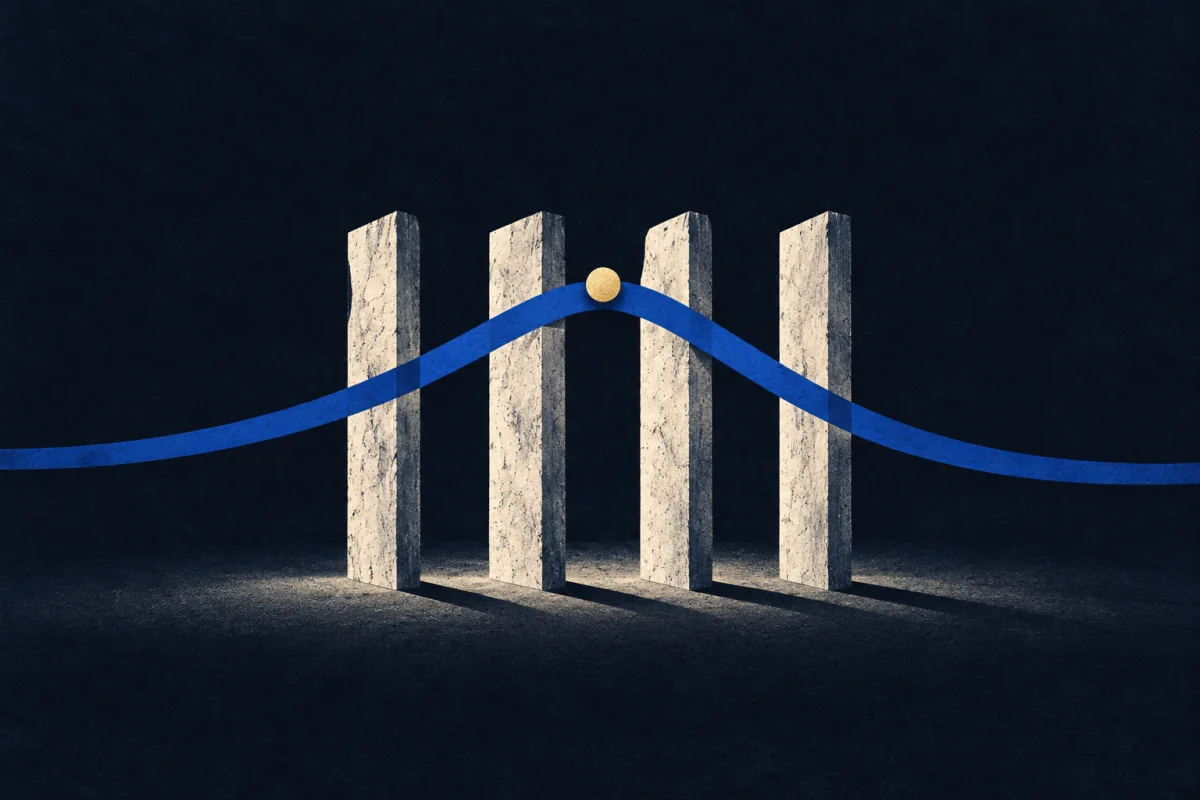
The rate of the slowest.
Not the fastest anybody can go, and not a crawl. The rate at which everybody can still be arriving together in forty minutes, held by somebody who is not negotiating about it.
Any group doing repeated physical work together has that rate. Most groups are running at the rate of whoever is strongest, and find out what that cost some time later.
Where It Stops
Musical ability is not this, though it often travels with it. The count here is serving load and fatigue rather than a piece of music, and a musician's instinct for a satisfying tempo is the wrong instrument.
It goes wrong as counting things that do not need it. Not all shared work is synchronised, and a rhythm imposed on people doing separate tasks is simply noise with authority attached.
It also fails where the group is skilled and settled. A crew that has worked together for years holds its own rate, and an external count inserted into that is an interruption.
Take the plainer explanation first. Anyone who has rowed, marched or worked a gang has been counted at and will count. The test is whether somebody sets the rate off the slowest person without being told to, on a job nobody has organised.
Where It Pays
Inside a job. Rigging and lifting, construction and demolition crews, marine and deck work, forestry, warehouse and removals, emergency services moving casualties, and any operation where several people apply force to the same object. Also rowing, dragon boat and drill, and the physical end of rehabilitation, where a patient and a therapist have to move as one thing rather than as two people cooperating.
What is being bought is fewer injuries and more sustainable output, neither of which anybody attributes correctly. Manual handling injuries cluster around uncoordinated lifting and around fatigue from working above a sustainable rate, and both are solved by one person holding a count that costs nothing. The saving appears as an absence in a safety record and gets credited to training, or to a good year, or to nothing at all.
Where it pays badly is anywhere work is individual, anywhere the task is mechanised, and in any culture that reads the person counting as the one not pulling their weight. Outside one. Moving furniture, boats, building something with friends, a village hall being emptied. The cost worth naming is that the role is invisible and mildly resented right up until the moment somebody drops something.
Try This
Next time you move something heavy with other people, do not lift on three.
Instead, watch who is slowest getting into position, and set the count so that person is ready. Say it out loud and keep it identical every time.
Then count the lifts. On about the fourth, everybody will have sped up, and you will feel the pull to go with them.
Do not. Bring it back by a fraction and notice how nobody remarks on it.
The rate of the slowest is a tool, not a self. Pick it up where several bodies have to act as one. Put it down where people are working separately, because there a count is only a way of being in charge.
If This Isn't You
Most people lift on three, get the thing moved, and think no more about it, which works the large majority of the time. Feeling no urge to set the rate is an answer, not a passivity.
Where To Go Next
Its near-twin — Drummer-Mind. Both carry a pulse for other people and both correct below the threshold of notice. Drummer-Mind is serving the music and would sacrifice anything to keep the feel. This one is serving load and fatigue, and would ruin any rhythm to protect the slowest person in the gang.
Its shadow — Marching-Voice. Marching-Voice carries frightened people forward through something and is deliberately audible and stirring. This one is flat, unstirring and arithmetic, and exists to stop people hurting themselves.
Most often confused with — Stage-Caller. Both call a group through a sequence. Stage-Caller marks discrete moments — standby, go — from a written order. This one holds a continuous rate and has nothing written down at all.