In Plain Sight
Some teachers hand music down one phrase at a time. They are not working through a syllabus. What a player almost has gets named, shaped and then left for the years it takes to set. You'd recognize this in the one whose former students are now teaching students of their own, in the same three words.
The Pattern at Work
The student plays four bars and they are not wrong. The teacher says one thing, which is not about the notes, the rhythm or the fingering, and is about where the phrase is going: that she is arriving at the fourth bar as though it were a destination when it is a doorway. That is not a correction that can be applied. It is a description of something the student is already half doing, said aloud so that she can hear it, and it will take about eighteen months to become how she plays.
The same lesson contains about three of those, and everything else is repetition. Scales, the same passage, the same two bars slowly. The teacher says very little during the repetition, which parents watching from a chair by the door sometimes read as value for money not being delivered.
Then there is the waiting, which is the part nobody sees. A phrase named in March does not change in March. It goes underground, the student stops thinking about it, and in the autumn it surfaces, in a different piece, without anybody mentioning it again. A teacher who chases it in June destroys it outright, and a great deal of this craft is knowing that and then not chasing.
Years later the student teaches somebody else and uses the same three words, in the same order, with the same slight emphasis. She does not remember where she got them and would be surprised to learn they were not hers.
What the Examples Show
It reads as musicianship being passed on, or as patience, or as a good ear for what a student needs.
What is distinctive is the naming. What gets said is not an instruction but a description of something the student is already partly doing, and the usefulness comes from hearing it rather than from being told to do it. An instruction produces a student applying a rule. A name produces a student who now perceives something and cannot stop perceiving it.
The second element is the delay. Almost everything real in music teaching takes months to appear, which means the feedback loop is far longer than the lesson, and a teacher who wants results this week will reach for instructions and get compliance instead of hearing.
And it is transmitted rather than taught. What is being handed over is a particular way of hearing a phrase, carried down through a line of teachers, and the words that carry it are often the same words for three generations.
Going Deeper
Music has been handed down person to person for as long as there has been music, and the written half has never carried the important part.
Indian classical training puts a student with one teacher for a decade or more, and what is transmitted is a way of moving through a raga that no notation holds. Conservatoire lineages in Europe trace themselves back through named teachers, and players identify each other's schooling by phrasing. Jazz was learned from records and from bandstands, which is the same transmission by a different route and produced lines of influence that can still be heard. Suzuki built an entire method on the observation that children learn to speak a language fluently by hearing it for years before anybody shows them a written word.
What all of those share is a dependence on time and proximity, and that is the bill.
The teacher works for years on something that will surface after the student has moved on, which means the results belong to somebody else and often to a later teacher, who receives the credit honestly and inaccurately. The economics are also poor: this is one-to-one work, priced by the hour, that cannot be scaled without becoming a different thing. And the line is fragile. A tradition of hearing is held in a small number of people, and two generations of interrupted teaching removes something that cannot be reconstructed from recordings, because the recordings preserve the result and not the way of arriving at it.
The Image
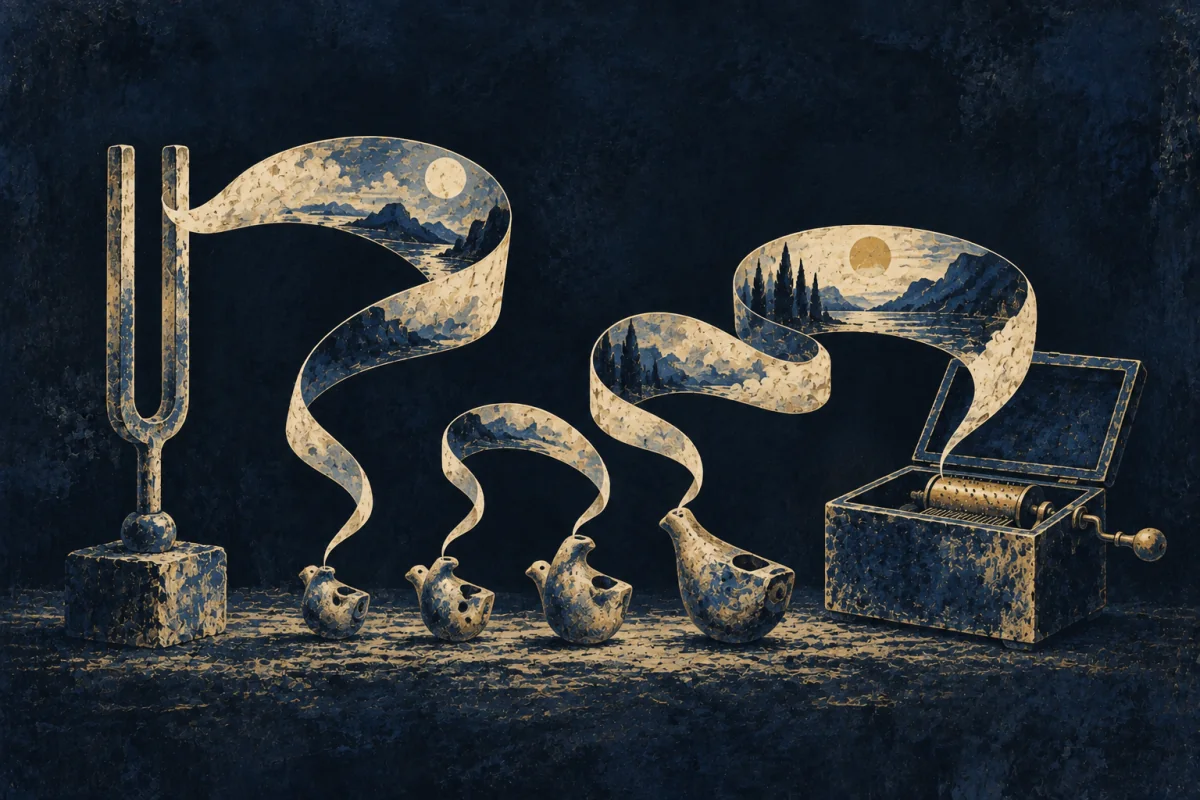
Named in March, arrives in October.
The thing said in a lesson does not change anything that week. It goes down, disappears, and comes back months later in a different piece, as though the student had thought of it.
Anybody teaching anything slow can be tested on this: whether they can say the thing once and then leave it entirely alone for two terms.
Where It Stops
Being a fine player is not this. Many excellent musicians teach badly, because what they do they do without supervision and cannot describe, so they demand the result rather than naming the process.
It goes wrong as never letting the student sound like themselves. The transmission is meant to end in somebody who plays differently from the teacher, and a lineage held too tightly produces accurate copies who stop developing at twenty-five.
It also fails with students who need a technical fix now. An audition in three weeks requires instructions, not names, and a teacher committed to the slow route can cost somebody an opportunity.
Take the plainer explanation first. Any instrumental teacher listens and corrects because that is the job. The test is the waiting — whether somebody can name a thing once and not mention it again for two terms.
Where It Pays
Inside a job. Instrumental and vocal teaching, conservatoire and academy work, youth music and peripatetic teaching in schools, choral training, and any coaching where the outcome is how a person does something rather than what they know about it. Also the teaching end of dance, craft and clinical skills, where the same delay applies.
What is being supplied is that the tradition continues in bodies rather than in archives. Recordings preserve results and teach nobody how to arrive at them. The how is held in a few thousand people at any given moment and is passed on at a rate of one lesson a week, which is slower than almost any other kind of knowledge transfer and has no substitute.
Where it pays badly is anywhere teaching is measured in grades passed within a year, anywhere group sizes remove the one-to-one, and in any system that requires the effect of a lesson to be demonstrated at the end of it. Outside one. Teaching a child, a friend, a choir, anybody who asks. The cost worth naming is not knowing. Most of this surfaces long after the student has gone, in rooms the teacher will never be in, and they are almost never told.
Try This
Find somebody who is nearly doing something well — playing, speaking, throwing, writing — and do not correct them.
Instead, describe what they are already doing, in one sentence, as neutrally as you can. Not what they should do. What is happening.
Then say nothing about it again. Not that week, not that month.
If it surfaces later, changed, you will know something about how this works that no amount of instruction will teach you. If it does not, you have lost nothing.
Named in March, arrives in October is a tool, not a self. Pick it up where somebody is building a way of doing something. Put it down where a deadline means they need a fix rather than a perception.
If This Isn't You
Most people learn from instructions, practise, and get good, which is efficient and how most skill spreads. Feeling no urge to name something and then wait two terms is an answer, not an impatience.
Where To Go Next
Its near-twin — Practice Teacher. Both correct sparingly and then leave a learner alone. Practice Teacher is building a physical habit and withholds words on principle. This one's whole method is the one sentence, and the silence afterwards is what protects it.
Its shadow — Sound-Mind. Sound-Mind holds the standard privately and acts on it in the moment of playing. This one is trying to get that standard into somebody else, which is a different and much slower problem.
Most often confused with — Performance Mentor. Both carry a lineage. Performance Mentor demonstrates at full quality and the body catches it. This one may not demonstrate at all, and works by naming something the student is already half doing.