In Plain Sight
This person builds things that must hold up when conditions change. They do not trust a plan just because it looks good. They test how it carries weight, takes strain, and stays useful in rough water. You'd notice this in the neighbor who fixes the wobbly gate, then leans on it twice before calling it done.
The Pattern at Work
A man finishes a handrail on his mother's back steps and does not call it done. He puts his own weight on it sideways, which is not how a handrail is meant to be loaded and is exactly how it will be loaded on the day it matters. Then he hangs off the end post, where the leverage is worst. The rail holds; the post moves about three millimetres, which nobody else would see. He takes it apart and puts a second fixing into the joist behind, because the first went into cladding, and cladding is not structure.
A sailing club fits new cleats to a pontoon. Most of the volunteers bolt them to the decking, which is what the instructions describe. One of them spends an afternoon underneath with a bag of steel plates, backing every cleat so the load spreads across the timber rather than into four bolt holes. He is asked why, since the boats are small. His answer is that the boats are not the load. The load is a small boat plus a south-westerly plus the wash of something much bigger going past too fast in November.
A village hall gets a storage rack for stacking chairs. The person who ends up specifying it asks two questions nobody else thought of: what happens when it is half empty and loaded on one side only, and what happens when somebody climbs the bottom shelf to reach the top one, which they will, because there is no ladder and there never will be. The rack that gets ordered is bolted to the wall and has a rail that stops a foot going where it should not.
What the Examples Show
The quick reading is caution, and the word that gets used in meetings is over-engineering, generally by somebody comparing two prices.
What is actually running is a habit of asking where the force goes. Not whether a thing is strong, which is a vague question, but what path a load takes through it and which part of that path is weakest. The three millimetres at the post is not a tolerance problem. It is a signal that the load is arriving somewhere it was not designed to arrive.
The second half is choosing the worst realistic case rather than the normal one. All three scenes turn on that: the grab that comes late, the November wash, the person with no ladder. Ordinary use is not what breaks things. Things break when everything ordinary happens at once, and designing for the average day is the same as not designing.
Going Deeper
The trade learned this by watching things fall down, and the record of what it learned is written in the losses. The cathedral vault at Beauvais went higher than anything before it and came down in 1284, and nobody has exceeded that height in stone since. The Tay Bridge stood nineteen months before a December gale took it and a train with it, and the inquiry found the wind loading had not been in the sums. Tacoma Narrows twisted itself apart in 1940 in a wind well below what it was built for, because the force that mattered was not the one anybody had been calculating.
Against that sits a quieter tradition of deliberate margin. Samuel Plimsoll spent years getting a line painted on the side of a ship, against the interests of everybody who owned one, because a hull with no visible limit gets loaded until it sinks and the crew gets blamed. Chain and lifting gear has been proof-loaded for centuries, pulled past anything it will be asked to carry, on the understanding that the only trustworthy test is one that could break it. Japanese carpenters framing for earthquakes built joints that move and give rather than resist, the same insight from the opposite direction.
All of it costs the people who do it in one currency. Margin is invisible when it works and looks like money wasted right up until the morning it is not, so the person insisting on it argues from something that has not happened against something that can be priced today. They are frequently overruled. And when they are not overruled, nothing occurs, which is the point and is no evidence at all that they were right.
The Image
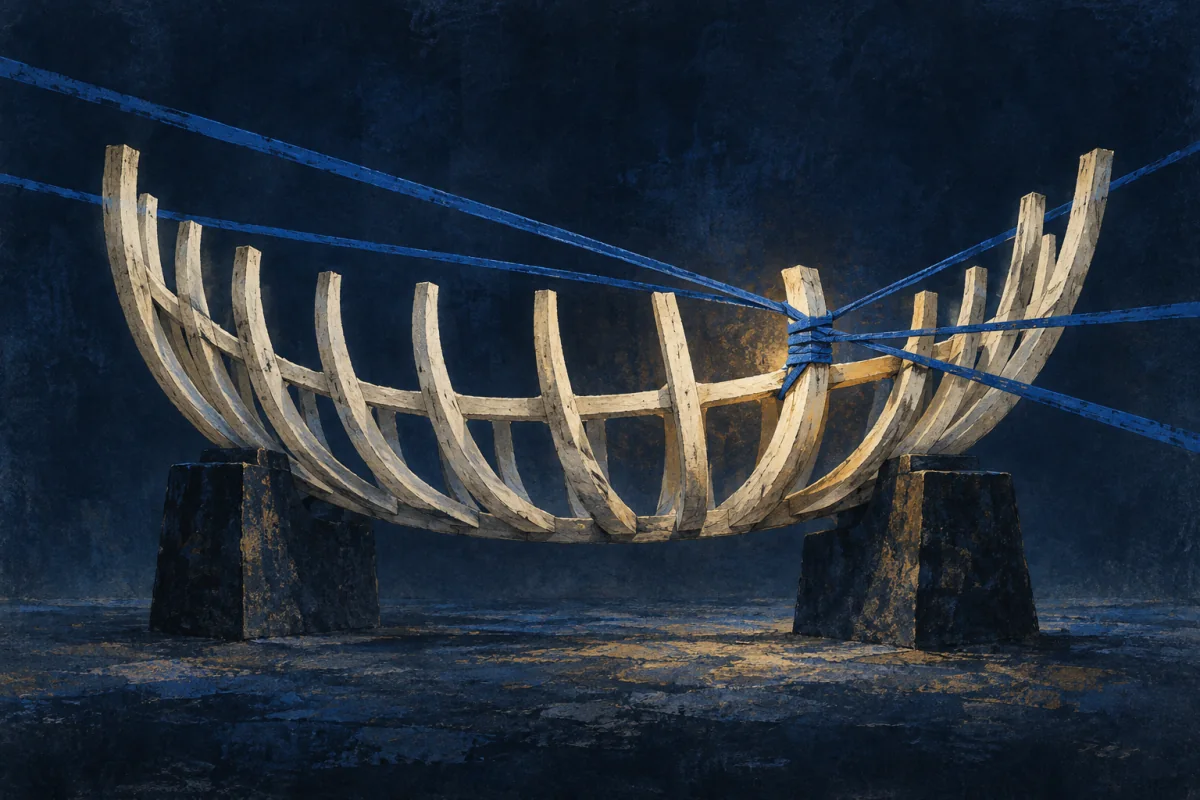
The proof load.
A chain rated for a ton is pulled well past a ton before anybody trusts it. The test is not there to reassure you. A chain that has never been overloaded has never told you anything, and the only honest way to learn its limit is to go looking for it deliberately, in a yard, rather than over somebody's head.
Ask it of anything you rely on: when was this last pulled harder than it will be in use?
Where It Stops
Being careful is not this. Neither is knowing the regulations, which encode somebody else's answer to this question and stop being useful the moment the situation is not the one they were written for.
It goes wrong as margin everywhere. A part made twice as strong is heavier, dearer and later, and a person who cannot say where the load goes will simply thicken everything, which is not engineering but anxiety with a chequebook.
It goes wrong the other way as a taste for the worst case for its own sake. Some risks are genuinely remote and should be accepted out loud.
It also fails where nothing is physical. Plans, teams and agreements do fail under load, but not in a way that a second fixing into the joist will help.
Take the plainer explanation first. Any qualified engineer does all of this because the discipline is exactly this. The test is whether it shows up on a garden gate, unpaid, with nobody checking.
Where It Pays
Inside a job. Structural and mechanical engineering, obviously, but the pattern earns most where there is no engineer: maintenance, plant and facilities, marine and rigging work, event and stage build, agricultural machinery, scaffolding, and anywhere a thing made for one purpose is quietly used for another. The contribution is not that failures get prevented, since prevented failures are unprovable. It is that an organisation gains somebody who can say which part will go first, which turns an argument about whether something is safe into a question with a location.
It pays badly wherever the deliverable is a quote, and badly again in work where everything is replaced before it can wear out.
Outside one. Houses, ladders, roof racks, towbars, trees over driveways, the loft conversion somebody did themselves, and every decision about whether a thing will take a child's weight. The cost worth naming is that this person cannot unsee it, so a normal afternoon in somebody else's garden includes a quiet inventory of what is holding what up. There is a second one that lands harder: saying the rack is not safe makes them, in that moment, the obstacle, and the gratitude only arrives in the version where they were ignored.
Try This
Pick one thing in your house you rely on without thinking — a shelf, a rail, a hook somebody else put in.
Do not test it to destruction. Work out instead where the load goes, and what each part is fixed to. Follow the chain until you reach something you are sure of, or until you run out.
Write down the weakest link and what would have to happen for it to matter. Doing this four or five times teaches more than any reading, because the answer is almost never the part you were worried about.
The proof load is a tool, not a self. Pick it up where a failure would hurt somebody. Put it down where the worst case is a dropped plate.
If This Isn't You
Most people use the rail, trust the shelf, and get on with the day, which is the only sane way to live among objects other people made. Feeling no urge to hang off the end post is an answer, not a gap.
Where To Go Next
Its near-twin — Object-Restorer. Both work for somebody who is not in the room yet. The Restorer leaves a repair the next person can undo. This one leaves a margin nobody will ever know was there.
Its shadow — From-Nothing Starter. The From-Nothing Starter's method is moving before the thing is proven and taking the part nobody else will touch. This one refuses to move until the load path is known, and the two of them in one room argue for the life of the project.
Most often confused with — Row-by-Row Builder. Both work slowly and hold the whole thing in mind while making one part. The Row-by-Row Builder follows a pattern toward a finish. This one interrogates a pattern to find where it will let go.